The 20th Anniversary of the EANET

9 December 2021 – Bangkok, Thailand

The EANET 20th Anniversary celebration was organized online, alongside the Science & Policy Dialogue, on Friday 26th of November 2021, gathering over one hundred participants from 30 countries, to discuss better air quality for all.

.

The EANET’s 20th Anniversary Opening Ceremony

Established in 2001 as an intergovernmental network to create a common understanding on the status of acid deposition in East Asia, the Acid Deposition Monitoring Network in East Asia (EANET) celebrated in 2021 its twenty years of successful inter-regional cooperation and activities.

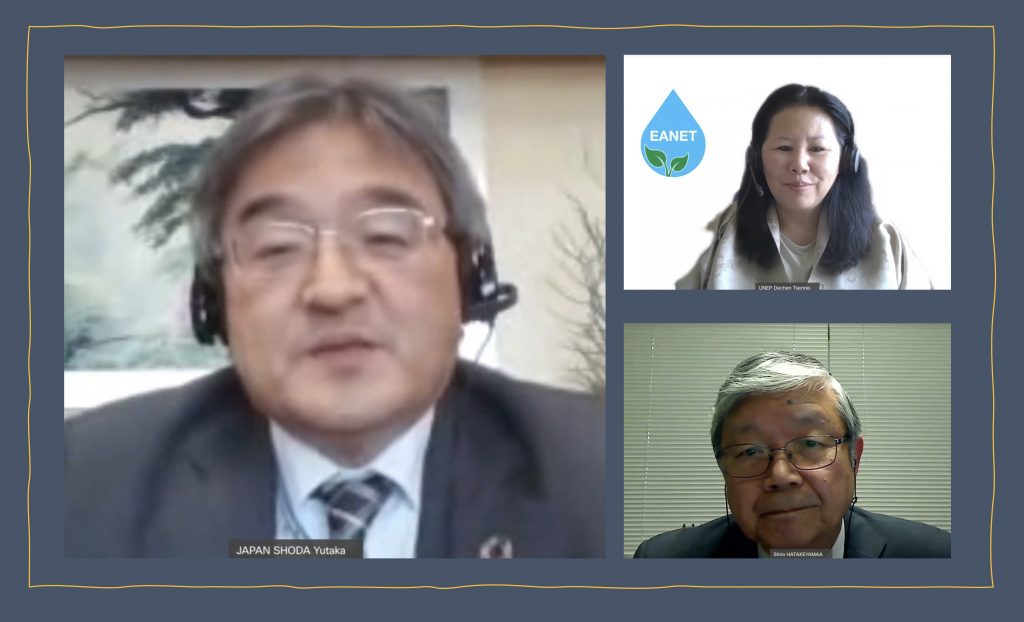
The EANET’s 20th Anniversary celebration was hosted by the Ministry of the Environment, Japan, and H.E. Mr. Yutaka Shoda, the Vice-Minister from the Ministry of the Environment, Japan, opened the celebrations by delivering the Opening Remarks.

.

.

Dr. Dechen Tsering, Regional Director and Representative, UN Environment Programme for Asia and the Pacific shared the event’s Welcome Remarks, followed by Congratulatory Remarks from the EANET National Focal Points from Malaysia, Thailand, and China. These were shared by Mr. Jamalulail bin Abu Bakar, Undersecretary, Environmental Management Division, Ministry of Environment and Water, Malaysia; Ms. Siwaporn Rungsiyanon, Director of the Transboundary Air Pollution Subdivision, Air Quality and Noise Management Division, Pollution Control Department, Ministry of Natural Resources and Environment, Thailand and by Mr. Zhou Jun, Director, Division of Asian, African and Latin American Affairs, Department of International Cooperation, Ministry of Ecology and Environment, China.

.

The Launch of the Summary of the Twentieth Anniversary of the EANET

To close the celebrations, Mr. Mohan Kumar Sammathuria, Principal Assistant Director of the Atmospheric Sciences, and Cloud Seeding Division, Malaysian Meteorological Department, Ministry of Environment and Water, Malaysia, and the Chairperson of the EANET Scientific Advisory Committee for 2021-2023, presented the newly launched publication “Summary of the Twentieth Anniversary of the EANET“.

The Summary of the Twentieth Anniversary of the EANET has been prepared based on the data accumulated in the past twenty years of activity of the EANET. It aims at providing a common understanding of the status of acid deposition in East Asia in an easily understandable manner. In addition, it may serve as a guidance document for policymakers, students, civil society, and various organizations that may become EANET partners soon.

.

Useful Resources

.

.


.

Photo credits: All rights reserved to EANET.

The EANET Emission Inventory Workshop in 2021

19 October 2021 – Bangkok, Thailand

The Asia Center for Air Pollution Research (ACAP), the Network Center (NC) for the EANET, organized the EANET Emission Inventory Workshop on 18 October 2021, gathering over 50 participants from 9 countries, to develop regional air quality management skills.

.

Why are emission inventories important?

To tackle atmospheric environment problems, it is essential to understand the status of air pollutants’ emissions and consider mitigation measures’ effectiveness. The emission inventory is an essential tool to obtain such information and to build appropriate atmospheric environmental policies.

.

Figure 1 – extract from the Emission Inventory Workshop presentation introduction slides

.

Building Capacity at a Regional Level

The objectives of the EANET Emission Inventory Workshop were to understand the role of an emission inventory in air quality management, obtain general information on an emission inventory, and learn basic knowledge on the development and application of an emission inventory.

For this purpose, invited experts provided five lecture presentations on developing and applying an emission inventory. Furthermore, the participants, selected by the National Focal Points (NFPs) of each EANET Participating Country, delivered short presentations about issues related to national emission inventories in their countries.

.

Figure 2 – Presentation of the lectures that took place during the Emission Inventory Workshop, (including experts from the Japan Automobile Research Institute (JARI), the National Institute for Environmental Studies, Japan (NIES), and the King Mongkut’s University of Technology Thonburi (KMUTT)).

.

Through discussions among lecturers and participants, the event aimed to enhance participants’ knowledge and encourage the development of national emission inventories.

.

Ways Forward

In conclusion, participants emphasized the usefulness of such capacity-building activities and noted that it could be interesting, in the future, to focus the workshop’s content on regional specificities.

Participants also highlighted that both technical (such as providing guidelines) and financial aspects are necessary for conducting emission inventory activities. Taking these observations into account, it may be interesting to focus EANET’s future activities on this demand.

Furthermore, the participants pointed out the benefits of sharing emission inventories throughout the EANET region to better understand the atmospheric environment issues and compare methodologies, including emission factors.

.

Find out more about technical capacity building by contacting the Network Center.

.

Download the Workshop’s outline and key presentations.

.

Photo credits: All rights reserved to the EANET.

EANET Individual Training in 2021

19 January 2022 – Niigata, Japan

The EANET Individual Training in 2021 was successfully organized online by the Network Center, from 4th to 19th November 2021, and included the participation of China, through the presentation of two virtual lectures. It aimed at providing participants from the EANET Participating Countries with technical support and capacity building on acid deposition monitoring. 

 .

Virtual Individual Training in 2021

Individual Training is a regular activity conducted yearly by the Network Center for the EANET (NC) which aims at improving the various monitoring skills of Participating Countries’ representatives. Individual Training sessions are usually conducted at the Network Center in Niigata, Japan, and tentatively planned for five or six trainees from the Participating Countries.

This year, due to COVID-19 related travel restrictions, the EANET Individual Training in 2021 was held via an online platform. It gathered 14 trainees from 7 EANET Participating Countries (namely from Indonesia, Lao PDR, Malaysia, Myanmar, the Philippines, Thailand, and Viet Nam). Furthermore, in total, approximately 50 observers from the EANET Participating Countries took part in the program.

 .

Improving Regional Monitoring Capabilities

During the Training, Scientists from the Network Center’s Planning and Training, Atmospheric Research, Ecological Impact Research, and Data Management Departments, delivered daily lectures. The main topics covered, among others, included the ecological effects of atmospheric deposition and EANET monitoring methods, automatic monitor maintenance, Quality Assurance, and Quality Control (QA/QC) activities, and data reporting procedures.

On the 17th of November, lectures were presented by Ms. Wang Xiaofei, from the China National Environmental Monitoring Centre, and by Mr. Li Jie, from the Institute of Atmospheric Physics, Chinese Academy of Sciences, on China’s Atmospheric Air Monitoring, and on the Development of an Atmospheric Environment Forecasting System and MICS-ASIA III Program, respectively.

Through this training, participants have deepened their knowledge of laboratory work, data evaluation, and reporting.

.

Interested in finding out more? Contact the Network Center for the EANET.

.

Photo Credit: All rights reserved to the EANET. 

The Twenty-third Session of the Intergovernmental Meeting on the Acid Deposition Monitoring Network in East Asia

30 November 2021 – Bangkok, Thailand

The Twenty-third Session of the Intergovernmental Meeting on the Acid Deposition Monitoring Network in East Asia (IG23) took place from 24 to 25 November 2021, virtually, and gathered over 70 representatives of the EANET Participating Countries, Secretariat, and Network Center for the EANET, to make important decisions on the expansion of the scope of the EANET, among other topics.

.

The IG23 Meeting

Chaired by Japan and co-chaired by Malaysia and Viet Nam, the IG23 started with the Opening Remarks from H.E. Mr. Yutaka Shoda, Vice-Minister, Ministry of the Environment, Japan, followed by Opening Remarks by Dr. Dechen Tsering, Regional Director, United Nations Environment Programme for Asia & the Pacific, and by Dr. Shiro Hatakeyama, Director General, Asia Center for Air Pollution Research.

.

Welcome and Opening Remarks delivered during the IG23 meeting.

.

Historical Decisions on the Expansion of the Scope of the EANET

Following the decision of the Twenty-second  Session of the Intergovernmental Meeting (IG22), held in November 2020, the EANET Participating Countries’ representatives have been working relentlessly on the process to expand the scope of the EANET, from acid deposition to also include a wider scope of atmospheric environment-related substances.

This historical progress required the EANET to develop a text supplementary document to the EANET Instrument, to define the scope of expansion and the target substances to be included in the EANET activities. In a landmark decision, 20 years after the creation of the Network, the IG23 has adopted the text of the Supplementary Document (Annex) to the Instrument for Strengthening the Acid Deposition Monitoring Network in East Asia.

.

Discussions among participants during the virtual IG23 meeting.

.

The EANET Project Fund and Project Guideline, a new financial mechanism allowing EANET to build co-financed projects with partners in the region and beyond, has also been approved by the IG23.

.

Ways Forward

In addition to these major decisions, the IG23 has also approved several important documents, including the Work Program and Budget of the EANET in 2022, and the Summary of the Twentieth Anniversary of the EANET publication, a new outreach document detailing the EANET’s past achievements and future opportunities.

As an important way forward for 2022, the EANET Participating Countries and partner organizations will be invited to start preparing and submitting project proposals for the pilot implementation of new EANET projects, in line with the EANET Project Guideline.

.

Read the IG23’s Report of the Session (including the Decisions of IG23 in Annex 2), and discover the virtual meeting’s pictures on Flickr.

.

Photos credits: all rights reserved to EANET.

The Working Group Meeting of EANET in 2022

29 August 2022 – Bangkok, Thailand

The Working Group Meeting (WG2022) of EANET in 2022 was organized virtually from 24 to 25 August 2022. It was attended by over 70 National Focal Points and representatives from the 13 EANET Participating Countries, and from the Secretariat and Network Center for the EANET, to discuss proposed projects submitted to the EANET Project Fund and other matters related to the expansion of the scope of the EANET.

.

Opening Session

Chaired by Japan and co-chaired by Malaysia and Viet Nam, the WG2022 started with Opening Remarks from Dr. Dechen Tsering, Regional Director, United Nations Environment Programme for Asia & the Pacific, and by Welcome Remarks from Dr. Shiro Hatakeyama, Director General, Asia Center for Air Pollution Research.

.

From left to right Mr. Bert Fabian, Dr. Dechen Tsering, and Dr. Hiro Hatakeyama, during the Opening Session of the WG2022 meeting

.

EANET Project Fund

In November 2021, the Twenty-third Session of the Intergovernmental Meeting on the Acid Deposition Monitoring Network in East Asia (IG23) approved a new financial mechanism, the EANET Project Fund. The Working Group meeting of the EANET was organized for the EANET National Focal Points and representatives from the 13 Participating Countries to discuss the EANET Project Plans, which are project proposals, to be submitted for funding from the EANET Project Fund.

.

Discussions among participants during the WG2022 meeting

.

During the WG2022, eight EANET Project Plans were presented and discussed by the Session. These project plans focus mainly on the effects of atmospheric deposition on ecosystems, capacity building (related to Volatile Organic Compounds – VOCs, monitoring activities, emission inventories, and PM2.5), and research fellowship programs.

.

Ways Forward

After the WG2022, the EANET Project Plans will be reviewed and discussed in October 2022 by the EANET Twenty-second Scientific Advisory Committee (SAC22) meeting, and finally submitted for approval to the 24th Intergovernmental meeting of the EANET (IG24) in November 2022.

Other important topics in line with the expansion of the Scope of the EANET adopted by IG23, were also discussed during the WG2022 and will be considered further by the IG23 in November 2022.

.

Read the Report of the WG2022 and discover the virtual meeting’s pictures on Flickr.

.

Photos credits: all rights reserved to EANET.

Second Lead Authors’ Meeting and Second Drafting Committee Meeting for the Fourth Periodic Report on the State of Acid Deposition in East Asia

9 March 2021 – Niigata, Japan

The Second Lead Authors’ Meeting (LA2) and the Second Drafting Committee Meeting (DC2) for the Fourth Periodic Report on the State of Acid Deposition in East Asia (PRSAD4) were held on 9 March 2021, virtually.

PRSADs are published every five years as comprehensive scientific assessment reports describing the outcome of EANET’s monitoring activities.

 .

Second Lead Authors’ Meeting and Second Drafting Committee Meeting

The meeting was organized online by the Network Center (NC) for the Acid Deposition Monitoring Network in East Asia (EANET), Niigata, Japan.

Drafting Committee (DC) members from 13 participating countries of the EANET, namely, Cambodia, China, Indonesia, Japan, Lao PDR, Malaysia, Mongolia, Myanmar, Philippines, Republic of Korea, Russia, Thailand, and Viet Nam, participated in the meeting. The NC, the EANET Secretariat, resource persons, and observers also joined the meeting to discuss the PRSAD4 preparation.

Dr. Shiro Hatakeyama, the Director General of the NC, delivered the opening remarks and Prof. Fan Meng, Chinese Research Academy of Environmental Sciences, delivered the opening address as the Chairperson of the Drafting Committee.

.

Structure and Content of the Regional Assessment of the Fourth Periodic Report on the State of Acid Deposition in East Asia (PRSAD4) Review

The lead authors of the respective chapters, among which Dr. Sergey Gromov (Russia), Prof. Kazuhide Matsuda (Japan) Dr. Park Jin-soo (Republic of Korea), Dr. Keiichi Sato (Japan), Prof. Atsushi Kume (Japan) and Dr. Toshimasa Ohara (Japan) presented and discussed with participants the planned detailed structure and contents of the PRSAD4. Main discussions concerned the usage of data, calculation methods, and the process to follow to submit questions to each lead author and contributor.

.

Additional Publications Discussions

The Drafting Committee’s Secretariat presented the Consideration on Further Process of Report Preparation, as well as the draft Summary of the Twentieth Anniversary of EANET, and the session discussed their content.

The Third Lead Author’s Meeting (LA3) and The third Drafting Committee Meeting (DC3) for PRSAD4 will take place virtually on August 4th and 5th 2021.

.

Access and read the previous publications of the Periodic Report on the State of Acid Deposition in East Asia since 2006.

.

Photo credits: Niigata by Tokyo Kohaku, free of the copyright license.

Joint Projects of the EANET with Participating Countries – Development of an Emission Inventory Manual for Mongolia

31 May 2021 – Niigata, Japan

Scientists from the EANET Participating Countries and the Network Center (located in Niigata, Japan) have been promoting joint research projects related to the EANET. In response to Mongolia’s request, an Emission Inventory Manual for Mongolia was developed and published in 2018 to provide key scientific data, including estimates of emissions of air pollutants, for policymakers to develop air pollution control measures.

.

Assessing Air Pollution in Mongolia

Mongolia is facing serious air pollution problems, especially in the capital, Ulaanbaatar city, where the population density is high. Most emissions of air pollutants result from the use of coal in power plants and domestic cooking. The level of air pollutants is normally high during the winter season when coal is also used for domestic heating. Emissions of air pollutants from road traffic are also quite significant. The major air pollutants detected in Ulaanbaatar city are sulfur dioxides (SO2), particle matters (TSP, PM10, PM2.5), and nitrogen dioxide (NO2).

To assist Mongolia in tackling air pollution issues, several international donors and agencies (World Bank, Asian Development Bank, Japan International Cooperation Agency) are developing and implementing projects for air pollution mitigation in Ulaanbaatar city. Since 2016, Clean Air Asia has been working closely with the Ministry of Environment and Tourism of Mongolia (MET) and the National Agency for Meteorology and Environmental Monitoring (NAMEM) on addressing air pollution at a national level.

 .

Developing Mongolia’s National Emission Inventory

In response to Mongolia’s request, the Asia Center for Air Pollution Research (ACAP), in collaboration with SUURI-KEIKAKU Co., Ltd, has developed an Emission Inventory Manual for Mongolia, as a part of the Integrated Programme for Better Air Quality in Asia (IBAQ Programme) of Clean Air Asia (CAA).

Available in Mongolian, English, and Japanese, the Emission Inventory Manual will be used for developing Mongolia’s national emission inventory of air pollutants and further support the formulation of effective air pollution control measures.

 .

Read the summary of the Emission Inventory Manual in the EANET Science Bulletin, Vol 5.

.

The authors appreciated the cooperation and assistance received from the Ministry of Environment and Tourism of Mongolia (MET), the National Agency for Meteorology and Environmental Monitoring (NAMEM), Clean Air Asia (CAA), and the Japan International Cooperation Agency (JICA).

.

Photo credits: Nogoonnuur, Mongolia, by Lightscape, free of the copyright license.

Joint Projects of the EANET with Participating Countries – Catchment Analysis in Thailand

10 June 2021 – Niigata, Japan

Scientists from the EANET Participating Countries and the Network Center (located in Niigata, Japan) have been promoting joint research projects related to the EANET. Consequently, the Network Center, in cooperation with the Thai Royal Forest Department, and the Environmental Research and Training Centre (ERTC), Thailand, conducted a joint research project on catchment analysis in Thailand to understand atmospheric deposition and its effects from 2005 to 2015.

.

Understanding Atmospheric Acid Deposition

Air pollution consists of significant amounts of aerosols (particulate matter) and trace gases (NOx, SOx, CO, and others). These air pollutants deposit on the earth’s surface through dry depositions and wet depositions (when dissolved in water droplets in clouds).

Wet and dry depositions of air pollutants cause detrimental impacts on the ecosystems and environment, including the acidification of the water bodies, such as rivers and lakes.

 .

Analyzing Acid Deposition and its Effects in Northeastern Thailand for Nearly 10 Years

The joint research project aimed to study the atmospheric wet deposition of acidic components and other relevant pollutants including elemental carbon, as well as their influence on water chemistry, chemical properties of soil, nutrient fluxes in soil-plant system, and sulfur dynamics in forest ecosystems.

For the catchment analysis, scientists from the Network Center established a study plot in a dry evergreen forest in Sakaerat Silvicultural Research Station, Nakhon Ratchasima Province, northeastern Thailand. The surveys on-site allowed researchers to accumulate nine full years of data, from October 2005 to December 2014.

Based on these results, several scientific papers were published in international journals focusing mainly on atmospheric deposition, soil and stream water chemistry. Ultimately, these scientific outputs significantly contributed to enhancing the global understanding of atmospheric deposition and its effects on forest ecosystems in the region.

.

Read the Report of the joint research project on catchment analysis in Thailand in the EANET Science Bulletin, Vol 5.

.

The authors acknowledged Jesada Luangjame, Thiti Visaratana, and Bopit Kietvuttinon, Royal Forest Department for their great contribution to the Sakaerat project including other colleagues who were involved in the project.  The study was supported financially by the Grant-in-Aid for Scientific Research on Innovative Areas (JP20120012) from the Ministry of Education, Culture, Sports, Science, and Technology (MEXT), Japan, the Environment Research and Technology Development Fund (C-052, C-082 and B-0801) from the Ministry of the Environment of Japan, and Asia-Pacific Network for Global Change Research (APN).

.

Photo credits: Sakaerat forest by Sase H., all rights reserved.

Scientific Outputs by the Task Force on Soil and Vegetation Monitoring of EANET

Scientific outputs by Task Force on Soil and Vegetation Monitoring of EANET_image

9 July 2020 – Niigata, Japan

The Task Force on Soil and Vegetation Monitoring of EANET has published a review on air pollution and tree and forest decline in East Asia.


The Task Force on Soil and Vegetation Monitoring of EANET

Task Forces established under the Scientific Advisory Committee (SAC) of the EANET are leading scientific assessment and research activities on acid deposition, air pollution, and their effects. The Task Force on Soil and Vegetation Monitoring of EANET has been conducting scientific assessment and research activities based on the “Strategy Paper for Future Direction of EANET on Monitoring of Effects on Agricultural Crops, Forest and Inland Water by Acidifying Species and Related Chemical Substances”.

As one of the activities in line with the strategy paper, the regional condition of forest decline and its relationship with air pollution have been compiled as the scientific review led mainly by Task Force members from Japan, China, Russia, and Malaysia based on scientific literature published in the respective countries.


Tree and Forest Decline in East Asia

Tree and forest declines related to air pollution have been observed with industrialization in the countries of Northeast Asia and their causes have been shifting depending on the time period. Firstly, a direct effect of SO2 was the main cause, however, causes have been shifting to acidification and nitrogen deposition, and then ozone, particulate matter (PM), and the interlinkage with climate change. Haze phenomena due to forest fires have been increasing in tropical and boreal forests and emitted PM inhibits photosynthesis.

In recent years, chronically high ozone concentrations may have had adverse effects on tree physiology in conjunction with climate change. Under the changing climate, no apparent effect of air pollution on tree decline was reported recently. However, monitoring air pollution is important to identify the cause of tree decline. Further economic growth in Southeast Asia is projected. The expansion of the monitoring network in tropical and boreal forests has been proposed in the review. Also, it was pointed out that countermeasures, such as restoration of urban trees and rural forests, would be important to ensure future ecosystem services.


The review work was started as one of the activities of the Task Force on Soil and Vegetation Monitoring of the EANET. The study was also supported by JSPS KAKENHI Grant Number JP19H00955. The studies in Russia were funded by the Russian Fund Fundamental Researches, the projects numbers are 03- 04-49565, 05-04-97219, 05-05-97259, 12-04-31036, by the Russian Fund Fundamental Researches and Irkutsk Region Government, the project 14-44-04067, by the Siberian Branch of the Russian Academy of Sciences, the Integration Project 17 with using equipment of “Baikal analytical center”, Irkutsk.


Read the full scientific review: Takahashi et al. 2020. Air pollution monitoring and tree and forest decline in East Asia: A review Science of the Total Environment 742, 140288

Curious about EANET’s research activities? Find out more on the Research activities’ or Publications’ pages.

.

Photo credits: Featured image by Alberto Bigoni free of copyright license.

.