Highlights from the EANET National Stakeholder Awareness Workshop in Cambodia

Bangkok, 17 April 2024

The EANET National Stakeholder Awareness Workshop in Cambodia – Understanding Air Pollution and its Sources, Weather, Climate, and Topography in Cambodia, was held in Phnom Phen, Cambodia, on 19 March 2024, in partnership with the Ministry of Environment, Cambodia, and the United Nations Environment Programme (UNEP), back-to-back with UNEP’s Cambodia Clean Air and Sustainable Transport Workshop, held on 18-19 March. About 30 participants joined the Workshop. The workshop aimed to promote the EANET’s achievements, gain insight into Cambodia’s specific needs related to air quality management, and foster the development of additional initiatives to assist in addressing acid deposition and air pollution.

.

Opening Session

The meeting started with Opening Remarks from Dr. Chou Monidarin, Deputy Director General of the General Directorate of Environmental Protection, Ministry of Environment Cambodia, and the National Focal Point of Cambodia for the EANET, followed by an introduction to the EANET and to the objectives of the meeting by Mr. Bert Fabian, Coordinator, Secretariat for the EANET. Prof. Meng Fan, Deputy Director General of the Network Center for the EANET, the Asia Center for Air Pollution Research (ACAP) then presented the activities of the EANET on air quality and acid deposition management, air pollution trends in the region, and the main activities of the EANET including monitoring, capacity building and technical support to Participating Countries.

.

EANET National Stakeholder Awareness Workshop in Cambodia
Group photo of participants on the first day of the workshop (photo by Clean Air Asia)

.

Assessing Cambodia’s Air Quality Landscape, Dynamics and Initiatives

Mr. Chandath Him outlined Cambodia’s air quality, citing primary pollution sources as older vehicles and industrial plants. With over 6.6 million registered motorcycles and cars since 1990, along with 1,859 operational industrial plants, pollution also stems from construction activities and agricultural practices. He highlighted the significance of airborne dust due to unpaved streets and construction, and discussed ongoing initiatives on monitoring like satellite projects and Low-Cost Sensors (LCS). Cambodia is updating its air pollution laws, including new vehicle emission standards, fines, and industry controls, with Euro 5/V standards enforced from January 2027. He introduced Cambodia’s Clean Air Plan, analyzing pollutants and proposing mitigation measures to reduce air pollution and combat climate change, aiming for integrated planning and coordinated management efforts.

Dr. Chanmoly OR, Director of the Research and Innovation Center at the Institute of Technology of Cambodia presented an analysis of the complex interplay between topography, weather, and air pollution in Cambodia. Favorable wind circulation aids in pollutant dispersion, while factors including humidity, temperature, and precipitation also influence air quality. The presentation underscored the need for comprehensive research to understand pollution sources better coming mainly from the the transport and construction sectors in urban areas, and from open-burning and agriculture, in rural areas, including emerging concerns such as microplastics particle pollution.

Dr. Anantaa Pandey outlined the Global Green Growth Institute‘s (GGGI) efforts to enhance air quality in Cambodia, focusing on emissions inventories, public transportation improvement, and capacity building. The program aims to address challenges such as equipment maintenance, expand monitoring infrastructure, and develop emission control strategies tailored to Cambodia’s context.

 .

Strategies for Effective Air Pollution Management

The discussion segment saw active participation from experts and policymakers, emphasizing the urgency of addressing air pollution through multifaceted strategies. Participants highlighted the importance of upgrading vehicle emission standards, promoting cleaner fuels, and regulating industrial emissions. Challenges such as economic constraints and the high cost of fuel upgrades were acknowledged, with suggestions for phased transitions and international support.

The EANET meeting concluded with a consensus on the need for concerted efforts to combat air pollution in Cambodia. Key takeaways included the importance of robust monitoring infrastructure, innovative solutions tailored to local contexts, and international collaboration. The meeting underscored the critical role of initiatives like EANET in guiding Cambodia towards a cleaner and healthier future.

.

Useful Resources

-Read the Panelists’ Presentations:

.

Photo credits: cover photo of Phnom Penh (2022) by allPhoto Bangkok, group photo by Clean Air Asia.


Kick-off Meeting – Stocktaking and Methodological Assessment of Emissions Inventories and Source Apportionment of Air Pollution in Southeast Asia

Emissions inventories kick-off meeting

1. Background

EANET is working to reduce acid deposition and air pollution in Northeast and Southeast Asia. It is an intergovernmental initiative established in 2001 including 13 Participating Countries initially focused on acid deposition. In 2021, EANET expanded its scope to cover broader air pollution issues and established a Project Fund mechanism to promote cooperation with other organizations outside of EANET.

EANET’s activities are guided by its five-year Medium-Term Plans and a detailed Work Programme and Budget including projects, approved by the Participating Countries every year. A project called “Stocktaking and Methodological Assessment of Emissions Inventories and Source Apportionment of Air Pollution in Southeast Asia” has been approved for implementation in 2024, at the Twenty-fifth Session of the Intergovernmental Meeting (IG25) on the EANET, as a Project Activity, funded by the EANET Project Fund and implemented in partnership with the Asian Institute of Technology, Regional Resource for Asia Pacific (RRC.AP/AIT).

.

2. Objectives

Emissions inventories and source apportionment of air pollution are fundamental elements of an air quality management framework. They enable policymakers, government regulators, and experts to better understand the sources of air pollution and their contribution to ambient air quality and identify appropriate policies. Many emissions inventory and source apportionment studies have been conducted in the EANET region.

This project aims to collate and analyze relevant key studies based on research and consultations with EANET National Focal Points and make these studies available as a database on the EANET website. The project will also identify follow-up opportunities and projects to work emissions inventories and/or source apportionment in the region.

An inception meeting of the project will be organized on Tuesday 26 March 2024 at the UN Conference Center (UNCC), meeting room B,  in Bangkok, Thailand. The objective of the meeting is to better understand the emissions inventory/ source apportionment situation in Southeast Asia and discuss with potential project partners the detailed activities to be carried out in the project. Participation in this meeting is by invitation only.

.

2. Draft Agenda (updated on 22 MAR)
.

.

Find out more about the EANET Project Activities on the EANET Project Fund page, and contact the Secretariat for the EANET for more information on the Emissions Inventories project.

The Twenty-fourth Senior Technical Managers’ Meeting on the EANET

5 September 2023 – Bangkok, Thailand

The Twenty-fourth Senior Technical Managers’ Meeting (STM24) on the Acid Deposition Monitoring Network in East Asia (EANET) took place in Niigata, Japan and online, on 29 and 30 August 2023. The Meeting gathered over 40 senior technical officials from the 13 EANET Participating Countries to discuss the status of the Network’s monitoring activities.

.

EANET Monitoring Activities in 2022

Dr. Shiro Hatakeyama, the Director General of the Asia Center for Air Pollution Research (ACAP), delivered the Opening Remarks, followed by Welcome Remarks by Mr. Bert Fabian, the Coordinator of the Secretariat for the EANET.

After presenting the progress of EANET activities in 2022 since STM23, the Network Center for the EANET (NC) shared the results of various reports on acid deposition and related substances monitoring activities. STM24 participants were invited to discuss and share knowledge and experience to collectively review these draft publications.

.

Some Participants of the STM24 in Niigata, Japan

.

Overview of the Preliminary Draft Data Report 2022 and Evaluation of the Results of the Inter-laboratory Comparison (ILC) Projects 2022

The NC presented the Preliminary Draft Data Report 2022. This report focuses on wet deposition, dry deposition (air concentration), soil and vegetation, inland aquatic environment, and catchment-scale monitoring. It includes a summary of the monitoring data in 2022 and related information submitted by the Participating Countries.

The NC also introduced the preliminary draft Report on the Inter-laboratory Comparison Projects in 2022 for wet deposition, dry deposition (filter pack method), soil, and inland aquatic environment.

.

Consideration of the National Monitoring Plans (NMPs), Current Monitoring Activities for the EANET, and Overall Air Concentration Monitoring Status of the Participating Countries

In line with previous STM meetings’ process, representatives of the Participating Countries presented their National Monitoring Plans (NMPs) and current EANET activities, including monitoring capacities, technical challenges, and future plans, while focusing on the general improvement of the activities of the EANET.

Dr. Meng Fan, Deputy Director General, ACAP, delivered the Closing Remarks. He expressed his great appreciation for the improvement of the data quality due to the efforts of the Participating Countries and hoped that the EANET monitoring, research, and capacity-building activities would continue to be strengthened through the expansion of the scope of the EANET.

.

The Report of the STM24 will soon be available on the Meeting Reports page. View the STM24 photos on Flickr.

.

Find out more, and access EANET data on the Monitoring System page.

.

Photo credits: cover photo of Japanese rice farm by S. Tsuchiya (2022), other images, all rights reserved to EANET.

The State of Acid Deposition in East Asia – from data to policy

29 June 2022 – Bangkok, Thailand

The EANET Awareness Workshop in 2022 “The State of Acid Deposition in East Asia – from data to policy” was organized virtually on Monday, 20 June 2022. It gathered participants from 17 different countries, scientists, and policymakers who discussed the biggest challenges and successes in acid deposition management in East Asia in the last 20 years.

.

Opening Session

Dr. Isabelle Louis, Deputy Regional Director of UNEP Asia Pacific office, opened the EANET Awareness Workshop in 2022 by delivering the opening remarks, followed by welcome remarks from Mr. Kenichiro Fukunaga, Deputy Director General in charge of Administrative Management at the Asia Center for Air Pollution Research (ACAP).

Key messages conveyed in the remarks celebrated the imminent release of the Fourth Periodic Report on the State of Acid Deposition in East Asia (PRSAD4) and the opportunities ahead for the EANET, in line with the expansion of its scope to air pollution, including the launch of the EANET Project Fund.

.

General Lecture – Key Findings from the Fourth Periodic Report on the State of Acid Deposition in East Asia (PRSAD4)

Since 2006, the EANET has been developing Periodic Reports on the State of Acid Deposition in East Asia (PRSADs), published every five years, and aiming at providing high-quality data to be used for research, formulation of policies, and measures to reduce the impacts of acid deposition and related air pollutants on the environment. In 2022, the Fourth Periodic Report on the State of Acid Deposition in East Asia (PRSAD4), will be released.

Prof. Meng Fan, Former Chairperson of the PRSAD4 Drafting Committee and Deputy Director General in charge of the Network Center for EANET, Asia Center for Air Pollution Research (ACAP), presented the General Lecture: Key Findings from the Fourth Periodic Report on the State of Acid Deposition in East Asia (PRSAD4). Findings and recommendations from the PRSAD4 highlighted the improvement of sulfur dioxide-related air pollution mostly in North-East Asia, while nitrogen deposition, particulate matter, nitrogen oxides, and ozone-related pollution were detected at a high level in the EANET region. The importance to continue deploying more monitoring sites was expressed.

.

Panel Discussion – From data to policy, good practices for evidence-based and data-driven policies in East Asia

The Panel Discussion gathered renowned scientists and key policymakers from the EANET Participating Countries. Discussions focused on the importance of regional cooperation and multilateralism to address global environmental problems including acid deposition and air pollution. Findings from the PRSAD4 were also discussed, in the specific context of Malaysia, Mongolia, Thailand, and the Philippines. Most panelists highlighted the incredible capacity-building efforts led by the EANET in the past twenty years, on emission inventories, acid deposition regulations, and monitoring support which have indirectly contributed to the development of regional policies. Finally, the panel also shared thoughts on the role EANET may play by helping fill the gap of the right to information on air pollution, as the right to a clean environment and clean air was recently included as a human right by the United Nations.

.

Useful Resources

Read a more detailed summary of the Workshop’s content in the EANET Awareness Workshop in 2022 Event Report.

.

View all Workshop’s recordings on the Secretariat for the EANET’s YouTube channel and the Workshop’s photos on Flickr.


.

Photo credits: All rights reserved to EANET.

The EANET launches its Project Fund and Project Guideline

21 April 2022 – Bangkok, Thailand

The Acid Deposition Monitoring Network in East Asia (EANET) launched the EANET Project Fund and Project Guideline, a new mechanism to encourage cooperation to fight the adverse effects of acid deposition and related pollutants on ecosystems and human health.

.

The EANET Project Fund

Almost one-third of the world’s population lives in the East Asian region. Due to rapid economic growth and industrialization, many countries in this region are facing a serious threat from acid deposition and related pollutants. Impacts of acid deposition affect aquatic environments, forests, soils; including human health when airborne particles are inhaled. Today almost the entire global population (99%) breathes air that exceeds the World Health Organization’s air quality limits.

The EANET Project Fund and Project Guideline, approved by the IG23 in 2021, is a new financial mechanism allowing EANET to build co-financed EANET Projects with partners in the region and beyond. Co-financing and contributing to the Project Fund will allow supporting effective action in East Asia and fund projects to help countries fight acid deposition’s effects.

.

The EANET Projects

Participating Countries and partner organizations, not members of EANET, now have the possibility to cooperate in a strong regional platform with extensive experience and knowledge, as part of the EANET Projects.

The EANET Projects are a set of projects defined by the Medium Term Plan (MTP) for the Acid Deposition Monitoring Network in East Asia (EANET) (2021-2025) to conduct specific non-core activities to achieve EANET objectives, using the EANET Project Fund, in accordance with the MTP and other EANET guiding documents.

EANET was established in 2001 as an intergovernmental initiative to create a common understanding of the state of acid deposition problems in East Asia, provide useful inputs for decision-making at various levels, and promote cooperation among countries. EANET Projects, in line with these objectives, will mainly focus on the monitoring of acid deposition and control of data, research, capacity building, and awareness-raising activities.

.

Find out more on the EANET Project Fund and Project Guideline, how to contribute to the EANET Fund, and submit a project proposal on the dedicated webpage or contact the Secretariat or the Network Center for additional information.

.

Photo credits: Ao Nang, Mueang Krabi District, Krabi, Thailand by Erik Karits (2022), free of copyright license.

The EANET Science & Policy Dialogue in 2021

9 December 2021 – Bangkok, Thailand

The EANET Science & Policy Dialogue online event took place on Friday 26th of November 2021, alongside the EANET’s 20th Anniversary celebration,  gathering over one hundred participants from 30 countries to discuss better air quality for all.

.

The Science & Policy Dialogue Opening and Keynote Sessions

The Science & Policy Dialogue online event followed the 20th Anniversary celebrations. It was inaugurated by Mr. Koki Azuma, Counsellor for Transboundary Pollution Analysis, General Affairs Division, Environmental Management Bureau, the Ministry of the Environment, Japan.

Dr. Hajime Akimoto, Guest Scientist at the National Institute for Environmental Studies, Japan, and also former Director-General of the Asia Center for Air Pollution Research (ACAP) presented the first Keynote Speech entitled: “Progress of Improvement, Challenges, and the Way forward on Air pollution Management in East Asia”. Dr. Markus Amann, Scientist from the Asia Pacific Clean Air Partnership (APCAP) Science Panel, and former Program Director at the International Institute for Applied Systems Analysis (IIASA), then presented the second Keynote Speech: “Bringing Science and Policy in Tackling Air Pollution: Lessons Learned from Europe and Asia”.

.

.

Bridging Science and Policy: The perspective of Future Cooperation on Air Pollution in the Region, the Panel Discussion

The Science & Policy Dialogue continued with a Panel Discussion regrouping experts gathered to discuss: “Bridging Science and Policy: The perspective of Future Cooperation on Air Pollution in the Region”.

Dr. Fan Meng, Deputy Director General, Asia Center for Air Pollution Research (ACAP); Prof. Young Sunwoo, Director General of the International Union of Air Pollution Prevention and Environmental Protection Associations (IUAPPA); Dr. Supat Wangwongwatana, Senior Instructor of the Faculty of Public Health, Thammasat University, Thailand; Mr. Bjarne Pedersen, Executive Director, Clean Air Asia; Dr. Qingfeng Zhang, Chief of the Rural Development and Food Security Thematic Group, and OIC/Chief of the Environment Thematic Group at the Asian Development Bank (ADB); Dr. Markus Amann, Scientist, Asia Pacific Clean Air Partnership (APCAP) Science Panel and Dr. Hajime Akimoto, Guest Scientist, National Institute for Environmental Studies, Japan (NIES) joined this discussion.

Key discussion points included the importance of sound science-based information for policymakers, the necessity of improving communication among actors, as part of systemic approaches and in line with available funding strategies. The EANET’s strengths, including the Network’s longevity and its large number of Participating Countries, were also noted, highlighting its great opportunities for future wider collaborations at regional and international levels.

 
Useful Resources

Download the two Keynote presentations:

Read a more detailed summary of the events’ content in the EANET 20th Anniversary of the EANET and the Science & Policy Dialogue Event Report

View all the event’s videos on the Secretariat for the EANET’s YouTube channel and photos on Flickr.

.

Photo credits: All rights reserved to EANET.

The EANET Emission Inventory Workshop in 2021

19 October 2021 – Bangkok, Thailand

The Asia Center for Air Pollution Research (ACAP), the Network Center (NC) for the EANET, organized the EANET Emission Inventory Workshop on 18 October 2021, gathering over 50 participants from 9 countries, to develop regional air quality management skills.

.

Why are emission inventories important?

To tackle atmospheric environment problems, it is essential to understand the status of air pollutants’ emissions and consider mitigation measures’ effectiveness. The emission inventory is an essential tool to obtain such information and to build appropriate atmospheric environmental policies.

.

Figure 1 – extract from the Emission Inventory Workshop presentation introduction slides

.

Building Capacity at a Regional Level

The objectives of the EANET Emission Inventory Workshop were to understand the role of an emission inventory in air quality management, obtain general information on an emission inventory, and learn basic knowledge on the development and application of an emission inventory.

For this purpose, invited experts provided five lecture presentations on developing and applying an emission inventory. Furthermore, the participants, selected by the National Focal Points (NFPs) of each EANET Participating Country, delivered short presentations about issues related to national emission inventories in their countries.

.

Figure 2 – Presentation of the lectures that took place during the Emission Inventory Workshop, (including experts from the Japan Automobile Research Institute (JARI), the National Institute for Environmental Studies, Japan (NIES), and the King Mongkut’s University of Technology Thonburi (KMUTT)).

.

Through discussions among lecturers and participants, the event aimed to enhance participants’ knowledge and encourage the development of national emission inventories.

.

Ways Forward

In conclusion, participants emphasized the usefulness of such capacity-building activities and noted that it could be interesting, in the future, to focus the workshop’s content on regional specificities.

Participants also highlighted that both technical (such as providing guidelines) and financial aspects are necessary for conducting emission inventory activities. Taking these observations into account, it may be interesting to focus EANET’s future activities on this demand.

Furthermore, the participants pointed out the benefits of sharing emission inventories throughout the EANET region to better understand the atmospheric environment issues and compare methodologies, including emission factors.

.

Find out more about technical capacity building by contacting the Network Center.

.

Download the Workshop’s outline and key presentations.

.

Photo credits: All rights reserved to the EANET.

The Twenty-third Session of the Intergovernmental Meeting on the Acid Deposition Monitoring Network in East Asia

30 November 2021 – Bangkok, Thailand

The Twenty-third Session of the Intergovernmental Meeting on the Acid Deposition Monitoring Network in East Asia (IG23) took place from 24 to 25 November 2021, virtually, and gathered over 70 representatives of the EANET Participating Countries, Secretariat, and Network Center for the EANET, to make important decisions on the expansion of the scope of the EANET, among other topics.

.

The IG23 Meeting

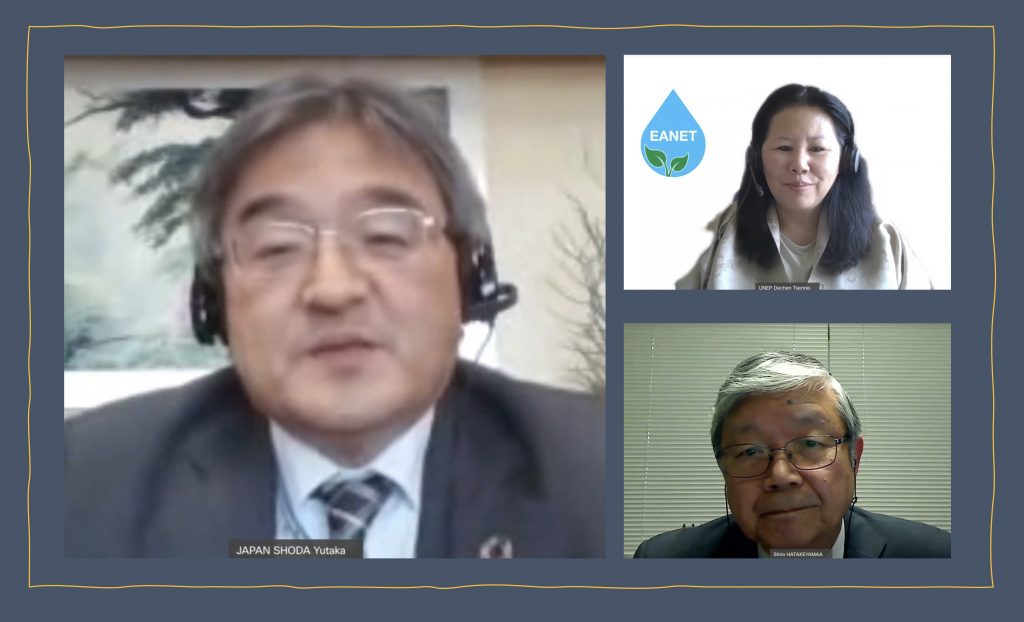
Chaired by Japan and co-chaired by Malaysia and Viet Nam, the IG23 started with the Opening Remarks from H.E. Mr. Yutaka Shoda, Vice-Minister, Ministry of the Environment, Japan, followed by Opening Remarks by Dr. Dechen Tsering, Regional Director, United Nations Environment Programme for Asia & the Pacific, and by Dr. Shiro Hatakeyama, Director General, Asia Center for Air Pollution Research.

.

Welcome and Opening Remarks delivered during the IG23 meeting.

.

Historical Decisions on the Expansion of the Scope of the EANET

Following the decision of the Twenty-second  Session of the Intergovernmental Meeting (IG22), held in November 2020, the EANET Participating Countries’ representatives have been working relentlessly on the process to expand the scope of the EANET, from acid deposition to also include a wider scope of atmospheric environment-related substances.

This historical progress required the EANET to develop a text supplementary document to the EANET Instrument, to define the scope of expansion and the target substances to be included in the EANET activities. In a landmark decision, 20 years after the creation of the Network, the IG23 has adopted the text of the Supplementary Document (Annex) to the Instrument for Strengthening the Acid Deposition Monitoring Network in East Asia.

.

Discussions among participants during the virtual IG23 meeting.

.

The EANET Project Fund and Project Guideline, a new financial mechanism allowing EANET to build co-financed projects with partners in the region and beyond, has also been approved by the IG23.

.

Ways Forward

In addition to these major decisions, the IG23 has also approved several important documents, including the Work Program and Budget of the EANET in 2022, and the Summary of the Twentieth Anniversary of the EANET publication, a new outreach document detailing the EANET’s past achievements and future opportunities.

As an important way forward for 2022, the EANET Participating Countries and partner organizations will be invited to start preparing and submitting project proposals for the pilot implementation of new EANET projects, in line with the EANET Project Guideline.

.

Read the IG23’s Report of the Session (including the Decisions of IG23 in Annex 2), and discover the virtual meeting’s pictures on Flickr.

.

Photos credits: all rights reserved to EANET.

EANET Research Fellowship Programme – The impacts of exposure to fine particulate matter on premature mortality in Bangkok, Thailand

EANET Fellowship 2018 featured image

1 December 2020 – Niigata, Japan

The Acid Deposition Monitoring Network in East Asia (EANET)’s fellowship program aims at funding researchers from the EANET’s participating countries to carry out research pertaining to acid deposition at the Network Center in Japan. Kessinee Unapumnuk, from Thailand, was awarded the EANET fellowship for 2018. She led her research on the impacts of exposure to fine particulate matter on premature mortality in Bangkok.

.

The impacts of fine particulate matters on human health

Fine particulate matters (PM2.5) affect human health and can lead to premature death if exposed for a long time. Chronic exposure to PM2.5 increases the risk of developing cardiovascular and respiratory diseases, as well as lung cancer. The World Health Organization (WHO) reported 4.2 million premature deaths due to cardiovascular and respiratory diseases and cancers worldwide in 2016 related to the exposure to ambient PM2.5 in both urban and rural areas.

Bangkok, Thailand’s capital, has been experiencing frequent episodes of air pollution characterized by a high concentration of PM2.5 due to combustion emissions from multiple sources and stagnant metrological conditions from January to April every year. Transportation-related sources are the major contributions to the PM2.5 levels and result in poor air quality in the city.

.

Understanding premature mortality attributable to PM2.5 in Bangkok’s districts

Unapumnuk has estimated premature mortalities caused by chronic obstructive pulmonary disease (COPD), lung cancer (LC), ischemic heart disease (IHD), and stroke attributed to long-term exposure to PM2.5 in several districts in Bangkok from 2010 to 2017.

In conclusion, the study suggests that a strict emission control of PM2.5 is needed in Bangkok to avoid significant mortality attributable to PM2.5.

.

Under the EANET Research Fellowship program 2018, this study was conducted at the Asia Center for Air Pollution (ACAP), Niigata Japan. The author acknowledged the help received from the Asia Centre for Air Pollution Research (ACAP) for performing the research as well from the Thai Pollution Control Department and the Ministry of Public Health.

.

Read the full article by Unapumnuk et al. in the EANET Science Bulletin Volume 5.

.

Photo credits: Bangkok by Nick van den Berg, free of the copyright license.

EANET Research Fellowship Programme – Study on the impacts of air pollution transport and its effects to human health in Cambodia

17 February 2021 – Niigata, Japan

The Acid Deposition Monitoring Network in East Asia (EANET)’s fellowship programme aims at funding researchers from the EANET’s Participating Countries to carry out research pertaining to acid deposition at the Network Center in Japan. Kong Savuth, from Cambodia, was awarded the EANET fellowship in 2018. Mr. Savuth’s research described human health effects of exposure to air pollutants, namely, ozone (O3) and particulate matter (PM2.5) in reference to the WHO Air quality guidelines (2005).

.

Impacts of air pollutants on human health

PM2.5 can penetrate deep inside the lungs and contribute to increasing the risk of cardiovascular and respiratory diseases including lung cancer. According to recent epidemiological studies, reducing the annual average PM2.5 concentrations of 10 μg m-3 could result in a significant reduction of premature mortality.

Ground-level O3 can cause respiratory problems leading to asthma, cough, inflammation of the respiratory tract, chronic bronchitis, and lung damage. A high-level concentration of O3 also causes premature mortality.

WHO estimates that in 2016, some 58% of outdoor air pollution-related premature deaths were due to ischaemic heart disease and strokes, while 18% of deaths were due to chronic obstructive pulmonary disease and acute lower respiratory infections respectively, and 6% of deaths were due to lung cancer.


.

Estimating premature mortality caused by PM2.5 and O3 in Cambodia

The researchers (Savuth and Yamashita) estimated premature mortality caused by the exposure to PM2.5 and O3 in Cambodia by using PM2.5 and O3 data simulated by CMAQ (Community Multiscale Air Quality – a chemical transport model) and Concentration-Response (C-R) functions.


Read the full study and its results, published in the EANET Science Bulletin, Vol 5.

.

Under the EANET Research Fellowship programme 2018, this study was conducted at the Asia Center for Air Pollution (ACAP), Niigata, Japan. The researcher, Kong Savuth, acknowledged the support and facilities provide by ACAP and by the National Institute for Environmental Studies (NIES), Japan, for performing the research.

Photo credits: Cambodia by Daniel Kirsch, free of the copyright license.