Highlights from the Twenty-fourth Session of the Scientific Advisory Committee (SAC24) on the EANET

7 November 2024 – Bangkok, Thailand

The Twenty-fourth Session of the Scientific Advisory Committee (SAC24) on the EANET took place from October 29 to 31, 2024, in Seoul, Republic of Korea and online, hosted by the Ministry of Environment, Republic of Korea, and the National Institute of Environmental Research (NIER), Republic of Korea. The session gathered over 55 representatives from the 13 EANET Participating Countries, along with the Network Center and the Secretariat for the EANET, to discuss the network’s recent achievements, assess key reports, and contribute suggestions for the upcoming Medium-Term Plan (MTP) of the EANET (2026-2030).

 .

Progress of EANET in 2023-2024

EANET reported substantial progress in its 2023-2024 core activities and project activities. This included advancements in both acid deposition research and broader air quality management issues, reflecting the network’s expanded scope. The Secretariat and Network Center highlighted successful activities, such as capacity building, project implementation and workshops to enhance awareness of air pollution challenges across East Asia. They also presented updates on EANET’s acid deposition and air quality monitoring, PM2.5 characterization, and ecosystems impact assessment. Among others, findings emphasized the effects of nitrogen on ecosystems and identified major pollution sources like biomass and plastic combustion. Pilot trials for a Hybrid Air Quality Monitoring Network revealed challenges in using Low-Cost Sensors, necessitating the need to further review the guidelines for low-cost sensor use in conventional air quality monitoring. A review of emission inventories and source apportionment studies in Southeast Asia underscored the need for further improvement and standardizing methodologies.

.

In-person participants at the SAC24

.

Adoption of Key Reports and National Monitoring Plans

A central aspect of SAC24’s discussions involved reviewing and adopting essential EANET reports. The 2023 Data Report provided an in-depth overview of monitoring data on wet and dry deposition, soil and vegetation, and inland aquatic environment in the 13 Participating Countries. Meanwhile, the Inter-laboratory Comparison (ILC) Report documented quality assessments across laboratories within the network, ensuring consistent analytical standards. Updated National Monitoring Plans were also reviewed, underscoring countries’ commitments to refining their data collection and monitoring capabilities. The adoption of these reports marks a significant step forward, providing reliable data that will support scientific research and policy decisions across the region.


Countries’ suggestions for the Next Medium-Term Plan (2026-2030)

The SAC24 engaged in forward-looking discussions regarding the next Medium-Term Plan (MTP) of EANET (2026-2030). Participating Countries offered valuable insights aimed at strengthening the monitoring network, expanding capacity-building efforts, and refining targeted pollutants in line with regional environmental priorities. Suggestions included developing sustainable monitoring frameworks that integrate advanced data collection methods, such as low-cost sensors and satellite data. Participants also emphasized the need for enhanced monitoring of specific pollutants like sulfur dioxide (SO₂), ozone (O3), nitrogen oxides (NOₓ), and PM2.5, while strengthening regional collaborations to align EANET’s objectives with international air quality standards. These insights will serve as a foundation for shaping EANET’s future strategies and objectives.

In conclusion, the SAC24 underscored EANET’s commitment to enhancing scientific collaboration across East Asia. The discussions and decisions during this session laid the groundwork for furthering EANET’s mission in air quality management and pollution control. Looking ahead, EANET’s focus on expanding its monitoring capabilities and strategic planning will be instrumental in addressing the region’s growing environmental challenges.

Recommendations from the SAC24 will be further considered in November 2024 by the 26th session of the Intergovernmental meeting (IG26) on the EANET, to be held in Kuala Lumpur, Malaysia.

.

Read the SAC24’s Report of the Session.

.

View the meeting photos on Flickr.

.

Photo credits: featured image of Bukhansan National Park, Bogungmun-ro, Seongbuk-gu, Seoul, Republic of Korea (2024) by Elliot Gouy; other images: all rights reserved to EANET.

Advancing Atmospheric and Environmental Monitoring in Asia: Technical Missions Supporting EANET Countries in 2023 and 2024

Bangkok, 20 February 2024

The Asia Center for Air Pollution Research (ACAP), as the Network Center (NC) for the EANET, has undertaken a series of technical missions aimed at supporting EANET Participating Countries to conduct their monitoring activities, e.g. Wet and Dry Deposition of atmospheric pollutants, inland, soil & vegetation and catchment monitoring, and meteorological data. From Mongolia, Indonesia, Lao PDR, and Cambodia, these missions have sought to enhance environmental monitoring capabilities and facilitate collaboration among stakeholders.

 .

Enhancing Monitoring Infrastructures in Mongolia

In Mongolia, the technical mission took place from 12th to 19th November 2023 in Ulaanbaatar and focused on updating monitoring site information and providing advanced technical guidance on the analysis of ion chromatography results. Additionally, a new rain sensor was deployed to enhance data accuracy. Meetings with the National Agency for Meteorology and Environmental Monitoring (NAMEM), the Central Laboratory of Environment and Meteorology (CLEM), the German-Mongolia Institute for Resources and Technology (GMIT), and the National University of Mongolia took place and aimed at deepening the understanding of EANET activities, particularly in Volatile Organic Compounds (VOCs) monitoring. Successful training sessions on VOCs monitoring, utilizing the sorbent tubes method, were conducted to reinforce local capacities.

.

Technical Knowledge Exchange in Indonesia

The technical mission in Indonesia took place from 11th to 16th December 2023 in Jakarta and Bandung, in partnership with the Secretariat for the EANET. It involved collaboration with laboratories affiliated with EANET activities. Visits were made to key institutions such as the Ministry of the Environment and Forestry, PSILKH Serpong, BMKG Jakarta, and BRIN Bandung, where technical guidance was provided, and feedback was collected. Discussions revolved around potential institutional arrangements to strengthen EANET implementation in Indonesia, promoting improved coordination and efficiency in environmental monitoring. During the mission, the NC representatives also met with the ASEAN Secretariat to discuss possible collaboration opportunities.

.

Pictures from the technical missions in Cambodia, Mongolia, and Lao PDR (Indonesia: see cover image above).
.
Strengthening Monitoring Infrastructures in Lao PDR

In Lao PDR, the technical mission took place in Vientiane, from the 11th to 15th December 2023. A visit was made to the Natural Resources and Environment Research Institute (NRERI), Ministry of Natural Resources and Environment (MoNRE). It included a comprehensive assessment of monitoring infrastructures and procedures. Maintenance work was undertaken on monitoring equipment, including the Wet-Only sampler and Filter Pack, to ensure precise data collection. Technical guidance was shared on inspection procedures and analytical methodologies, particularly focusing on ion chromatography. Additionally, knowledge exchange through meetings and discussions on EANET activities facilitated enhanced collaboration among stakeholders.

.

Sustaining Environmental Monitoring Efforts in Cambodia

The mission in Cambodia took place in Phnom Penh, from the 8th to the 12th of January 2024. It focused on sustaining continuous monitoring efforts for various pollutants. A visit was made to the Ministry of Environment, Cambodia, to provide maintenance and calibration of the ozone monitor, which was installed in 2019 through the IBAQ Programme, alongside training sessions to ensure effective ozone data reporting. Technical assistance was extended for repairing sampling systems and optimizing ion chromatography procedures, thereby strengthening the country’s capacity for environmental monitoring.

.

The NC for the EANET’s technical missions across Mongolia, Indonesia, Lao PDR, and Cambodia have aimed at enhancing environmental monitoring capabilities and fostering collaboration among stakeholders. By providing specialized technical expertise and facilitating knowledge exchange, these missions significantly contribute to assisting Participating Countries’ efforts to provide high-quality air quality monitoring data and improve technical capabilities in the Region. The NC will conduct more technical missions in 2024 to support other EANET Participating Countries.

.

Find out more about the EANET monitoring sites and download EANET data.

.

Photo credits: all rights reserved to EANET.

EANET Training on Air Quality Monitoring Systems Using Low-Cost Sensors

19 October 2023 – Bangkok, Thailand

The EANET Training on Air Quality Monitoring Systems Using Low­-Cost Sensors took place on 6 and 7 September 2023, in Hanoi, Viet Nam, and online. The event was jointly organized by the ADB, the Network Center for the EANET, and the Vietnam Institute of Meteorology, Hydrology, and Climate Change (IMHEN) and gathered 100 participants, online and in person, from the EANET Participating Countries and beyond, to learn about LCS equipment operation, quality assurance, data accuracy, early problem detection, and effective use of monitoring data.

.

Opening Session

Ms. Karma Yangzom, Principal Environment Specialist at the Asian Development Bank (ADB), delivered Opening Remarks expressing gratitude for joining the Vietnam project with IMHEN. She highlighted the significance of the hybrid method in addressing monitoring resource constraints, emphasizing the need for meticulous use of LCS to ensure sensor functionality and data verification, emphasizing the importance of high-quality, verified data, and underlining the workshop’s objective to research proper LCS utilization while expressing appreciation to EANET for hosting the workshop with hopes of providing valuable information to participants.

Dr. Le Ngoc Cau, the Director of the Center of Environmental Research at the Vietnam Institute of Meteorology, Hydrology, and Climate Change (IMHEN), expressed gratitude to the Asia Center for Air Pollution Research, ACAP (the Network Center for the EANET) and ADB for their support in the project to establish an air quality system, highlighting the costliness of such systems in urban areas and the potential of LCS as a more affordable alternative if data accuracy can be ensured. The LCS has been installed in two provinces in Vietnam as part of the project, providing participants with a deeper understanding of its capabilities, and he thanked all the participants and EANET for organizing the workshop.

.

Introduction to the use of Low-Cost Sensors in Vietnam and in other Asian Countries

Dr. Le Ngoc Cau delivered a presentation on IMHEN’s role, its air quality monitoring system, air quality modeling, and EANET activities in Vietnam. He highlighted the installation of a PM2.5 monitor in Hoa Binh station in 2015 and the collaborative installation of LCS at the same station with the Network Center. Dr. Cau emphasized the importance of verifying LCS data for reliability and the need to figure out how to integrate LCS and conventional monitoring data. They expressed interest in further collaboration with international organizations.

Ms. Karma Yangzom shared experiences from Asian countries regarding the use of Air Quality sensors in ADB projects aimed at enhancing awareness and efforts to improve air quality. She highlighted the stability of AQ Mesh sensors, which only require sensor replacements every two years, and emphasized the use of LCS to present air quality information to the public. She highlighted the importance of ensuring the reliability of the data generated from the LCS.

.

EANET Projects on LCS Technical studies

Dr. Akie Yuba, a Senior Researcher from ACAP, provided a report on LCS technical studies in Vietnam and Myanmar, which were carried out as part of EANET Project Activities. In Hoa Binh, Vietnam, five LCS units were installed, with a specific focus on PM2.5 and other parameters. In Yangon, Myanmar, LCS units, specifically GBiot and Haz Scanner, were utilized for monitoring PM2.5, O3, NO2, and meteorological data during both monsoon and non-monsoon seasons. A good correlation was observed in the data, though different values were displayed in the slopes, emphasizing the need for blackout preparedness to prevent electricity voltage fluctuations.

Dr. Hiroaki Minoura, a Guest Researcher at ACAP demonstrated, along with Dr. Yuba, how to install an LCS, how to initiate it, to connect it to a data server, and how to retrieve LCS data when there are data communication issues.

.

.

Dr. Kazuhiro Misaka, Director of Green Blue Corporation, a private company specializing in the inspection, and maintenance of environmental monitoring and measurement equipment, delivered a presentation on data screening and analysis obtained with LCS and the Hybrid Air Quality Monitoring Network (HAQMN), accompanied by Dr. Akie Yuba and Dr. Hiroaki Minoura. Dr. Misaka explained the process of screening raw LCS data and removing noise signals. Dr. Yuba discussed the screening and validation of hourly LCS data, while Dr. Minoura covered topics related to data interpretation, visualization, and trend analysis.

.

Challenges and Ways Forward

In the last session, Dr. Alison Simcox from the U.S. Environmental Protection Agency (US-EPA) was invited to share insights on LCS experiences. She clarified that LCS data was not deemed an official guideline, and further studies on its functionality were being considered. Two key questions were introduced: the challenges encountered by LCS and Hybrid Air Quality Monitoring Networks (HAQMN) in Asian countries and potential collaborations for promoting LCS in these regions. Commenting on the wrap-up for the way forward, challenges related to technology and policy in utilizing LCS were emphasized, with a focus on the need for capacity building to address issues such as calibration and data interpretation. Dr. Alison stressed the importance of understanding the purpose of LCS usage, whether it was identifying wildfires, creating smoke maps, or monitoring global changes in PM2.5.

Mr. Kenichiro Fukunaga, Deputy Director General of ACAP, delivered the Closing Remarks and conveyed his gratitude to various organizations and participants for their contributions to the workshop and to the EANET Low-cost sensor project. He expressed expectations for the expansion and enhancement of LCS activities in monitoring, research, and capacity building.

.

Useful Resources:

.

  • View the workshop’s photos on Flickr.

.

Find out more about EANET’s Project Fund and Project Activities.

.

Photo credits: cover photo of Vietnam (2021) by Hoach Le Dinh; all other photos: all rights reserved to EANET.

The Twenty-fourth Senior Technical Managers’ Meeting on the EANET

5 September 2023 – Bangkok, Thailand

The Twenty-fourth Senior Technical Managers’ Meeting (STM24) on the Acid Deposition Monitoring Network in East Asia (EANET) took place in Niigata, Japan and online, on 29 and 30 August 2023. The Meeting gathered over 40 senior technical officials from the 13 EANET Participating Countries to discuss the status of the Network’s monitoring activities.

.

EANET Monitoring Activities in 2022

Dr. Shiro Hatakeyama, the Director General of the Asia Center for Air Pollution Research (ACAP), delivered the Opening Remarks, followed by Welcome Remarks by Mr. Bert Fabian, the Coordinator of the Secretariat for the EANET.

After presenting the progress of EANET activities in 2022 since STM23, the Network Center for the EANET (NC) shared the results of various reports on acid deposition and related substances monitoring activities. STM24 participants were invited to discuss and share knowledge and experience to collectively review these draft publications.

.

Some Participants of the STM24 in Niigata, Japan

.

Overview of the Preliminary Draft Data Report 2022 and Evaluation of the Results of the Inter-laboratory Comparison (ILC) Projects 2022

The NC presented the Preliminary Draft Data Report 2022. This report focuses on wet deposition, dry deposition (air concentration), soil and vegetation, inland aquatic environment, and catchment-scale monitoring. It includes a summary of the monitoring data in 2022 and related information submitted by the Participating Countries.

The NC also introduced the preliminary draft Report on the Inter-laboratory Comparison Projects in 2022 for wet deposition, dry deposition (filter pack method), soil, and inland aquatic environment.

.

Consideration of the National Monitoring Plans (NMPs), Current Monitoring Activities for the EANET, and Overall Air Concentration Monitoring Status of the Participating Countries

In line with previous STM meetings’ process, representatives of the Participating Countries presented their National Monitoring Plans (NMPs) and current EANET activities, including monitoring capacities, technical challenges, and future plans, while focusing on the general improvement of the activities of the EANET.

Dr. Meng Fan, Deputy Director General, ACAP, delivered the Closing Remarks. He expressed his great appreciation for the improvement of the data quality due to the efforts of the Participating Countries and hoped that the EANET monitoring, research, and capacity-building activities would continue to be strengthened through the expansion of the scope of the EANET.

.

The Report of the STM24 will soon be available on the Meeting Reports page. View the STM24 photos on Flickr.

.

Find out more, and access EANET data on the Monitoring System page.

.

Photo credits: cover photo of Japanese rice farm by S. Tsuchiya (2022), other images, all rights reserved to EANET.

The EANET Emission Inventory Webinar Workshop on Open Biomass Burning – Join us on December 5th!

 
1. Background

One of the key sources of particulate matter (PM) pollution in the EANET Participating Countries especially in Southeast Asia, is the open burning of biomass such as agricultural wastes, forests, and municipal wastes.

Open burning of agricultural crop residues is one of the key sources causing severe air pollution. Reducing emissions from agricultural waste burning is among the 25 recommended clean air measures in Air Pollution in the Asia Pacific: Science-Based Solutions (UNEP and CCAC, 2018).

It is essential to understand the current status of emissions from open biomass burning sources to consider effective mitigation ways. The emission inventory is a powerful tool for this purpose. However, methodologies to estimate emissions from open biomass burning are much different from those for other anthropogenic sources.

.

2. Objectives and Participants

The objectives of the Emission Inventory Webinar Workshop are to learn basic methodologies to estimate emissions from open biomass burning sources including considerable uncertainties. In addition, application methodologies of the emission inventories to analyze influences of open biomass burning emissions will also be introduced. Furthermore, participants will share short presentations about issues related to open biomass burning in their country, and discussions with experts will be conducted.

Target workshop participants are technical officers, practitioners, and policymakers who are involved in air quality management issues, especially in charge of or interested in developing a national emission inventory.

.

3. Agenda and Program

.

4. Registration

If you would like to participate in the EANET Emission Inventory Webinar Workshop on Open Biomass Burning, please send the registration form to the Webinar Workshop Secretariat (eiwws2022@acap.asia).

.

For further inquiries, contact the Network Center for the EANET.

The EANET/IIASA International Workshop on Strengthening the Science-Policy Interface for Clean Air and a Sustainable Future in Asia – Join us on 19 December!

Registration is now closed.

.

1. Background

In many parts of Asia, the single greatest threat to human health and to a sustainable future is air pollution. A growing body of modeling research has employed emissions inventories, scenario development, and benefit estimation techniques to identify technological and behavioral changes that can limit that threat. The multiple benefits resulting from these interventions offer cost-effective solutions to air quality, public health, and other sustainable development concerns. One would therefore anticipate that the results that would translate easily into policy. However, this is not always the case. Frequently, there can be a disconnect between scientifically based models and the policies they seek to influence. It is therefore critical to discuss not only the most recent scientifically-based models but how that work can effectively interface with decision makers. In short, if models are going to matter, they need to be supported by efforts to strengthen the science-policy interface for clean air.

The EANET/IIASA International Workshop on Strengthening the Science-Policy Interface for Clean Air and a Sustainable Future in Asia will take place on Monday 19 December 2022, from 13:30-17:00 (Tokyo Time: UTC +9).

.

2. Objectives and Participants

The primary objective of this half-day workshop is to provide learning opportunities on the state-of-the-art modeling analysis that can strengthen that interface in Asia.

This workshop consists of three sessions as follows:

  • Session 1 – Multiple development benefits of coordinated actions to tackle air pollution: This session is jointly organized by the Acid Deposition Monitoring Network in East Asia (EANET) and the International Institute for Applied Systems Analysis (IIASA). The modeling analysis employed by a project activity of EANET is presented along with modeling analysis results from ongoing collaborative research projects between IIASA and the Ministry of the Environment of Japan (MOEJ) on multiple development benefits of coordinated actions to tackle air pollution.
  • Session 2 – Exploit synergetic linkages among SDGs: This session presents modeling analysis results from ongoing collaborative research projects between IIASA and MOEJ on synergies of achieving several sustainable development goals.
  • Session 3 – How to implement and promote a science-policy dialogue: This panel discussion session will discuss how we can design science-policy dialogue to reflect implications from modeling analysis to policy development and to co-design models by incorporating social and institutional dimensions of feasibility.

Expected targeted participants are policymakers, scientists, researchers, practitioners, and technical officers of local/national governments working on air pollution-related problems in the EANET Participating Countries of EANET and beyond.

.

3. Agenda and Program

.
4. Date, Time, and Location

Date: 19 Dec 2022 (Monday)

Time: 13:30-17:00 (Tokyo Time: UTC +9)

Online: Register for the hybrid event here.

.

For further inquiries, contact the Network Center for the EANET via email or by phone at (+81)25-263-0556.

The 13th International Workshop on Atmospheric Modeling Research in East Asia – Join us on December 22nd-23rd!

1. Background

The EANET has developed a close relationship with the community of Model Inter-Comparison Studies for Asia (MICS-Asia) which is a project aiming at improving air quality and climate models not only by enhancing scientific understanding of the atmospheric environment but also by developing a common scientific understanding for policy-making in Asia. The International Workshop on Atmospheric Modeling Research in East Asia is a regular workshop of MICS-Asia which has received support from the EANET throughout the previous Medium Term Plans. Summaries of previous MICS-Asia workshops are available in the Reports of the Session of the Scientific Advisory Committee (SAC) on the EANET.

Air quality models are effective scientific tools to understand the status of the atmospheric environment and evaluate the effects of mitigation measures. However, extensive experience is necessary to utilize air quality models effectively, and participating in workshops led by experienced researchers is a practical way to develop skills and expertise on this matter.

.

2. Objectives and Participants

The International Workshop on Atmospheric Modeling Research in East Asia provides capacity-building opportunities for air quality modeling to the EANET. Its goal is to allow participants to become familiar with a methodology to analyze the status of atmospheric environment-related substances, including processes of atmospheric chemistry and physics, using air quality models. In addition, participants will learn from examples of the application of air quality modeling systems to evaluate recent atmospheric environmental problems as well as from the latest information on air quality modeling systems including settings and model configuration.

This workshop targets participants from the EANET Participating Countries who are experts in air quality modeling and are willing to improve their knowledge of air quality models’ implementation and want to learn about the latest information on recent air quality modeling systems. The workshop is also suitable for technical officers, practitioners, and policymakers from the Region who are involved in air quality management issues and interested in utilizing air quality modeling systems.

.

3. Agenda and Program

.

4. Registration

If you would like to participate in the 13th International Workshop on Atmospheric Modeling Research in East Asia, please fill in and send the registration form to the Workshop’s Secretariat (modelws2022@acap.asia).

.

For further inquiries, contact the Network Center for the EANET.

EANET Workshop on the Relationship between the Atmospheric Environment, Human Health and Ecosystems – Join us on October 31st!


The registration is now closed.

1. Background

As mentioned in the Medium Term Plan for the Acid Deposition Monitoring Network in East Asia (EANET) (2021-2025), the Participating Countries established the EANET in 2000 to recognize increasing concerns about acid deposition due to rapid economic development in East Asia that had jeopardized environmental sustainability. The establishment of EANET has benefited from the viewpoint of environmental sustainability and the experience of Europe and other regions that have earlier carried out relevant activities for monitoring acid deposition and related substances, including quality assurance and quality control (QA/QC), data accumulation, and evaluation. Over the span of 20 years, the accumulation of scientific knowledge and regional economic development, the environmental pollution situation worldwide, and the urgent and important fields of action have changed significantly, and, in November 2021, the Twenty-third Session of the Intergovernmental Meeting on the Acid Deposition Monitoring Network in East Asia (IG23) for the EANET made important decisions on the expansion of the scope of the EANET, from acid deposition, to also include a wider scope of atmospheric environment-related substances.

As the deterioration of the atmospheric environment by pollutants emitted from anthropogenic activities may cause adverse effects on humans and ecosystems, the Workshop on the Relationship between the Atmospheric Environment and Human Health and Ecosystems will allow discussions and experience-sharing with various stakeholders, such as policymakers, scientists, and the general public.

To further discuss and understand scientific knowledge and relevant policy measures, the Workshop on the Relationship between the Atmospheric Environment and Human Health and Ecosystems will gather renowned East Asian and European researchers and experts from academia (Hokkaido University, Japan, and Nanjing University of Information Science and Technology, China), international organizations (CLRTAP-UNECE, WHO, IIASA), and from the Network Center for the EANET, to share scientific findings on the effects of atmospheric deposition on human health and ecosystems, as well as best science-based practices for policy-makers to reduce the impacts of atmospheric pollutants.

.

2. Objectives and Participants

The Workshop on the Relationship between the Atmospheric Environment and Human Health and Ecosystems will aim at:

  • sharing scientific knowledge on the relationships between the atmospheric environment and human health and between the atmospheric environment and ecosystems
  • showcasing science-based policy experiences on the reduction of atmospheric pollutants in other regions, such as Europe
  • contributing to sharing a common understanding of future directions for environmental measures to be developed by policymakers and scientists at the national and international levels

Although this event is open to the public, the expected participants will be mainly government officials from the EANET Participating Countries, scientists, such as the Scientific Advisory Committee members, Task Force members, other relevant scientists from the EANET and beyond, etc.


3. Agenda and Program

Useful Resources

.

For further inquiries, contact the Network Center for the EANET.

Workshop on National Air Quality Monitoring Systems and Methodologies with Related Partners – Join us on July 6th!

.

The registration is now closed.

.

1. Background

The EANET as an intergovernmental network in East Asia has achieved excellent progress in monitoring cooperation and had great progress in dealing with common concerned problems in the region. The EANET has been monitoring more than 18 atmospheric substances including ions at 64 monitoring sites in the EANET Participating Countries. EANET implements five monitoring items – wet deposition, dry deposition (air concentration), soil and vegetation, inland aquatic environment, and catchment-scale monitoring.

Depending on differentiated economic stages, industrial structures and meteorological conditions, Participating Countries face diversified environmental challenges and priorities, and even in the same region, the challenges differ from time to time. Therefore, in dealing with acid deposition and air pollution issues, it becomes critical to understand the latest atmospheric environment status in the EANET region firstly, and constantly keep up with the latest trend of air pollution measurements and state-of-the-art research methodology/technology, and fully utilize all aspects of resources to seek the solutions in improving air quality in EANET.

Through more than 20 years of activities, the EANET has established a comprehensive and integrated monitoring network, and EANET monitoring data has been used to evaluate and analyze the atmospheric environment in East Asia. The EANET has focused on the national level to promote cooperation among thirteen Participating Countries to address air pollution, including acid deposition issues, and has achieved significant progress in improving air quality in the East Asia region. However, considering the lifetime of air pollution substances, city-level air quality management is also important besides the national level. Furthermore, in terms of implementing management regulations and standards, along with initiatives from central governments, the local/city governments are also crucial in steadily carrying out various measurements.

To accelerate its further development, the Twenty-third Intergovernmental Meeting of the EANET reached an agreement to expand its scope and enable the EANET to conduct monitoring of more atmospheric environment-related substances. In response to this historical decision of scope expansion and steadily undertaking the necessary actions to adopt the changes of EANET, sharing the latest monitoring system and methodologies, discussing the most pressing challenges, and thinking together about possible solutions among the EANET Participating Countries with related partners are critical.

This workshop will gather different stakeholders (scientists and researchers, government officers, technicians including QA/QC managers, the representative of an international organization) together and invite them to discuss from different perspectives on how to overcome the challenges so as to improve the monitoring system in EANET.

This workshop will be divided into two sessions. The first session will briefly introduce the EANET monitoring activities and its function, followed by the case studies of Japan, R. of Korea, and China. In addition, the specific monitoring methodologies including QA/QC activities will be also introduced. In the second session, the panel discussion will take place involving different stakeholders to seek solutions for improving the EANET monitoring system.

.

2. Objectives and Participants

This workshop aims to provide an opportunity of sharing a wide range of national and international experiences in the field of atmospheric monitoring, discussing the current development and future challenge of monitoring systems and related methodologies in EANET.

Although this event is open to the public, the expected participants will be mainly Representative of Participating Countries of the EANET including:

  • Central and local government officials from monitoring and air quality management related departments or divisions
  • Scientists, researchers, and technicians (including QA/QC managers and technicians) in the related area
  • Participants from related stakeholders, including representatives from UNEP and other regional and international organizations
  • The Network Center for the EANET, the Secretariat for the EANET

.

3. Agenda

There will be two sessions based on the objectives of the workshop.

The first session aims to:

  • Provide an overview of the development of science and policy related to acid deposition in East Asia over 30 years.
  • Introduce the monitoring systems of Japan, R. of Korea, and China.
  • Discuss national monitoring system with QA/QC capacity for a wide range of monitoring stations, including mobile monitoring units, and introduce past experiences in order to expand possible opportunities in Participating Countries.

The second session aims to:

  • Provide discussion platform to various stakeholders to discuss the challenges the Participating Countries are facing, and seek possible or efficient solutions in improving monitoring system.
  • Provide useful and practical advice from scientific views in strengthening monitoring system from the SAC members of EANET.
  • Provide lesson learned and important insights for air quality monitoring management experiences towards resolving the related difficulties in the Participating Countries of the EANET.
  • Share Clean Air Asia (CAA)’s knowledge gained through the cooperation between cities that has been implemented over the years in strengthening and improving City’s air quality monitoring system.
  • Discuss opportunities of respective concerns or difficulties in further developing air quality monitoring systems in Participating Countries of the EANET involving different stakeholders.

In the second session following two guiding discussion points (tentative) will be provided.

  1. Air pollution issue are deferred from country to country, and deferred from time to time. Taking the latest trend of your country into account, what do you think are the most significant challenge such as targeted substances and spatial coverage for the EANET in improving atmospheric environment in 5-10 years ahead?
  2. International cooperation is critical from national to city-level in dealing with the regional air pollution issue. But, what is the pros and cons of the linkage between national-level and city-level cooperation, and what are the key points to optimize the co-benefit for the regional/city-level air quality in terms of monitoring system, its solutions and prioritized actions?

.

Access the full Programme here.

.

Download the Workshop’s presentations:

Development and role of monitoring system in EANET and the case study of Japan

Latest National and Local/City Monitoring System in the Republic of Korea

Study on the Co-control of PM2.5 and Ozone Pollution in Beijing, Tianjin, Hebei, and Surrounding Region of China

Monitoring methodologies and QA/QC activities in the EANET

-Introduction to EANET Project Fund and Project Activities 2022-2023

.

For further inquiries, contact the Network Center for the EANET.

EANET Seminar on Expanding Monitoring Systems using Low-Cost Sensor (LCS) – Join us on July 21st!

.

The registration is now closed.

.

1. Background

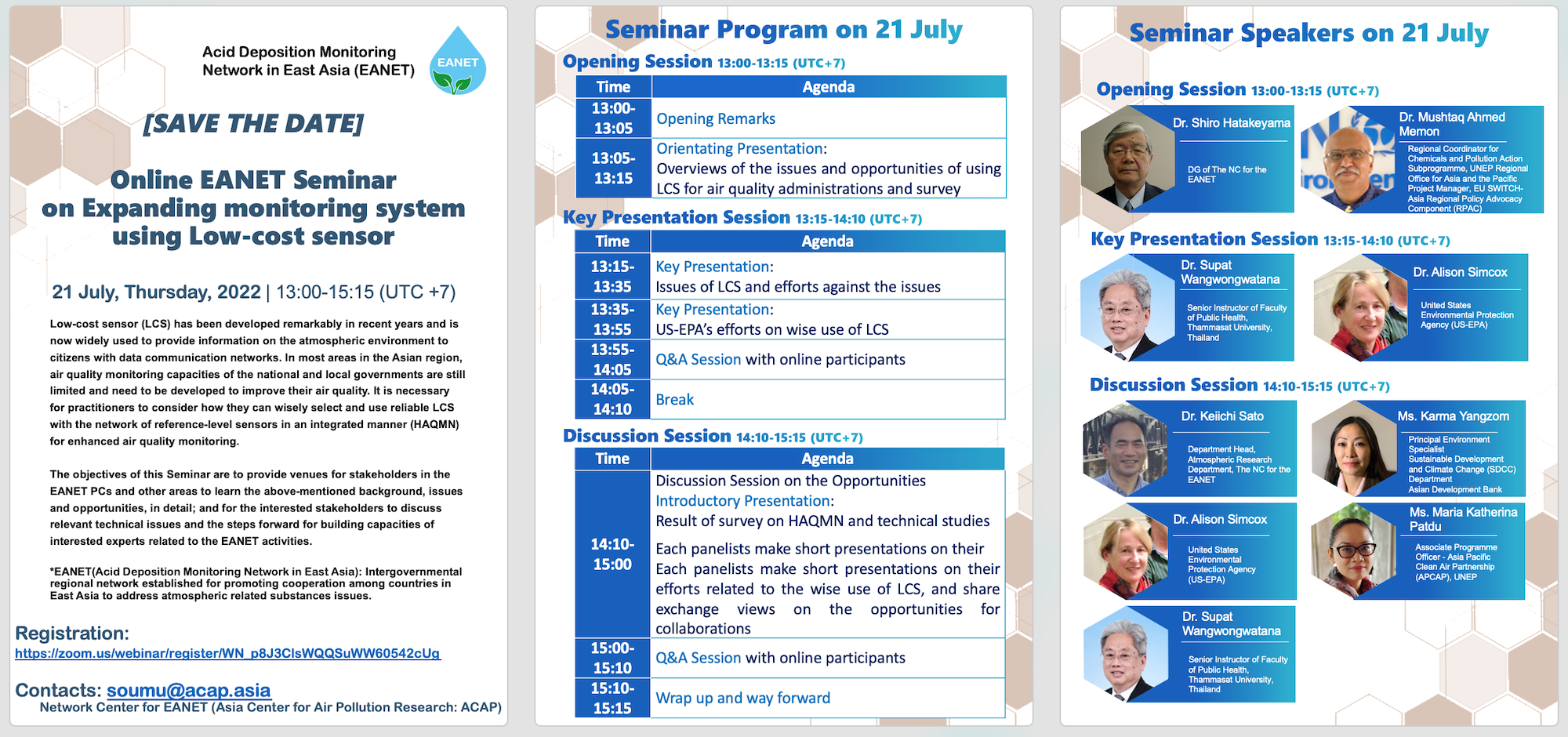
Low-cost Sensor (LCS) technology to measure air quality has expanded remarkably in recent years, and it is now widely used by the private sector. It provides information on the atmospheric environment to citizens through data communication networks.

Noticing the cost-effectiveness of LCS, international organizations have started to promote the use of LCS in selected areas to strengthen the capacity of governments where official air monitoring networks are insufficient. However, various surveys conducted by US-EPA, the EU, and others, as well as some experiences in the Asian region reveal that some types of LCSs in the market have problems with accuracy and reliability, while some types are reliable. It is observed that some less reliable LCS and improper use of LCS, including wrong interpretation of measured data, sometimes cause problems including unnecessary social confusion.

Air quality monitoring authorities, such as US-EPA, recommend that LCS is to be used for providing supplementary information for non-regulatory purposes. They recently developed testing protocols to evaluate the accuracy and reliability of LCS.

In most areas in the Asian region, air quality monitoring capacities of the national and local governments are still limited and need to be developed to improve their air quality to achieve SDGs. Considering emerging sub-regional-scale and serious seasonal air pollution events, such as PM2.5, building a network of reliable and internationally comparable air quality data becomes more important.

Thus, it is necessary for practitioners to consider how they can wisely select and use reliable LCS with the network of reference-level sensors in an integrated manner for enhanced air quality monitoring.

The EANET has been developing an air quality monitoring network in the East Asia region with governments and scientists from its 13 Participating Countries and assisting them to develop domestic capacity. The EANET is expanding its scope and seeking collaboration with potential partners. The EANET is conducting this activity considering the best use of reliable LCS for capacity building among its Participating Countries.

.

2. Objectives and Participants

The EANET will proceed with technical studies and capacity building on methods for collecting reliable air quality data with a concept of Hybrid Air Quality Monitoring Network (HAQMN) where highly reliable LCS and existing reference-level monitoring equipment are used in an integrated manner.

This concept and relevant work provide opportunities for EANET: (1) to strengthen its monitoring network, especially in expanding spatial coverage of the motoring of PM2.5 and ozone with high time resolution; and (2) to assist the Participating Countries of the EANET in developing their air quality monitoring network.

With such overarching goals, the objectives of this Seminar are to provide venues for stakeholders in the EANET Participating Countries and other areas to learn the above-mentioned background, issues, and opportunities of LCS in detail from the experiences of the air pollution monitoring experts.

Although this event is open to the public, the expected participants will be mainly representatives, experts, and practitioners of air quality monitoring from the EANET Participating Countries, non-Participating Countries, academia, and monitoring related service providers.

.

3. Agenda

.

Download the Concept Note and Programme here.

.

Download the Workshop’s presentations:

Issues of LCS and Efforts Against the Issues: Thailand’s Experiences (presented by Dr. Supat Wangwongwatana)

US-EPA’s efforts on wise use of LCS (presented by Dr. Alison Simcox)

Results of the survey on HAQMN and technical studies in some EANET Participating Countries (presented by Dr. Keiichi Sato)

Experience in using Low-Cost Sensors under ADB TA 9608 (presented by Ms. Karma Yangzom)

Air quality data challenges and opportunities in developing Asia (presented by Ms. Maria Katherina Patdu)

.

For further inquiries, contact the Network Center for the EANET.