Capacity Building in the EANET – The Individual Training 2022

12 January 2023 – Niigata, Japan

The EANET Individual Training in 2022 was successfully organized by the Network Center for the EANET (NC) in November and December 2022. It consisted of virtual lectures and in-person laboratory training and aimed at providing technical support and capacity building to participants from the EANET Participating Countries on acid deposition monitoring.

.

Strengthening the EANET’s Monitoring Capacities

The Individual Training has been a regular activity conducted yearly by the NC in Niigata, Japan,  to improve the various monitoring skills of the representatives from the EANET Participating Countries. In 2022, due to COVID-19-related travel restrictions, the EANET Individual Training took place online. 28 government officers and researchers from 7 EANET Participating Countries (Cambodia, Indonesia, Malaysia, Myanmar, the Philippines, Russia, and Viet Nam) completed the online course, from November 1st to 18th 2022.

This year’s session started with Opening Remarks from Dr. Shiro Hatakeyama, Director General of ACAP, followed by an introduction of the participants and of the EANET. Lectures on atmospheric deposition (including wet and dry deposition), the effects on ecosystems, and related monitoring methods, were presented. The second week of the training focused on data monitoring including automatic monitor maintenance of particulate matter and ozone monitors, data analysis, sampling methods, pretreatment, and electric conductivity and pH measurement for dry/wet samples and inorganic carbon measurement. Finally, during the last week of the training, participants learned about the EANET quality assurance and quality control activities, data reporting, and data evaluation procedures. An introduction to the Inter-Laboratory Comparison Project 2021 was also provided. The virtual lectures were followed by onsite laboratory training in Niigata, Japan, in December 2022.

.

Participants during the EANET Individual Training 2022

.

The Individual Training allowed participants to deepen their knowledge of acid deposition monitoring, data evaluation, and reporting, in close relation to their on-the-ground laboratory work. In addition to matters specific to the East Asian region, broader topics, including lectures on atmospheric deposition, data management, maintenance of equipment, and coordination for monitoring activities, were delivered by scientists and researchers from the NC.

 .

Ways Forward

The expected outcome of the EANET Individual Training was for participants from both the virtual lectures and in-person laboratory training to disseminate experience and knowledge to colleagues in their country, allowing them to actively carry on monitoring acid deposition and air pollution activities. The NC continuously provides support in this dissemination effort.

The Individual Training program is a 2022 EANET Project activity, which received support from the governments of Japan and the Philippines.

.

Find out more about the EANET Individual Training through the Program of EANET Individual Training 2022 or contact the NC.

.

Photo credits: featured image of Niigata, Japan (2023) by snowdrop on Unsplash, other images: all rights reserved to EANET.

Capacity Building in the EANET – The Individual Training 2022 Laboratory Session

19 January 2023 – Niigata, Japan

As part of the EANET Individual Training in 2022, a session in the laboratory was held by the Network Center for the EANET (NC) in December 2022. It aimed at providing practical capacity building to representatives from the EANET Participating Countries on wet and dry deposition monitoring.

.

Practical Field Training

The Individual Training has been conducted as a regular activity yearly by the NC in Niigata, Japan,  to improve the various monitoring skills of the representatives from the EANET Participating Countries.

In 2022, the laboratory session of the training was held in person in Niigata, Japan, at the Asia Center for Air Pollution Research (ACAP). A representative from the Environmental Management Bureau (EMB) of the Department of Environment and Natural Resources (DENR) from the Philippines completed the training.

Held from 11 to 17 December 2022, the training aimed at developing professional expertise and knowledge of wet deposition (precipitation sample) and dry deposition (4 Stage Filter Pack).

The laboratory session consisted of various technical exercises focusing on specific topics and practical outputs including pH and electric conductivity, filter pack sampling, and standard operating procedures of inorganic ions analysis. Through these exercises, laboratory work techniques were demonstrated and explained. These included maintaining a steady temperature during the measurements of pH and electric conductivity, how to clean laboratory wares, and understanding differences in the sampling when using a gas volume meter or a gas flow meter, for filter pack sampling.

.

The training also included a site visit at the Niigata – Maki Station, where the trainee observed automatic rainwater samplers, sampling setups for water-insoluble and water-soluble organic carbon, and filter pack samplers for particulate matter, gases, and carbons. This activity helped familiarize him with the field equipment used for air quality monitoring. In addition to the original training program, instructors shared knowledge on black carbon analysis (sampling, analysis, and instrument operation), atmospheric microplastics analysis, and PM2.5 data processing. (Figure 4 – Checking a rainwater sampler at the Niigata – Maki Station).

.

Ways Forward

The expected outcome of the laboratory session of the Individual Training is for the participant to disseminate experience and knowledge to colleagues in his country. The NC continuously provides support in this dissemination effort.

The  Individual Training program is a 2022 EANET Project activity, which received support from the governments of Japan and the Philippines.

.

Find out more about the EANET Individual Training through the Program of EANET Individual Training 2022 or contact the NC.

.

View the photos on Flickr.

.

Photo credits: all rights reserved to the EANET.

EANET joins forces in Mongolia with regional and global partners to fight air pollution at the High-Level Forum on Clean Air

9 March 2023 – Bangkok, Thailand

EANET, as one of the existing intergovernmental bodies in Asia, collaborated in the organization of the High-Level Forum on Clean Air, alongside the Ministry of Environment and Tourism of Mongolia, the United Nations Economic and Social Commission for Asian and the Pacific (ESCAP), and the UN Environment Programme (UNEP), held in Ulaanbaatar, Mongolia from 2 to 3 March 2023. The Forum supported the operationalization of ESCAP’s recently adopted Asia-Pacific Regional Action Programme on Air Pollution (RAPAP).

.

The High-Level Forum on Clean Air

The Forum gathered around 100 participants including high-level representatives from governments, national experts, researchers, and representatives from regional organizations working on air pollution.

Among key high-level representatives, H.E. Mr. Oyun-Erdene Luvsannamsrai, Prime Minister of Mongolia; H.E. Mr. Naseer Ahamed, Minister of Environment of Sri Lanka; Ms. Armida Alisjahbana, Under-Secretary-General of the United Nations and Executive Secretary of ESCAP, and Ms. Dechen Tsering, Regional Director, Asia and the Pacific Office, UN Environment Programme, joined the hybrid event.

Watch the Opening Session

.

The Forum aimed at presenting and discussing the implementation of the Asia-Pacific Regional Action Programme on Air Pollution (RAPAP), adopted at the 7th session of the ESCAP Committee on Environment and Development in 2022. Various sessions were organized, including a ministerial roundtable, sessions on air quality management, monitoring, best practices, capacity building, air quality data and standards, and partnerships through the RAPAP.

Stakeholders from a wide variety of countries, from Asia and beyond, organizations, and sectors shared their experience in actively leading air pollution-related actions, showing the abundance of expertise in the domain.

.

Sharing EANET’s Long-term Expertise in Air-quality Monitoring and Capacity Building

The EANET, as a key regional intergovernmental organization for East Asia, along with the North-East Asia Clean Air Partnership (NEACAP), was invited to share its expertise in several sessions.

Prof. Meng Fan, Deputy Director-General of the Network Center for the EANET, shared EANET’s two decades of experience during Session 2: Air Quality Monitoring Session. He highlighted the trends of air pollution and acid deposition in the EANET region, including the decrease of sulphur dioxide over time, and the increase of ozone, in Southeast Asia specifically. He also explained the impacts of acidification in forests and inland waters in the region.

Watch Prof. Meng’s presentation (at 35’06’’)

.

Mr. Bert Fabian, the Coordinator of the Secretariat for the EANET, was invited as a panelist in Session 3: Best Practice Sharing and Capacity Building. In his presentation, he explained the role of EANET in strengthening the data-science-policy link over the past two decades, highlighting the capacity-building and training activities achieved by the Network, and presented the new Project Activities in 2023. He called for increased cooperation amongst various partners in support of Project activities in 2024.

Mr. Kwon-Ho Jeon, a Senior coordinator at the National Institute of Environmental Research (NIER), Republic of Korea, presented NIER’s training activities particularly on the upcoming TNT and Capacity Building Program in 2023, a partnership between NIER and EANET.

Watch Mr. Fabian’s and Mr. Jeon’s presentations (at 4’20’’ and 11’53’’)

.

The High-Level Forum offered a meeting point for many organizations and government representatives. Several stakeholders mentioned ongoing participation in the EANET, such as Ms. Uranchimeg Tserendorj the Director-General of the Natural Resources Policy Coordination Department from the Ministry of Environment and Tourism, Mongolia, and Undersecretary Juan Miguel Cuna of the Department of Environment and Natural Resources, Philippines.

EANET will explore opportunities to cooperate amongst various partners to complement the implementation of the RAPAP. EANET will continue to play a key role in Northeast and Southeast Asia in air quality and acid deposition management.

.

Interested in finding out more about EANET’s monitoring activities and findings? Read the Fourth Periodic Report on the State of Acid Deposition in East Asia (PRSAD4).

.

Photo credits: Ulaanbaatar by duku photography, free of rights, all videos: all rights reserved to Orgil Media.

Workshop on National Air Quality Monitoring Systems and Methodologies with Related Partners – Join us on July 6th!

.

The registration is now closed.

.

1. Background

The EANET as an intergovernmental network in East Asia has achieved excellent progress in monitoring cooperation and had great progress in dealing with common concerned problems in the region. The EANET has been monitoring more than 18 atmospheric substances including ions at 64 monitoring sites in the EANET Participating Countries. EANET implements five monitoring items – wet deposition, dry deposition (air concentration), soil and vegetation, inland aquatic environment, and catchment-scale monitoring.

Depending on differentiated economic stages, industrial structures and meteorological conditions, Participating Countries face diversified environmental challenges and priorities, and even in the same region, the challenges differ from time to time. Therefore, in dealing with acid deposition and air pollution issues, it becomes critical to understand the latest atmospheric environment status in the EANET region firstly, and constantly keep up with the latest trend of air pollution measurements and state-of-the-art research methodology/technology, and fully utilize all aspects of resources to seek the solutions in improving air quality in EANET.

Through more than 20 years of activities, the EANET has established a comprehensive and integrated monitoring network, and EANET monitoring data has been used to evaluate and analyze the atmospheric environment in East Asia. The EANET has focused on the national level to promote cooperation among thirteen Participating Countries to address air pollution, including acid deposition issues, and has achieved significant progress in improving air quality in the East Asia region. However, considering the lifetime of air pollution substances, city-level air quality management is also important besides the national level. Furthermore, in terms of implementing management regulations and standards, along with initiatives from central governments, the local/city governments are also crucial in steadily carrying out various measurements.

To accelerate its further development, the Twenty-third Intergovernmental Meeting of the EANET reached an agreement to expand its scope and enable the EANET to conduct monitoring of more atmospheric environment-related substances. In response to this historical decision of scope expansion and steadily undertaking the necessary actions to adopt the changes of EANET, sharing the latest monitoring system and methodologies, discussing the most pressing challenges, and thinking together about possible solutions among the EANET Participating Countries with related partners are critical.

This workshop will gather different stakeholders (scientists and researchers, government officers, technicians including QA/QC managers, the representative of an international organization) together and invite them to discuss from different perspectives on how to overcome the challenges so as to improve the monitoring system in EANET.

This workshop will be divided into two sessions. The first session will briefly introduce the EANET monitoring activities and its function, followed by the case studies of Japan, R. of Korea, and China. In addition, the specific monitoring methodologies including QA/QC activities will be also introduced. In the second session, the panel discussion will take place involving different stakeholders to seek solutions for improving the EANET monitoring system.

.

2. Objectives and Participants

This workshop aims to provide an opportunity of sharing a wide range of national and international experiences in the field of atmospheric monitoring, discussing the current development and future challenge of monitoring systems and related methodologies in EANET.

Although this event is open to the public, the expected participants will be mainly Representative of Participating Countries of the EANET including:

  • Central and local government officials from monitoring and air quality management related departments or divisions
  • Scientists, researchers, and technicians (including QA/QC managers and technicians) in the related area
  • Participants from related stakeholders, including representatives from UNEP and other regional and international organizations
  • The Network Center for the EANET, the Secretariat for the EANET

.

3. Agenda

There will be two sessions based on the objectives of the workshop.

The first session aims to:

  • Provide an overview of the development of science and policy related to acid deposition in East Asia over 30 years.
  • Introduce the monitoring systems of Japan, R. of Korea, and China.
  • Discuss national monitoring system with QA/QC capacity for a wide range of monitoring stations, including mobile monitoring units, and introduce past experiences in order to expand possible opportunities in Participating Countries.

The second session aims to:

  • Provide discussion platform to various stakeholders to discuss the challenges the Participating Countries are facing, and seek possible or efficient solutions in improving monitoring system.
  • Provide useful and practical advice from scientific views in strengthening monitoring system from the SAC members of EANET.
  • Provide lesson learned and important insights for air quality monitoring management experiences towards resolving the related difficulties in the Participating Countries of the EANET.
  • Share Clean Air Asia (CAA)’s knowledge gained through the cooperation between cities that has been implemented over the years in strengthening and improving City’s air quality monitoring system.
  • Discuss opportunities of respective concerns or difficulties in further developing air quality monitoring systems in Participating Countries of the EANET involving different stakeholders.

In the second session following two guiding discussion points (tentative) will be provided.

  1. Air pollution issue are deferred from country to country, and deferred from time to time. Taking the latest trend of your country into account, what do you think are the most significant challenge such as targeted substances and spatial coverage for the EANET in improving atmospheric environment in 5-10 years ahead?
  2. International cooperation is critical from national to city-level in dealing with the regional air pollution issue. But, what is the pros and cons of the linkage between national-level and city-level cooperation, and what are the key points to optimize the co-benefit for the regional/city-level air quality in terms of monitoring system, its solutions and prioritized actions?

.

Access the full Programme here.

.

Download the Workshop’s presentations:

Development and role of monitoring system in EANET and the case study of Japan

Latest National and Local/City Monitoring System in the Republic of Korea

Study on the Co-control of PM2.5 and Ozone Pollution in Beijing, Tianjin, Hebei, and Surrounding Region of China

Monitoring methodologies and QA/QC activities in the EANET

-Introduction to EANET Project Fund and Project Activities 2022-2023

.

For further inquiries, contact the Network Center for the EANET.

EANET Seminar: Learnings on Reducing Emissions from Open Burning – Join us on September 6th!

.

Registration is now closed.

.

1. Background

One of the key sources of particulate pollution in Southeast Asia is the open burning of biomass. The solution to this problem in air pollution modeling research is broadly labeled as bans on burning; however, this solution is difficult to enforce and may cause further disadvantages for the poorest farmers.

There is sufficient evidence that alternatives to bans, including using crop residues for mulch and fertilizer or growing high-yield crops such as mushrooms, may offer a more sustainable solution.

.

2. Objectives and Participants

Through this seminar, policymakers and practitioners will share their experience in dealing with sustainable solutions and present how national governments may enable the spread and replication of alternatives to open burning. Various viewpoints on the issue will be presented  and considered. One of the objectives of this seminar is to approach the issue of open burning from various perspectives of national governments, and other stakeholders, which may lead to incentives beyond the event.

In addition, the EANET seeks ways to assess the open burning problem in the context of the ASEAN’s activities.

Although this event is open to the public, the expected participants will be mainly policymakers, practitioners, and technical officers of local/national governments working on air pollution-related issues, from the EANET Participating Countries of EANET and beyond.

.

3. Agenda

.

Download the concept note here.

.

This seminar is a side-event of the Fourth Asia Pacific Clean Air Partnership (APCAP) Joint Forum, find out more and register for the Fourth Asia Pacific Clean Air Partnership (APCAP) Joint Forum here.

.

For further inquiries on the Seminar, contact the Network Center for the EANET.

EANET Seminar on Expanding Monitoring Systems using Low-Cost Sensor (LCS) – Join us on July 21st!

.

The registration is now closed.

.

1. Background

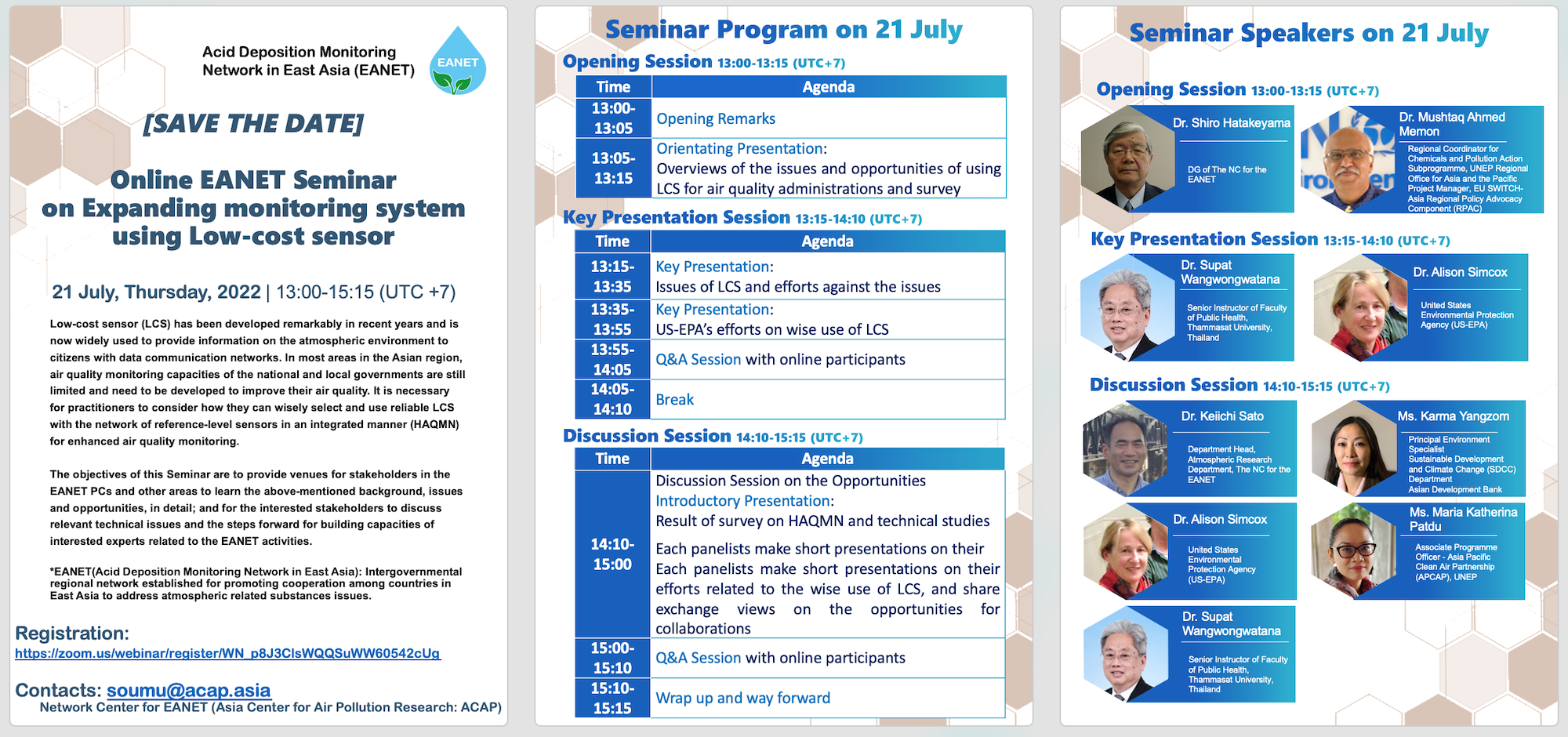
Low-cost Sensor (LCS) technology to measure air quality has expanded remarkably in recent years, and it is now widely used by the private sector. It provides information on the atmospheric environment to citizens through data communication networks.

Noticing the cost-effectiveness of LCS, international organizations have started to promote the use of LCS in selected areas to strengthen the capacity of governments where official air monitoring networks are insufficient. However, various surveys conducted by US-EPA, the EU, and others, as well as some experiences in the Asian region reveal that some types of LCSs in the market have problems with accuracy and reliability, while some types are reliable. It is observed that some less reliable LCS and improper use of LCS, including wrong interpretation of measured data, sometimes cause problems including unnecessary social confusion.

Air quality monitoring authorities, such as US-EPA, recommend that LCS is to be used for providing supplementary information for non-regulatory purposes. They recently developed testing protocols to evaluate the accuracy and reliability of LCS.

In most areas in the Asian region, air quality monitoring capacities of the national and local governments are still limited and need to be developed to improve their air quality to achieve SDGs. Considering emerging sub-regional-scale and serious seasonal air pollution events, such as PM2.5, building a network of reliable and internationally comparable air quality data becomes more important.

Thus, it is necessary for practitioners to consider how they can wisely select and use reliable LCS with the network of reference-level sensors in an integrated manner for enhanced air quality monitoring.

The EANET has been developing an air quality monitoring network in the East Asia region with governments and scientists from its 13 Participating Countries and assisting them to develop domestic capacity. The EANET is expanding its scope and seeking collaboration with potential partners. The EANET is conducting this activity considering the best use of reliable LCS for capacity building among its Participating Countries.

.

2. Objectives and Participants

The EANET will proceed with technical studies and capacity building on methods for collecting reliable air quality data with a concept of Hybrid Air Quality Monitoring Network (HAQMN) where highly reliable LCS and existing reference-level monitoring equipment are used in an integrated manner.

This concept and relevant work provide opportunities for EANET: (1) to strengthen its monitoring network, especially in expanding spatial coverage of the motoring of PM2.5 and ozone with high time resolution; and (2) to assist the Participating Countries of the EANET in developing their air quality monitoring network.

With such overarching goals, the objectives of this Seminar are to provide venues for stakeholders in the EANET Participating Countries and other areas to learn the above-mentioned background, issues, and opportunities of LCS in detail from the experiences of the air pollution monitoring experts.

Although this event is open to the public, the expected participants will be mainly representatives, experts, and practitioners of air quality monitoring from the EANET Participating Countries, non-Participating Countries, academia, and monitoring related service providers.

.

3. Agenda

.

Download the Concept Note and Programme here.

.

Download the Workshop’s presentations:

Issues of LCS and Efforts Against the Issues: Thailand’s Experiences (presented by Dr. Supat Wangwongwatana)

US-EPA’s efforts on wise use of LCS (presented by Dr. Alison Simcox)

Results of the survey on HAQMN and technical studies in some EANET Participating Countries (presented by Dr. Keiichi Sato)

Experience in using Low-Cost Sensors under ADB TA 9608 (presented by Ms. Karma Yangzom)

Air quality data challenges and opportunities in developing Asia (presented by Ms. Maria Katherina Patdu)

.

For further inquiries, contact the Network Center for the EANET.