The Network Center for the EANET releases the Data Report 2024


17 April 2026

(This post has been updated from the original post, published on 20 February 2025).

Composed of data collected in 2024, comprising atmospheric deposition and air pollution monitoring data endorsed by the Scientific Advisory Committee (SAC) end of 2025, the “Data Report 2024” and the “Report of the Inter-laboratory Comparison Project 2024” have been uploaded in open access on the EANET website.

.

What is EANET data?
Figure 1 – Location of acid deposition monitoring sites in 2019 (access the most recent sites’ information on the EANET Site Information page)

In the context of the resolution on promoting regional cooperation on air pollution to improve air quality globally, adopted in UNEA-6 in March 2024, the importance of referring to high-quality data for air quality management has never been greater.

Covering the area of 13 countries, from Irkutsk (Russia) in the North to Lombok (Indonesia) in the South, Ochiishi (Japan) in the East, and Mandalay (Myanmar) in the West, the EANET’s total surface is extremely wide and diverse.

Since 1998 (during the preparatory phase activities of the Network), the EANET has deployed monitoring stations in urban, rural, and remote locations to monitor atmospheric deposition and air pollution (in 2021, the EANET countries adopted an Annex defining monitored atmospheric environment-related substances). These monitoring sites gather high-quality data related to the deposition of major acidifying species and related chemical substances such as sulfate (SO42-), nitrate (NO3), hydrogen (H+) in precipitation, sulfur dioxide (SO2), nitrogen dioxide (NO2), ozone (O3), and particulate matter (PM) in ambient air.

Monitoring data are used to evaluate the state of atmospheric deposition and air pollution as well as their impacts on ecosystems. Data on the atmospheric wet deposition of acidic components and other relevant pollutants have for example been used to understand the impacts of pollution on forest ecosystems, such as for the study led by EANET scientists in the dry evergreen forest of Sakaerat, in Nakhon Ratchasima Province, in northeastern Thailand.

Monitoring activities carried out in 2024 are presented in the Data Report 2024 (published in December 2025) and available in open access online.

.

High-quality Data

Over the years, EANET scientists and monitoring officers have improved the collective knowledge and skills of the Network, among others on the quality assurance and quality control (QA/QC) of the data.

The Report of the Inter-laboratory Comparison Project is conducted each year among the EANET analytical laboratories, based on the quality assurance/quality control (QA/QC) programs of the Network. The objectives of this project are to recognize the analytical precision and accuracy of the measurement in each participating laboratory, to give further opportunities to improve the quality of the analysis and to improve the reliability of analytical data through the assessment of suitable analytical methods and techniques.

.

Why download EANET data?

EANET data is available for non-commercial use for scientists, researchers, students, mobile app developers, etc… and anyone who wishes to understand the state of acid deposition and air pollution in East Asia over the last two decades.

By widely sharing data, EANET aims to improve global knowledge on atmospheric deposition and air pollution, as well as provide collaboration opportunities to improve public health and ecosystems’ restoration. In 2024 and 2025, over 135 peer-reviewed papers were published using the network’s long-term monitoring datasets.

.

How to access EANET Data?

The “Data Report 2024” and the “Report of the Inter-laboratory Comparison Project 2024” are available in open access online, for non-commercial use only.

Users may also access customized data, such as hourly, weekly, and bi-weekly data on wet and dry deposition monitoring, by registering on the monitoring portal.

.

Download the “Data Report 2024” and the “Report of the Inter-laboratory Comparison Project 2024”

.

Photo credits: Monitoring sites map: all rights reserved to EANET; cover photo: Aerial view of trees during daytime by Luke Paris, (2019), free of copyrights.

The Network Center for the EANET releases the Data Report 2023

20 February 2025 – Niigata, Japan

(This post has been updated from the original post, published on 11 March 2024).

Composed of data collected in 2023, comprising acid deposition and air pollution monitoring data endorsed by the Scientific Advisory Committee (SAC) end of 2024, the “Data Report 2023” and the “Report of the Inter-laboratory Comparison Project 2023” have been uploaded in open access on the EANET website.

.

What is EANET data?
Figure 1 – Location of acid deposition monitoring sites in 2019 (access the most recent sites’ information on the EANET Site Information page)

In the context of the resolution on promoting regional cooperation on air pollution to improve air quality globally, adopted in UNEA-6 in March 2024, the importance of referring to high-quality data for air quality management has never been greater.

Covering, in 2024, the area of 13 countries, from Irkutsk (Russia) in the North to Lombok (Indonesia) in the South, Ochiishi (Japan) in the East, and Mandalay (Myanmar) in the West, the EANET’s total surface is extremely wide and diverse.

Since 1998 (during the preparatory phase activities of the Network), the EANET has deployed monitoring stations in urban, rural, and remote locations to monitor acid deposition and air pollution (in 2021, the EANET countries adopted an Annex defining monitored atmospheric environment-related substances). These monitoring sites gather high-quality data related to the deposition of major acidifying species and related chemical substances such as sulfate (SO42-), nitrate (NO3), hydrogen (H+) in precipitation, sulfur dioxide (SO2), nitrogen dioxide (NO2), ozone (O3), and particulate matter (PM) in ambient air.

Monitoring data are used to evaluate the state of acid deposition and air pollution as well as their impacts on ecosystems. Data on the atmospheric wet deposition of acidic components and other relevant pollutants have for example been used to understand the impacts of pollution on forest ecosystems, such as for the study led by EANET scientists in the dry evergreen forest of Sakaerat, in Nakhon Ratchasima Province, in northeastern Thailand.

Monitoring activities carried out in 2023 are presented in the Data Report 2023 (published in December 2024) and available in open access online.

.

High-quality Data

Over the years, EANET scientists and monitoring officers have improved the collective knowledge and skills of the Network, among others on the quality assurance and quality control (QA/QC) of the data.

The Report of the Inter-laboratory Comparison Project is conducted each year among the EANET analytical laboratories, based on the quality assurance/quality control (QA/QC) programs of the Network. The objectives of this project are to recognize the analytical precision and accuracy of the measurement in each participating laboratory, to give further opportunities to improve the quality of the analysis and to improve the reliability of analytical data through the assessment of suitable analytical methods and techniques.

.

Why download EANET data?

EANET data is available for non-commercial use for scientists, researchers, students, mobile app developers, etc… and anyone who wishes to understand the state of acid deposition and air pollution in East Asia over the last two decades.

By widely sharing data, EANET aims to improve global knowledge on acid deposition and air pollution, as well as provide collaboration opportunities to improve public health and ecosystems’ restoration.

.

How to access EANET Data?

The “Data Report 2023” and the “Report of the Inter-laboratory Comparison Project 2023” are available in open access online, for non-commercial use only.

Users may also access customized data, such as hourly, weekly, and bi-weekly data on wet and dry deposition monitoring, by registering on the monitoring portal.

.

Download the “Data Report 2023” and the “Report of the Inter-laboratory Comparison Project 2023”

.

Photo credits: Monitoring sites map: all rights reserved to EANET; cover photo: Cloud fall in Japan by S. Tsuchiya, (2023), free of copyrights.

The Network Center for the EANET releases the Data Report 2022

Data Report

11 March 2024 – Niigata, Japan

(This post has been updated from the original post, published on 21 February 2023).

Composed of data collected in 2022, comprising acid deposition and air pollution monitoring data endorsed by the Scientific Advisory Committee (SAC) end of 2023, the “Data Report 2022” and the “Report of the Inter-laboratory Comparison Project 2022” have been uploaded in open access on the EANET website.

.

What is EANET data?
Figure 1 – Location of acid deposition monitoring sites in 2019 (access the most recent sites’ information on the EANET Site Information page)

In the context of the resolution on promoting regional cooperation on air pollution to improve air quality globally, adopted in UNEA-6 in March 2024, the importance of referring to high-quality data for air quality management has never been greater.

Covering, in 2024, the area of 13 countries, from Irkutsk (Russia) in the North to Lombok (Indonesia) in the South, Ochiishi (Japan) in the East, and Mandalay (Myanmar) in the West, the EANET’s total surface is extremely wide and diverse.

Since 1998 (during the preparatory phase activities of the Network), the EANET has deployed monitoring stations in urban, rural, and remote locations to monitor acid deposition and air pollution (in 2021, the EANET countries adopted an Annex defining monitored atmospheric environment-related substances). These monitoring sites gather high-quality data related to the deposition of major acidifying species and related chemical substances such as sulfate (SO42-), nitrate (NO3), hydrogen (H+) in precipitation, sulfur dioxide (SO2), nitrogen dioxide (NO2), ozone (O3), and particulate matter (PM) in ambient air.

Monitoring data are used to evaluate the state of acid deposition and air pollution as well as their impacts on ecosystems. Data on the atmospheric wet deposition of acidic components and other relevant pollutants have for example been used to understand the impacts of pollution on forest ecosystems, such as for the study led by EANET scientists in the dry evergreen forest of Sakaerat, in Nakhon Ratchasima Province, in northeastern Thailand.

Monitoring activities carried out in 2021 are presented in the Data Report 2022 (published in December 2023) and available in open access online.

.

High-quality Data

Over the years, EANET scientists and monitoring officers have improved the collective knowledge and skills of the Network, among others on the quality assurance and quality control (QA/QC) of the data.

The Report of the Inter-laboratory Comparison Project is conducted each year among the EANET analytical laboratories, based on the quality assurance/quality control (QA/QC) programs of the Network. The objectives of this project are to recognize the analytical precision and accuracy of the measurement in each participating laboratory, to give further opportunities to improve the quality of the analysis, and to improve the reliability of analytical data through the assessment of suitable analytical methods and techniques.

.

Why download EANET data?

EANET data is available for non-commercial use for scientists, researchers, students, mobile app developers, etc… and anyone who wishes to understand the state of acid deposition and air pollution in East Asia over the last two decades.

By widely sharing data, EANET aims to improve the global knowledge on acid deposition, as well as to provide collaboration opportunities to improve public health and ecosystems’ restoration.

.

How to access EANET Data?

The “Data Report 2022” and the “Report of the Inter-laboratory Comparison Project 2022” are available in open access online, for non-commercial use only.

Users may also access customized data, such as hourly, weekly, and bi-weekly data on wet and dry deposition monitoring, by registering on the monitoring portal.

.

Download the “Data Report 2022” and the “Report of the Inter-laboratory Comparison Project 2022”

.

Photo credits: Monitoring sites map: all rights reserved to EANET; cover photo: lake during golden hour by Hendra Yudha Pratama, (2018), free of copyrights.

The Network Center for the EANET releases the Data Report 2021

21 February 2023 – Niigata, Japan

(This post has been updated from the original post, published on 25 March 2022).

Composed of acid deposition monitoring data gathered in 2021 and endorsed by the Scientific Advisory Committee (SAC) in 2022, the “Data Report 2021” and the “Report of the Inter-laboratory Comparison Project 2021” have been uploaded in open access on EANET website.

.

What are EANET data?
Figure 1 – Location of acid deposition monitoring sites in 2019 (access the most recent sites’ information on the EANET Site Information page)

In the context of the recent adoption in March 2022 by governments at UNEA-5.2 of a key resolution supporting the establishment of a comprehensive science policy panel on the sound management of chemicals and waste and preventing pollution, the importance of referring to high-quality data has never been greater.

Covering in 2022 the area of 13 countries, from Irkutsk (Russia) in the North to Lombok (Indonesia) in the South, Ochiishi (Japan) in the East, and Mandalay (Myanmar) in the West, the Acid Deposition Monitoring Network in East Asia (EANET)’s total surface is extremely wide and diverse.

Since 1998 (during the preparatory phase activities of the Network), the EANET has deployed monitoring stations in urban, rural, and remote locations to monitor acid deposition. These monitoring sites gather high-quality data related to the deposition of major acidifying species and related chemical substances such as sulfate (SO₄²⁻), nitrate (NO₃⁻), hydrogen (H+) in precipitation, sulfur dioxide (SO₂), nitrogen dioxide (NO₂), ozone (O₃), and particulate matter (PM) in ambient air.

Monitoring data are used to evaluate the state of acid deposition as well as impacts on ecosystems. Data on the atmospheric wet deposition of acidic components and other relevant pollutants have for example been used to understand the impacts of pollution on forest ecosystems, such as for the study led by EANET scientists in the dry evergreen forest of Sakaerat, in Nakhon Ratchasima Province, in northeastern Thailand.

Monitoring activities carried out in 2021 are presented in the Data Report 2021 (published in December 2022) and available in open access online.

.

High-quality Data

Over the years, EANET scientists and monitoring officers have improved the collective knowledge and skills of the Network, among others on the quality assurance and quality control (QA/QC) of the data.

The Report of the Inter-laboratory Comparison Project is conducted each year among the EANET analytical laboratories, based on the quality assurance/quality control (QA/QC) programs of the Network. The objectives of this project are to recognize the analytical precision and accuracy of the measurement in each participating laboratory, to give further opportunities to improve the quality of the analysis, and to improve the reliability of analytical data through the assessment of suitable analytical methods and techniques.

.

Why download EANET data?

EANET data is available for non-commercial use for scientists, researchers, students, mobile app developers, etc… and anyone who wishes to understand the state of acid deposition and air pollution in East Asia over the last two decades.

By widely sharing data, EANET aims at improving the global knowledge on acid deposition, as well as providing collaboration opportunities to improve public health and ecosystems’ restoration.

.

How to access EANET Data?

The “Data Report 2021” and the “Report of the Inter-laboratory Comparison Project 2021” are available in open access online, for non-commercial use only.

Users may also access customized data, such as hourly, weekly, and bi-weekly data on wet and dry deposition monitoring, by registering on the monitoring portal.

.

Download the “Data Report 2021” and the “Report of the Inter-laboratory Comparison Project 2021”

.

Photo credits: Monitoring sites map: all rights reserved to EANET; cover photo: Cloud fall in Japan by S. Tsuchiya, (2023), free of copyrights.

The EANET Science & Policy Dialogue in 2021

9 December 2021 – Bangkok, Thailand

The EANET Science & Policy Dialogue online event took place on Friday 26th of November 2021, alongside the EANET’s 20th Anniversary celebration,  gathering over one hundred participants from 30 countries to discuss better air quality for all.

.

The Science & Policy Dialogue Opening and Keynote Sessions

The Science & Policy Dialogue online event followed the 20th Anniversary celebrations. It was inaugurated by Mr. Koki Azuma, Counsellor for Transboundary Pollution Analysis, General Affairs Division, Environmental Management Bureau, the Ministry of the Environment, Japan.

Dr. Hajime Akimoto, Guest Scientist at the National Institute for Environmental Studies, Japan, and also former Director-General of the Asia Center for Air Pollution Research (ACAP) presented the first Keynote Speech entitled: “Progress of Improvement, Challenges, and the Way forward on Air pollution Management in East Asia”. Dr. Markus Amann, Scientist from the Asia Pacific Clean Air Partnership (APCAP) Science Panel, and former Program Director at the International Institute for Applied Systems Analysis (IIASA), then presented the second Keynote Speech: “Bringing Science and Policy in Tackling Air Pollution: Lessons Learned from Europe and Asia”.

.

.

Bridging Science and Policy: The perspective of Future Cooperation on Air Pollution in the Region, the Panel Discussion

The Science & Policy Dialogue continued with a Panel Discussion regrouping experts gathered to discuss: “Bridging Science and Policy: The perspective of Future Cooperation on Air Pollution in the Region”.

Dr. Fan Meng, Deputy Director General, Asia Center for Air Pollution Research (ACAP); Prof. Young Sunwoo, Director General of the International Union of Air Pollution Prevention and Environmental Protection Associations (IUAPPA); Dr. Supat Wangwongwatana, Senior Instructor of the Faculty of Public Health, Thammasat University, Thailand; Mr. Bjarne Pedersen, Executive Director, Clean Air Asia; Dr. Qingfeng Zhang, Chief of the Rural Development and Food Security Thematic Group, and OIC/Chief of the Environment Thematic Group at the Asian Development Bank (ADB); Dr. Markus Amann, Scientist, Asia Pacific Clean Air Partnership (APCAP) Science Panel and Dr. Hajime Akimoto, Guest Scientist, National Institute for Environmental Studies, Japan (NIES) joined this discussion.

Key discussion points included the importance of sound science-based information for policymakers, the necessity of improving communication among actors, as part of systemic approaches and in line with available funding strategies. The EANET’s strengths, including the Network’s longevity and its large number of Participating Countries, were also noted, highlighting its great opportunities for future wider collaborations at regional and international levels.

 
Useful Resources

Download the two Keynote presentations:

Read a more detailed summary of the events’ content in the EANET 20th Anniversary of the EANET and the Science & Policy Dialogue Event Report

View all the event’s videos on the Secretariat for the EANET’s YouTube channel and photos on Flickr.

.

Photo credits: All rights reserved to EANET.

The 20th Anniversary of the EANET

9 December 2021 – Bangkok, Thailand

The EANET 20th Anniversary celebration was organized online, alongside the Science & Policy Dialogue, on Friday 26th of November 2021, gathering over one hundred participants from 30 countries, to discuss better air quality for all.

.

The EANET’s 20th Anniversary Opening Ceremony

Established in 2001 as an intergovernmental network to create a common understanding on the status of acid deposition in East Asia, the Acid Deposition Monitoring Network in East Asia (EANET) celebrated in 2021 its twenty years of successful inter-regional cooperation and activities.

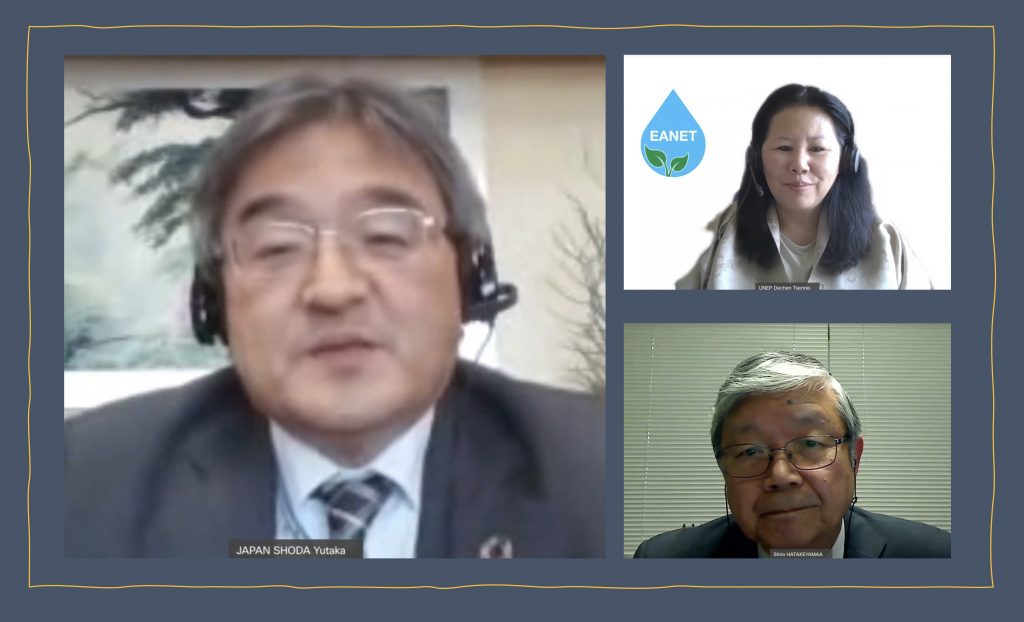
The EANET’s 20th Anniversary celebration was hosted by the Ministry of the Environment, Japan, and H.E. Mr. Yutaka Shoda, the Vice-Minister from the Ministry of the Environment, Japan, opened the celebrations by delivering the Opening Remarks.

.

.

Dr. Dechen Tsering, Regional Director and Representative, UN Environment Programme for Asia and the Pacific shared the event’s Welcome Remarks, followed by Congratulatory Remarks from the EANET National Focal Points from Malaysia, Thailand, and China. These were shared by Mr. Jamalulail bin Abu Bakar, Undersecretary, Environmental Management Division, Ministry of Environment and Water, Malaysia; Ms. Siwaporn Rungsiyanon, Director of the Transboundary Air Pollution Subdivision, Air Quality and Noise Management Division, Pollution Control Department, Ministry of Natural Resources and Environment, Thailand and by Mr. Zhou Jun, Director, Division of Asian, African and Latin American Affairs, Department of International Cooperation, Ministry of Ecology and Environment, China.

.

The Launch of the Summary of the Twentieth Anniversary of the EANET

To close the celebrations, Mr. Mohan Kumar Sammathuria, Principal Assistant Director of the Atmospheric Sciences, and Cloud Seeding Division, Malaysian Meteorological Department, Ministry of Environment and Water, Malaysia, and the Chairperson of the EANET Scientific Advisory Committee for 2021-2023, presented the newly launched publication “Summary of the Twentieth Anniversary of the EANET“.

The Summary of the Twentieth Anniversary of the EANET has been prepared based on the data accumulated in the past twenty years of activity of the EANET. It aims at providing a common understanding of the status of acid deposition in East Asia in an easily understandable manner. In addition, it may serve as a guidance document for policymakers, students, civil society, and various organizations that may become EANET partners soon.

.

Useful Resources

.

.


.

Photo credits: All rights reserved to EANET.

The EANET Emission Inventory Workshop in 2021

19 October 2021 – Bangkok, Thailand

The Asia Center for Air Pollution Research (ACAP), the Network Center (NC) for the EANET, organized the EANET Emission Inventory Workshop on 18 October 2021, gathering over 50 participants from 9 countries, to develop regional air quality management skills.

.

Why are emission inventories important?

To tackle atmospheric environment problems, it is essential to understand the status of air pollutants’ emissions and consider mitigation measures’ effectiveness. The emission inventory is an essential tool to obtain such information and to build appropriate atmospheric environmental policies.

.

Figure 1 – extract from the Emission Inventory Workshop presentation introduction slides

.

Building Capacity at a Regional Level

The objectives of the EANET Emission Inventory Workshop were to understand the role of an emission inventory in air quality management, obtain general information on an emission inventory, and learn basic knowledge on the development and application of an emission inventory.

For this purpose, invited experts provided five lecture presentations on developing and applying an emission inventory. Furthermore, the participants, selected by the National Focal Points (NFPs) of each EANET Participating Country, delivered short presentations about issues related to national emission inventories in their countries.

.

Figure 2 – Presentation of the lectures that took place during the Emission Inventory Workshop, (including experts from the Japan Automobile Research Institute (JARI), the National Institute for Environmental Studies, Japan (NIES), and the King Mongkut’s University of Technology Thonburi (KMUTT)).

.

Through discussions among lecturers and participants, the event aimed to enhance participants’ knowledge and encourage the development of national emission inventories.

.

Ways Forward

In conclusion, participants emphasized the usefulness of such capacity-building activities and noted that it could be interesting, in the future, to focus the workshop’s content on regional specificities.

Participants also highlighted that both technical (such as providing guidelines) and financial aspects are necessary for conducting emission inventory activities. Taking these observations into account, it may be interesting to focus EANET’s future activities on this demand.

Furthermore, the participants pointed out the benefits of sharing emission inventories throughout the EANET region to better understand the atmospheric environment issues and compare methodologies, including emission factors.

.

Find out more about technical capacity building by contacting the Network Center.

.

Download the Workshop’s outline and key presentations.

.

Photo credits: All rights reserved to the EANET.

EANET Individual Training in 2021

19 January 2022 – Niigata, Japan

The EANET Individual Training in 2021 was successfully organized online by the Network Center, from 4th to 19th November 2021, and included the participation of China, through the presentation of two virtual lectures. It aimed at providing participants from the EANET Participating Countries with technical support and capacity building on acid deposition monitoring. 

 .

Virtual Individual Training in 2021

Individual Training is a regular activity conducted yearly by the Network Center for the EANET (NC) which aims at improving the various monitoring skills of Participating Countries’ representatives. Individual Training sessions are usually conducted at the Network Center in Niigata, Japan, and tentatively planned for five or six trainees from the Participating Countries.

This year, due to COVID-19 related travel restrictions, the EANET Individual Training in 2021 was held via an online platform. It gathered 14 trainees from 7 EANET Participating Countries (namely from Indonesia, Lao PDR, Malaysia, Myanmar, the Philippines, Thailand, and Viet Nam). Furthermore, in total, approximately 50 observers from the EANET Participating Countries took part in the program.

 .

Improving Regional Monitoring Capabilities

During the Training, Scientists from the Network Center’s Planning and Training, Atmospheric Research, Ecological Impact Research, and Data Management Departments, delivered daily lectures. The main topics covered, among others, included the ecological effects of atmospheric deposition and EANET monitoring methods, automatic monitor maintenance, Quality Assurance, and Quality Control (QA/QC) activities, and data reporting procedures.

On the 17th of November, lectures were presented by Ms. Wang Xiaofei, from the China National Environmental Monitoring Centre, and by Mr. Li Jie, from the Institute of Atmospheric Physics, Chinese Academy of Sciences, on China’s Atmospheric Air Monitoring, and on the Development of an Atmospheric Environment Forecasting System and MICS-ASIA III Program, respectively.

Through this training, participants have deepened their knowledge of laboratory work, data evaluation, and reporting.

.

Interested in finding out more? Contact the Network Center for the EANET.

.

Photo Credit: All rights reserved to the EANET. 

The Twenty-first Session of the Scientific Advisory Committee on the Acid Deposition Monitoring Network in East Asia

29 October 2021 – Bangkok, Thailand

The Scientific Advisory Committee (SAC) of the Acid Deposition Monitoring Network in East Asia (EANET) held its Twenty-first Session of the SAC (SAC21) Meeting from 26-28 October 2021, to discuss acid deposition monitoring data provided in 2020.

 .

Reporting on Acid Deposition Monitoring in 2020

The Session was organized virtually by the Secretariat and the Network Center (NC) for the EANET. Over 60 members of the SAC and/or their representatives from the Participating Countries of the EANET joined the meeting.

Scientists from the NC presented the results from activities of acid deposition monitoring, based on data provided by the EANET Participating Countries and retrieved from their national monitoring sites for 2020.

The Draft EANET Data Report 2020 was presented to the Session, showcasing different results and trends in the region since 2000. In addition, the Draft Report on the Inter-laboratory Comparison (ILC) Projects 2020 was also introduced, and it showed that most samples submitted by the participating laboratories met the Data Quality Objective (DQO) of EANET.

.

Scientists from the EANET Network Center presenting several acid deposition monitoring data reports

.

Discussing EANET’s Future Activities for 2021-2025

The NC presented an overview of the National Monitoring Plans of the Participating Countries for 2021, based on the submissions made during the recent Twenty-second Senior Technical Managers’ Meeting (STM22) on the EANET.

As part of the ongoing process of expansion of the scope of the EANET, as decided by the IG22, the SAC21 members were also invited to share their comments, from the scientific viewpoint, on the draft Annex to the EANET Instrument, for consideration and approval at the IG23 of EANET, in November 2021.

.

Some participants during the SAC21 virtual meeting

.

Other important administrative documents and publications such as the Summary of the 20th Anniversary of the EANET and the Draft Fourth Periodic Report on the State of Acid Deposition in East Asia (PRSAD4) were also discussed during the SAC21.

.

EANET Data Reports can be accessed on EANET’s website and 2020 data will be available soon.

.

Photo credits: All rights reserved to EANET.

The Twenty-third Session of the Intergovernmental Meeting on the Acid Deposition Monitoring Network in East Asia

30 November 2021 – Bangkok, Thailand

The Twenty-third Session of the Intergovernmental Meeting on the Acid Deposition Monitoring Network in East Asia (IG23) took place from 24 to 25 November 2021, virtually, and gathered over 70 representatives of the EANET Participating Countries, Secretariat, and Network Center for the EANET, to make important decisions on the expansion of the scope of the EANET, among other topics.

.

The IG23 Meeting

Chaired by Japan and co-chaired by Malaysia and Viet Nam, the IG23 started with the Opening Remarks from H.E. Mr. Yutaka Shoda, Vice-Minister, Ministry of the Environment, Japan, followed by Opening Remarks by Dr. Dechen Tsering, Regional Director, United Nations Environment Programme for Asia & the Pacific, and by Dr. Shiro Hatakeyama, Director General, Asia Center for Air Pollution Research.

.

Welcome and Opening Remarks delivered during the IG23 meeting.

.

Historical Decisions on the Expansion of the Scope of the EANET

Following the decision of the Twenty-second  Session of the Intergovernmental Meeting (IG22), held in November 2020, the EANET Participating Countries’ representatives have been working relentlessly on the process to expand the scope of the EANET, from acid deposition to also include a wider scope of atmospheric environment-related substances.

This historical progress required the EANET to develop a text supplementary document to the EANET Instrument, to define the scope of expansion and the target substances to be included in the EANET activities. In a landmark decision, 20 years after the creation of the Network, the IG23 has adopted the text of the Supplementary Document (Annex) to the Instrument for Strengthening the Acid Deposition Monitoring Network in East Asia.

.

Discussions among participants during the virtual IG23 meeting.

.

The EANET Project Fund and Project Guideline, a new financial mechanism allowing EANET to build co-financed projects with partners in the region and beyond, has also been approved by the IG23.

.

Ways Forward

In addition to these major decisions, the IG23 has also approved several important documents, including the Work Program and Budget of the EANET in 2022, and the Summary of the Twentieth Anniversary of the EANET publication, a new outreach document detailing the EANET’s past achievements and future opportunities.

As an important way forward for 2022, the EANET Participating Countries and partner organizations will be invited to start preparing and submitting project proposals for the pilot implementation of new EANET projects, in line with the EANET Project Guideline.

.

Read the IG23’s Report of the Session (including the Decisions of IG23 in Annex 2), and discover the virtual meeting’s pictures on Flickr.

.

Photos credits: all rights reserved to EANET.