EANET Seminar on Expanding Monitoring Systems using Low-Cost Sensor (LCS) – Join us on July 21st!

.

The registration is now closed.

.

1. Background

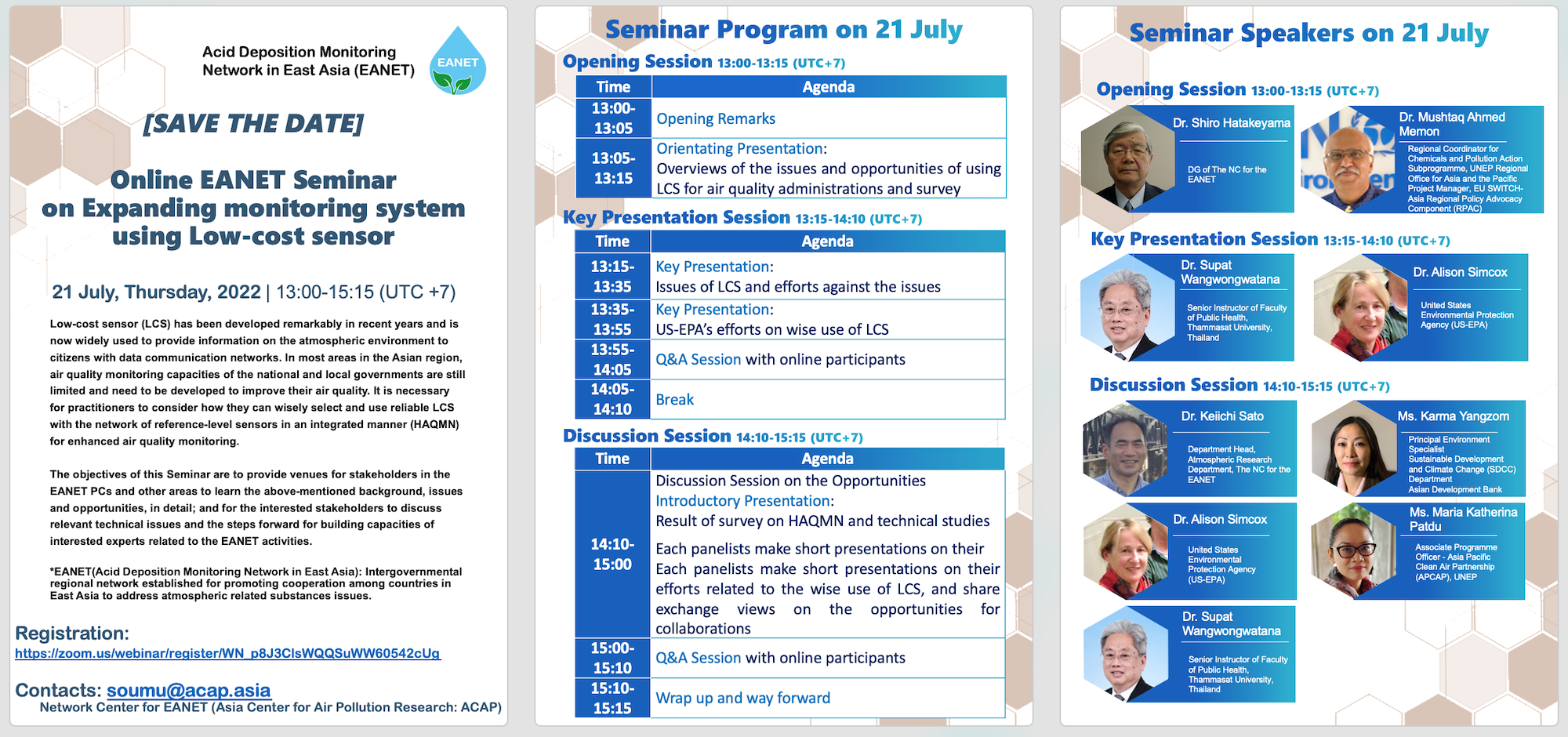
Low-cost Sensor (LCS) technology to measure air quality has expanded remarkably in recent years, and it is now widely used by the private sector. It provides information on the atmospheric environment to citizens through data communication networks.

Noticing the cost-effectiveness of LCS, international organizations have started to promote the use of LCS in selected areas to strengthen the capacity of governments where official air monitoring networks are insufficient. However, various surveys conducted by US-EPA, the EU, and others, as well as some experiences in the Asian region reveal that some types of LCSs in the market have problems with accuracy and reliability, while some types are reliable. It is observed that some less reliable LCS and improper use of LCS, including wrong interpretation of measured data, sometimes cause problems including unnecessary social confusion.

Air quality monitoring authorities, such as US-EPA, recommend that LCS is to be used for providing supplementary information for non-regulatory purposes. They recently developed testing protocols to evaluate the accuracy and reliability of LCS.

In most areas in the Asian region, air quality monitoring capacities of the national and local governments are still limited and need to be developed to improve their air quality to achieve SDGs. Considering emerging sub-regional-scale and serious seasonal air pollution events, such as PM2.5, building a network of reliable and internationally comparable air quality data becomes more important.

Thus, it is necessary for practitioners to consider how they can wisely select and use reliable LCS with the network of reference-level sensors in an integrated manner for enhanced air quality monitoring.

The EANET has been developing an air quality monitoring network in the East Asia region with governments and scientists from its 13 Participating Countries and assisting them to develop domestic capacity. The EANET is expanding its scope and seeking collaboration with potential partners. The EANET is conducting this activity considering the best use of reliable LCS for capacity building among its Participating Countries.

.

2. Objectives and Participants

The EANET will proceed with technical studies and capacity building on methods for collecting reliable air quality data with a concept of Hybrid Air Quality Monitoring Network (HAQMN) where highly reliable LCS and existing reference-level monitoring equipment are used in an integrated manner.

This concept and relevant work provide opportunities for EANET: (1) to strengthen its monitoring network, especially in expanding spatial coverage of the motoring of PM2.5 and ozone with high time resolution; and (2) to assist the Participating Countries of the EANET in developing their air quality monitoring network.

With such overarching goals, the objectives of this Seminar are to provide venues for stakeholders in the EANET Participating Countries and other areas to learn the above-mentioned background, issues, and opportunities of LCS in detail from the experiences of the air pollution monitoring experts.

Although this event is open to the public, the expected participants will be mainly representatives, experts, and practitioners of air quality monitoring from the EANET Participating Countries, non-Participating Countries, academia, and monitoring related service providers.

.

3. Agenda

.

Download the Concept Note and Programme here.

.

Download the Workshop’s presentations:

Issues of LCS and Efforts Against the Issues: Thailand’s Experiences (presented by Dr. Supat Wangwongwatana)

US-EPA’s efforts on wise use of LCS (presented by Dr. Alison Simcox)

Results of the survey on HAQMN and technical studies in some EANET Participating Countries (presented by Dr. Keiichi Sato)

Experience in using Low-Cost Sensors under ADB TA 9608 (presented by Ms. Karma Yangzom)

Air quality data challenges and opportunities in developing Asia (presented by Ms. Maria Katherina Patdu)

.

For further inquiries, contact the Network Center for the EANET.

Next-Generation Air Quality Monitoring: Technologies, Communities, and Governance for Clean Air – Join us on November 26th!

.

Background

The Acid Deposition Monitoring Network in East Asia (EANET) was established in 2001 as a regional intergovernmental network to promote cooperation among countries in East Asia to address acid deposition problems. In 2021, at the Twenty-Second Session of the Intergovernmental Meeting (IG22), the 13 Participating Countries of the EANET agreed to expand its scope to address wider air pollution problems and launched the EANET Project Fund to encourage cooperation with partners outside of its network.

In the last 20 years, the EANET has made excellent progress in acid deposition monitoring cooperation, including on particulate matter, sulfur dioxide, nitrogen dioxide, and ozone. The Network has fostered a regional monitoring network and scientific exchange platforms which have contributed to solving acid deposition and air pollution problems in East Asia.

In November 2024, the Twenty-sixth Intergovernmental Meeting (IG26) on the EANET approved the Work Programme and Budget of the EANET Core Activities in 2025, including Activity 10: Promotion of public awareness on acid deposition, including other priority chemical species, etc.

In this respect, and in line with the efforts to facilitate the sharing of a common understanding on air quality issues, the EANET Regional Awareness Workshop in 2025: “Next-Generation Air Quality Monitoring: Technologies, Communities, and Governance for Clean Air”  will be organized on Wednesday 26 November in Bangkok , Thailand, and in a hybrid format as part of UNEP’s Clean Air Week 2025, from 24-28 November 2028, at the Sukosol Hotel in Bangkok, Thailand.

.

Short Description

Air pollution remains the single largest environmental health risk worldwide, with Asia experiencing the most severe impacts. Effective air quality management requires robust, reliable, and inclusive monitoring systems that integrate scientific innovation, community participation, and policy action. While governments and research institutions have traditionally relied on reference-grade monitoring, new technologies—including low-cost sensors, satellite monitoring, artificial intelligence (AI), and open-source toolkits—are reshaping the landscape of air quality management.

.

Objective and Participants

This session explores how innovative approaches are enabling more accessible, hyperlocal, and transparent data generation and governance. It brings together leading experts, civil society, academia to share lessons from on-the-ground experiences, advanced modelling approaches, community-led initiatives, and legal innovations such as the Pollution Release and Transfer Register (PRTR) bill in Thailand.

The discussion will focus on:

  • Pathways to integrate innovative monitoring into governance frameworks for cleaner air
  • How new technologies and open-source tools can strengthen monitoring and data transparency.
  • The role of numerical models, AI, and satellite data in supporting decision-making at the local, national and regional scale.
  • How community engagement and right-to-know legislation can empower citizens.

Expected in-person and online participants will include the EANET National Focal Points, Scientific Advisory Committee members, and other EANET members and partners, including policymakers, national researchers, and scientists. It will also welcome representatives of partner organizations working on related issues, as well as participants joining the Clean Air Week.

.

Tentative Agenda

.

Contact

.

Joint workshop on Air Pollution Policy Based on PM2.5 Source Information – Join us on June 12th!

1. Background

PM2.5 pollution remains a critical environmental and public health challenge in East Asia due to its complex origins, including biomass burning, urban transportation emissions, and secondary aerosol formation. The high PM2.5 concentrations have significant health impacts and contribute to transboundary air pollution, making regional cooperation essential.

While many East Asian countries have made progress in establishing PM2.5 mass concentration monitoring networks, capacities related to PM2.5 chemical component analysis, PM2.5 source apportionment, and the effective use of PM2.5 source information for policy development remain limited. Moreover. Insufficient technical expertise, human resources, and consistent data availability continue to hinder evidence-based air quality management.

The EANET Project in 2026 (EANET 2026-06) aims to promote the standardization of PM2.5 chemical composition measurements and source apportionment methodologies using receptor models, as well as to strengthen capacities of PM2.5 chemical analysis and source apportionment in East Asia. This joint workshop is positioned as an initial step within the project framework, serving as a platform for identifying regional needs, sharing existing knowledge, and exploring pathways to connect scientific findings with air pollution policy.

This workshop will provide opportunities to share experiences and lessons learned from the ongoing SATREPS project (Air-SATREPS), as well as other PM2.5 source apportionment studies conducted in the East Asian region. Through the knowledge and experience exchange, the workshop seeks to enhance synergy and mutual complementarity between Air-SATREPS activities and EANET initiatives.

 .

2. Objectives

✓ To review the current status, challenges, and needs related to PM2.5 chemical composition measurement and PM2.5 source apportionment in East Asian countries;

✓ To discuss PM2.5 analysis approaches that are feasible under limited financial and human resources, including the use of low-cost sensors (LCS) and simplified analytical techniques;

✓ To share perspectives on capacity building, methodological standardization, and pathways for policy application of PM2.5 source apportionment, based on experiences from SATREPS and other related research projects.

.

3. Concept Note, Agenda, and Speakers

Download the concept note and program here.

.

For further inquiries, contact the Network Center for the EANET


Sustainable Nitrogen Management Seminar 2025 – Join us on 22 December!

1. Background

Reactive nitrogen (Nr), including ammonia (NH3) and nitrogen oxides (NOx), has been produced by anthropogenic activities. Release of Nr to the environment is thought to pose substantial threats to human and ecosystem health. Therefore, to achieve sustainable nitrogen utilization, it is necessary to reduce Nr loss to the environment (Hayashi et al. 2021, Environmental Pollution).

To tackle the above issue, the resolution “Sustainable Nitrogen Management (UNEA 5.2),” which was adopted at the Fifth Session of the United Nations Environment Assembly, encouraged countries to develop national action plans for sustainable nitrogen management and to accelerate actions to significantly reduce nitrogen waste globally by 2030 and beyond.

NOx from fuel/waste combustion are precursors of photochemical oxidants and PM2.5, with adverse effects on human health and terrestrial ecosystems. NH3 emitted into the atmosphere from agricultural activities also contributes to the formation of PM (e.g., NH4NO3, (NH4)2SO4). Excessive nitrogen input from the atmosphere has adverse effects on terrestrial ecosystems and inland waters, including acidification and eutrophication (Yamashita et al. 2022, Science of the Total Environment). Thus, the Nr problem is also an atmospheric environmental problem.

EANET has been monitoring atmospheric deposition of these Nr species, because they are also important as acid deposition. EANET has the potential to contribute to the understanding of nitrogen flows from the atmosphere to ecosystems and to the discussion on sustainable nitrogen management.

 .

2. Objectives

This seminar aims to foster a shared understanding of sustainable nitrogen management within the EANET community and to facilitate discussions on how EANET data can contribute to addressing global nitrogen challenges, as well as identifying which aspects of EANET’s monitoring activities should be prioritized to support this goal.

.

3. Concept Note, Agenda, and Speakers

Download the concept note and program here.

.

For further inquiries, contact the Network Center for the EANET


EANET Seminar – Utilizing Satellite Monitoring including access to Dust and Sand Storm: Join us on December 12th!

1. Background

Satellite observation of air pollutants, including acidifying substances, has become an increasingly important tool for air quality monitoring. Compared with ground-based systems that are often spatially limited, satellite instruments provide near-real-time, consistent coverage over large areas and help identify the sources, transport, and meteorological influences on air pollution. Such data also contributes to understanding the links between air quality, climate change, and policy needs.

In East Asia, the Republic of Korea has played a leading role through the Geostationary Environment Monitoring Spectrometer (GEMS), launched in 2019, which measures NO2, O, SO₂, and Aerosol Optical Depth (AOD) hourly across the region. The Pan-Asia Partnership for Geospatial Air Quality information (PAPGAPi) Project, initiated in 2020 by the National Institute of Environmental Research (NIER) under the Ministry of Environment of the Republic of Korea, with support from the Korea International Cooperation Agency (KOICA) and the United Nations Economic and Social Commission for Asia and the Pacific (UNESCAP), involves 13 Asian countries to share GEMS data and strengthen regional capacity. Japan is also advancing satellite observation with the Global Observing SATellite for Greenhouse gases and Water cycle (GOSAT-GW), the third in the GOSAT series following GOSAT (2009) and GOSAT-2 (2018), was launched in June 2025.

GOSAT-GW carries two instruments—Total Anthropogenic and Natural emissions mapping SpectrOmeter-3 (TANSO-3) and Advanced Microwave Scanning Radiometer-3 (AMSR3). The TANSO-3 sensor was developed and operated by the Ministry of the Environment; Japan (MOEJ), the National Institute for Environmental Studies (NIES), and the Japan Aerospace Exploration Agency (JAXA). Given the challenges of monitoring wide-area phenomena such as Dust and Sand Storms (DSS) in Northeast Asia and haze in Southeast Asia, satellite technology offers a highly effective approach. For EANET Participating Countries, enhanced understanding of space-based observations will help integrate these technologies with ground-level and low-cost sensor monitoring, strengthening collaborative efforts to assess and manage air quality in the region.

 .

2. Objectives
  • To discuss and make recommendations, if possible, on the possibility of future collaboration with organizations related to satellite monitoring
  • To discuss the applications of satellite monitoring for such problems as DSS.
  • To obtain scientific knowledge on the relationships between satellite monitoring and ground-level monitoring.

.

3. Expected participants
  • Government officials, such as representatives for the Intergovernmental Meetings and Working Groups in the EANET, other relevant officials, etc.
  • EANET-related scientists, such as the Scientific Advisory Committee members, Task Force members, other relevant scientists, etc.
  • Resource persons, including invited speakers from other regional networks and international organizations

.

4. Concept Note, Agenda, and Speakers

Download the concept note and program here.

.

5. Speakers (in order of appearance)


Prof. Meng Fan

Meng Fan, Ph.D, Deputy Director General in charge of the Network Center for EANET, Asia Center for Air Pollution Research (ACAP). Previously, he held the position in Chinese Academy of Environmental Sciences (CRAES) including deputy chief engineer and director of the Institute of Atmospheric Environment. He has been conducting research in the field of air quality modeling, atmospheric chemistry, air pollution control policy and synergistic control of air pollution and climate change. He has been leading the project of PM2.5 source apportionment for 2+26 cities of Beijng-Tianjin-Hebei and surrounding region, Regulatory Air Quality Modeling System Development and LTP project Chinese group and other international cooperation research projects. He has been published as author and co-author of over 80 papers in scientific journals. He has been adjunct professor and doctoral supervisor of Beijing Normal University and Tongji University of China.

.

Ms. Yujeong Kim

Ms. Yujeong Kim is a Senior Programme Management Officer for the United Nations Environment Programme’s Asia Pacific Office based in Bangkok. She is also the Ad Interim Coordinator for the Secretariat for the EANET. Her current work focuses on enhancing environmental science-policy interface in the region. Before joining UNEP, she worked for the Office for Sustainable Development of the UN Department of Economic and Social Affairs, where she led capacity building and policy advisory activities aimed at accelerating the achievement of the SDGs for Member States. Her dedication to sustainable development extends to her previous roles in the Korean Government, where she led policy design and implementation on crucial environmental issues, including air quality, chemicals, water, climate change, and green growth. Ms. Kim holds a Master of Public Affairs from Indiana University and a Bachelor of Science in Earth System Sciences from Seoul National University.

.

Dr. Hiroshi Tanimoto

Hiroshi Tanimoto is Director of the Earth System Division and Research Director of the Climate Change and Air Quality Research Program at the National Institute for Environmental Studies (NIES), Japan. He also serves as Head of the Global Atmospheric Chemistry Section and Science and Application Lead for the NIES GOSAT-GW Project. Dr. Tanimoto’s research focuses on atmospheric chemistry, global air pollution, volatile organics, and satellite-based Earth observations related to air quality and climate change. He has held leadership roles in numerous international initiatives, including Vice-President of iCACGP, Co-Chair of WMO GAW Expert Teams, and contributing roles to IGAC, CEOS AC-VC, and the Arctic Council EGBCM. Dr. Tanimoto has received multiple honors for his work, including the NIES Award (2018), the Nishida Prize (2017), and the Hitachi Environment Foundation Environment Prize (2008). He earned his Ph.D. in Chemistry from the University of Tokyo in 2001.

.

Dr. Wang Tao

Dr. Tao Wang received his Degree of Doctor of Sciences on Physical Geography from the Institute of Desert Research, Chinese Academy of Sciences in 1988. Dr. Tao Wang is a widely recognized on desert environment and aeolian desertification researcher and made significant contributions for researching and combating desertification in China. His main achievements include to monitor and assess quantificationally the areas, distribution and damage of aeolian desertified land in different decade for last 60 years in Northern China,to analyses the climatic change and the human factor’s impact on the processes of aeolian desertification, to study comprehensively the different fields of aeolian desertification such as the key basic scientific issues, physical and biological process, monitoring and assessing, combating stratagem and approach. He had published more than 300 papers and 10 books in English and Chinese. Dr. Tao WANG was the former Director General of Northwest Institute of Eco-environment and Resources, Chinese Academy of Sciences (CAS), President of Lanzhou Branch, CAS and Director of Key Lab. of Desert and Desertification, CAS, Member of the Science-Policy- Interface of UNCCD. At present, he still served some international and non-governmental organizations such as the President of International Desert Research Association (IDRA), Director General of International Center for Research and Training on Desertification Control of UNEP-CAS, President of Desert Society of China and Director of International Joint Research Center on Deserts and Desertification (IJRCDD, CHINA).

.

Dr. Hye Jung Shin

Dr. Hye Jung Shin is the Director of the Environmental Satellite Center at the National Institute of Environmental Research (NIER) in the Republic of Korea. She has over two decades of experience in environmental and atmospheric research, with expertise spanning air quality monitoring, satellite-based environmental analysis, and meteorological applications. Dr. Shin began her career in the Applied Meteorological Research Division of the National Institute of Meteorological Research (2000–2003) and subsequently worked at the Daegu Regional Environmental Office and various research divisions within NIER. From 2007 to 2025, she served in the Air Quality Research Division before assuming her current role at the Environmental Satellite Center. She holds a Ph.D. (2012), M.A. (2001), and B.A. (1999) from Ewha Womans University in the Republic of Korea.

.

For further inquiries, contact the Network Center for the EANET


EANET Seminar for Sharing information on early warning for local and regional air pollution for the Mekong sub-region – Join us on October 23rd!

  1. Background

The Mekong region faces a persistent challenge of seasonal air pollution, with higher numbers of haze alerts at levels 2 and 3 compared to the southern part of the ASEAN. Levels 2 and 3 mean an escalation from an increased risk of regional haze in the region to a high risk of severe regional haze. Therefore, this project will focus on the Mekong region while contributing to the overall goal of achieving a haze-free ASEAN.

There are eight EANET Participating Countries that are also members of the ASEAN and who have ratified the ASEAN Agreement of Transboundary Haze Pollution (AATHP) in 2015. The ASEAN is currently introducing the second roadmap (2023-2030). This second roadmap includes new features to enhance sub-regional activities, focusing on both the southern and northern (Mekong) regions.

This project forms a part of the joint efforts of ASEAN and Japan as described in paragraph 2.6.5 of ‘Implementation Plan of the Joint Vision Statement on ASEAN-Japan Friendship and Cooperation Trusted Partners on 17 December 2023, Tokyo, Japan, which states “Support technical and policy exchanges on air pollution control, such as haze pollution, promote cooperation through the Acid Deposition Monitoring Network in East Asia (EANET), and explore ways to support the ASEAN Coordinating Centre for Transboundary Haze Pollution Control and implementation of the ASEAN Agreement on Transboundary Haze Pollution”.

 .

  1. Objectives
  • To learn and share the scientific approach to assess the Haze problem in ASEAN region including the Early Warning System for air pollutants which was developed and implemented in other countries, and source apportionment methodology which can identify the emission source of PM/Haze.
  • To discuss, and make recommendations, if possible, the possibility of near-future cooperation especially on the Second Roadmap for ASEAN Cooperation on Transboundary Haze Pollution Control with Means of Implementation (ASEAN Haze-Free Roadmap).
  • To strengthen the science-policy-action interface to support the implementation of the Second ASEAN Haze Free Roadmap

.

  1. Expected participants
  • Government officials, such as representatives for the Intergovernmental Meetings and Working Groups in the EANET, other relevant officials, etc.
  • EANET related scientists, such as the Scientific Advisory Committee members, Task Force members, other relevant scientists, etc.
  • Resource persons, including invited speakers from other regional networks and international organizations

.

  1. Concept Note, Agenda and Speakers

Download the concept note and program here.

.

  1. Speakers (in order of appearance)

Dr. Yusuke Kiriyama

Dr. Yusuke Kiriyama is engaged in research on the analysis of atmospheric dynamics of air pollutants, including fine particulate matter (PM2.5), and is affiliated with the Data Management Department of the Asia Center for Air Pollution Research. He played a central role in the work on air quality simulation within ACAP, participated in international collaborative research programs, and contributed internationally through JICA projects. He earned his PhD in Science from Tokyo University of Science, where his doctoral research involved simulating the causes of high concentrations of photochemical oxidants.

 .

Dr. Keiichi Sato

Dr. Keiichi Sato is involving research on fine particulate matter (PM2.5) source identification, and atmospheric deposition, currently serving as the Head of the Atmospheric Research Department at the Asia Center for Air Pollution Research (ACAP). With over a decade of experience in ACAP, he has played a role in long term monitoring of EANET and collaborative research programs with institutions in East Asian countries. He earned his PhD in Environmental Chemistry from Osaka Prefecture University, where his doctoral research explored the atmospheric behaviors of soluble substances in aqueous phase.

.

Mr. Gaston Melo-Felgueres

Mr. Gaston Melo-Felgueres is an international development professional specializing in digital transformation, AI governance, and sustainable development. Currently serving as Associate Expert at UN ESCAP, he manages projects across Asia-Pacific focused on helping governments develop national AI frameworks, implement digital cooperation initiatives, and build sustainable technology capacity. Previously, he served as International Policy Specialist at Google, managing government relations and AI integration across multiple regions.

.

Mr. Xavier Mari

Mr. Xavier MARI is a Senior Scientist at the French National Research Institute for Sustainable Development (IRD). He has served as the IRD Representative in Thailand since September 2022, with extended responsibilities for India, Nepal, Bangladesh, and Myanmar. For the past 20 years, he has been working in partnership across the Asia–Pacific region. He leads the International Research Network Impact of Black Carbon in Southeast Asia (SOOT-SEA), which brings together a multidisciplinary consortium of scientists from Southeast Asian and European countries. This network addresses the multiple health, climate, environmental, and socio-political challenges associated with fine particulate air pollution in the Asia–Pacific region. He joined IRD in 2002 and has held postings for six years in New Caledonia (2004–2009) and eight years in Vietnam (2009–2013 and 2018–2022). His current work focuses on the establishment of a regional observatory for pollutants emitted from combustion processes. The goal of this observatory is to build robust scientific evidence on the characteristics and impacts of these pollutants through a multisectoral approach, to promote emission-reduction actions, and to support policymakers in designing targeted regulations aimed at reducing emissions and mitigating air pollution impacts. Throughout his career, he has been convinced of the need for cross-cutting, multidisciplinary, and multi-actor approaches—moving beyond thematic silos that have proven ineffective in addressing the major global challenges of our time.

.

Mr. Ekachai Lojanaphiwat

Mr. Ekachai Lojanaphiwat is a Project Advisor at GIZ Thailand, leading regional cooperation under the Southeast Asia Climate & Clean Air Initiative (SEACAI). His work focuses on improving air quality management and mitigating short-lived climate pollutants (SLCPs) across the Mekong sub-region through evidence-based policies, technology applications, and multi-stakeholder collaboration. With over a decade of experience in environmental management and sustainable development, he has contributed to several ASEAN initiatives on transboundary haze pollution, circular economy, and climate resilience. Mr. Lojanaphiwat holds a Bachelor’s degree in Environmental Engineering, an MBA, and is currently pursuing a PhD in Environmental Engineering and Management at the Asian Institute of Technology (AIT).

.

Mr. Khamhu Tounalom

Mr. Khamhou Tounalom is the Director of the Environmental and Haze Research Center under the Biotechnology and Ecology Institute, Ministry of Agriculture and Environment, Lao PDR. With extensive experience in pollution emission inventory, haze management, and environmental policy implementation, Mr. Tounalom has led national and regional projects on air quality and sustainable environmental practices, contributing to Lao PDR’s efforts under the Stockholm Convention on POPs and regional haze cooperation initiatives.

.

Mr. Sitthideth Nonthaxay

Mr. Sitthideth Nonthaxay is the Director of the Environmental Quality Analysis Center at the Ministry of Agriculture and Environment, Lao PDR. An environmental engineer with over 12 years of experience, he specializes in water and air quality monitoring, laboratory management, and international environmental collaboration. Sitthideth has led national and regional projects under IAEA, EANET, MRC, and CASA, and is skilled in ISO/IEC 17025 accreditation, isotopic analysis, and environmental data reporting. He serves as a key coordinator for ASEAN and UNEP initiatives, contributing to regional air quality and water management programs.

.

For further inquiries, contact the Network Center for the EANET


Unlocking and Future-Proofing Air Quality Management in Asia – Join us on May 27-29th!

.

Background

Air pollution is one of the most pressing environmental health crises globally. It is responsible for more than 6.5 million deaths annually, the bulk of which – 70 percent – occur in the Asia Pacific. In addition to health hazards, air pollution threatens the region’s economy, food and water security, and climate systems. This hampers the region’s efforts to grow sustainably and alleviate poverty. Urbanization has been identified as one of the main drivers of environmental change with many cities having seen high — and in some areas, rising — levels of air pollution over the past decade. Everyone is affected, but women, children, the elderly, and people living in poverty are bearing the brunt of its impact. It is infringing on the right to a clean, healthy, and sustainable environment.

Many efforts and initiatives have been implemented over the past decades to tackle air pollution but have not been able to fully address the problem and need to be responsive to emerging global and regional challenges. At the Sixth Session of the United Nations Environment Assembly (UNEA-6) in February 2024 in Nairobi, Kenya, member states underscored the need to elevate efforts on addressing the significant impacts of air pollution, in line with the Sustainable Development Goals, and adopted a new resolution on Promoting regional cooperation on air pollution to improve air quality globally.

Within the context of this workshop, “future-proofing” refers to anticipating future challenges that will impact air quality management and identifying solutions, for example, weather and meteorological conditions driving the frequency of forest and wildfires, or increasing dust and sandstorms, driving haze and severe air pollution episodes. “Unlocking” refers to examining and identifying key policies and solutions leading to measurable improvement in air quality.

These can help inform implementation of the new resolution which requests UNEP to “form and facilitate a cooperation network on air quality” working with relevant stakeholders and regional initiatives such as the Acid Deposition Monitoring Network in East Asia (EANET), the Malé Declaration, the Association of Southeast Asian Nations Agreement on Transboundary Haze Pollution, the Asia-Pacific Clean Air Partnership (APCAP), North-East Asia Clean Air Partnership (NEACAP) and the Thematic Working Group on Air Quality and Health.

The resolution also requests UNEP to provide an “updated global online platform for network-wide information sharing and communication”. At the regional level, after the adoption of the Regional Action Programme on Air Pollution (RAPAP) in 2022, ESCAP is initiating the development of an online RAPAP Partnership and Coordination Platform. The Platform aims to facilitate complementarities among multilateral and multi-stakeholder cooperation mechanisms as well as countries to provide a repository of collaborative work and scale up the impact of joint actions.

.

Objective

This workshop is jointly organized by UNEP, ESCAP, and EANET to support the regional implementation of the UNEA resolution on promoting regional cooperation on air pollution to improve air quality globally and support discussions to “unlock” and “future-proof” air quality management in the region.

This workshop serves as EANET’s Regional Awareness Workshop in 2024 to inform its Participating Countries on the key challenges and emerging issues on air quality management and provide inputs to its Medium-Term Plan for 2026-2030. This workshop also serves as an important opportunity for ESCAP to inform stakeholders about the development of the RAPAP Partnership and Coordination Platform, map out activities of potential partners, and obtain feedback and suggestions on the Platform as a shared resource for information exchange and coordination, thus facilitating multilateral and international cooperation in support of RAPAP.

In this respect, the EANET Awareness Workshop in 2024 will be organized from 27-28 May in Conference Room 4 at the United Nations Conference Centre in Bangkok (UNCC), Thailand, and in a hybrid format, under the name “Unlocking and Future-Proofing Air Quality Management in Asia, Multi-stakeholder consultation workshop for improved multilateral and international cooperation on air pollution”. On 27 May, the 2024 edition of LowCarbon.Earth will be launched, inviting applications by startups working on six areas: Clean air; Agri-food; Renewable energy; Digital innovation; Sustainable mobility; and Plastic pollution. Finally, on 29 May in Meeting Room B, at the UNCC closed EANET meetings by invitation only (see the Program below) will take place back-to-back with the Workshop.

.

Program (as of 23 May)


.

.

For further inquiries, contact the EANET Secretariat, UNEP, or the Environment and Development Division, ESCAP.

EANET Regional Awareness Workshop in 2023: A focus on Volatile Organic Compounds and Low-Cost Sensors – Join us on May 30th!

.

Registration is now closed, contact the EANET Secretariat for more info

.

Background

Due to rapid economic growth and industrialization, many countries in East Asia are still facing serious threats from air pollution and acid deposition, in a more global context where almost the entire global population (99%) breathes air that exceeds the World Health Organization’s air quality limits, hindering populations’ right to a healthy environment.

The Acid Deposition Monitoring Network in East Asia (EANET) was established in 2001 as a regional intergovernmental network to promote cooperation among countries in East Asia to address acid deposition problems. In 2021, at the Twenty-Second Session of the Intergovernmental Meeting (IG22), the 13 Participating Countries of the EANET agreed to expand its scope to address wider air pollution problems and launched the EANET Project Fund to encourage cooperation with partners outside of its network.

In the last 20 years, the EANET has made excellent progress in acid deposition monitoring cooperation, including on particulate matter, sulfur dioxide, nitrogen dioxide, and ozone. The Network has fostered a regional monitoring network and scientific exchange platforms that contribute to solving acid deposition and air pollution problems in East Asia.

In November 2022, the Twenty-fourth Session of the Intergovernmental Meeting (IG24) approved the first batch of “EANET Project Plans” funded through the EANET Project Fund, with an Estimated Income for Project Activities in 2023 of US$489,700, including funding from EANET, additional financial support from Japan (MOEJ) from the Republic of Korea (NIER); and in collaboration with the Asian Development Bank (ADB); and in-kind support from Japan (JARI, NIES), Mongolia, the Philippines, and Viet Nam (IMHEN, MONRE) for the implementation of 8 projects, among which two projects focusing on Volatile Organic Compounds (VOC) and Low-Cost Sensors (LCS).

In this respect, and in line with the efforts to facilitate the sharing of a common understanding of air quality and acid deposition issues, the EANET Awareness Workshop in 2023 will be organized on Tuesday, 30 May 14:00-17:00 (ICT) at the United Nations Convention Center in Bangkok (UNCC Theatre), Thailand, and in a hybrid format, under the nameEANET Regional Awareness Workshop in 2023: a focus on Volatile Organic Compounds (VOCs) and Low Cost Sensors (LCS)”, as part of the Climate and Clean Air Conference: Air Quality Action Week, organized by the UN Environment Programme (UNEP) and the Climate and Clean Air Coalition (CCAC). The Workshop is held in cooperation with the Regional Resource Centre for Asia and the Pacific (RRC.AP).

.

Objective and Participants

Objective: the EANET Awareness Workshop is expected to increase public understanding of air pollution and acid deposition issues through the lens of experts, policymakers, and other stakeholders from the EANET region and globally. The two sessions will focus on innovative and emerging topics, specifically on Volatile Organic Compounds (VOCs) and Low-Cost Sensors (LCS) related opportunities, limitations, and good practices, and possibly generate future collaboration ideas.

Participants: the sessions will be attended online and/or in person by the EANET National Focal Points, Scientific Advisory Committee members, and other EANET members and partners, including policymakers, national researchers, and scientists mainly from the Network’s 13 Participating Countries. It will also welcome representatives of partner organizations working on related issues, as well as participants joining the Air Quality Action Week in Bangkok.

.

Session description

Session 1: Volatile Organic Compounds (VOCs) are a component of air pollution that includes a complex mixture of hundreds of carbon-containing gases. VOCs also include a wide variety of chemicals, some of which can cause short- and long-term adverse health effects. However, due to the unique characteristics of VOCs and the relatively high cost of measurement, VOC monitoring and its related activities in the EANET region are still at an early stage.

Session 1 will showcase issues and challenges on VOCs. Experts and stakeholders from the EANET Participating Countries will discuss how VOCs can be monitored and possibly mitigated. Two examples, funded by MOEJ through the EANET Project Fund and co-finance, of technical assistance to build implementation plans in Mongolia and the Philippines will be show-cased, considering how to replicate similar activities in the EANET region and beyond.

Session 2: The Low-cost sensor (LCS) technology to measure air quality has remarkably advanced in recent years and is now widely used by the private sector and provides information on the atmospheric environment to citizens through data communication networks. Noticing the cost-effectiveness of LCS, international organizations have started to promote the use of LCS in selected areas to strengthen the capacity of governments where official air monitoring networks are insufficient.

In Session 2, we will learn about the wide potential of Low-Cost Sensors (LCS), including the related limitations and opportunities. Panelists will discuss improving air quality monitoring networks, citizen-data, and the development of hybrid monitoring networks, such as through the HAQMN Project funded by MOEJ through the EANET Project Fund and co-finance, and finally data and quality standards’ requirements. A deployment plan in Viet Nam, in collaboration with the ADB and other partners, will be presented, allowing possible similar deployments in the region.

.

Draft Programme (updated on 19 May 2023)

.

Download the Concept Note and Draft Programme here (updated on 24 April).

.

The Speakers (in order of appearance)

.

Ms. Marlene Nilsson

Ms. Marlene Nilsson joined UNEP, Regional Office for Asia and the Pacific in April 2023 as the Deputy Regional Director. Marlene is an experienced staff member with a career spanning over 20 years supporting United Nations leadership. Since 2019, she held the position of Senior Programme Management Officer/Special Assistant in the Office of the UNEP Executive Director. During her 11 years at UNEP, she also gained substantial programmatic and management experience, having worked in the Executive Office, Ecosystems Division and Policy and Programme Division. Prior to joining UNEP, Marlene spent 13 years with United Nations Peacekeeping, working on crisis management, peace negotiations, and political affairs both in the field (Eritrea, Ethiopia and Sudan) and at United Nations Headquarters in New York. Marlene holds a master’s degree in Political Science.

.

Mr. Bert Fabian

Mr. Bert Fabian is the Coordinator of the Secretariat for the EANET. He has been with the United Nations Environment Programme (UNEP) as a Programme Officer since 2013 as lead for the Sustainable Mobility Unit’s activities in Asia and the Pacific. He has supported more than 15 countries in developing policies on transport, air pollution, and climate change and managed projects worth about 13.5 million USD including about 5.6 million USD allocated for Asia and the Pacific. Mr. Fabian coordinated the activities of UNEP with the Global Fuel Economy Initiative and managed the Electric 2&3 Wheelers project in East Africa and Southeast Asia. He also managed projects on strengthening the air quality management community of practice in Asia and the Pacific and on understanding the relationships between COVID-19 and air quality impacts, policies, and measures in cities.

.

Prof. Meng Fan

Prof. Meng Fan is the Deputy Director General in charge of the Network Center for EANET, Asia Center for Air Pollution Research (ACAP). Prior to this position, he has been Deputy Chief Engineer, Director of the Institute of Atmospheric Environment, and Director of the Research Department for the 2+26 Cities in Beijing, Tianjin, Hebei of the Chinese Academy of Environmental Sciences (CRAES). He has been conducting research in the field of air quality modeling, atmospheric chemistry, air pollution control policy, and synergistic control of air pollution and climate change. Dr. Meng Fan has been published as the author and co-author of over 80 papers in highly regarded, peer-reviewed journals and is also an adjunct professor and doctoral supervisor at Beijing Normal University and Tongji University of China.

.

Dr. Zhu Meihua

Dr. Meihua Zhu serves as a Chief Senior Researcher in the Planning and Training Department & Atmospheric Research Department for Asia Center for Air Pollution Research (ACAP). Her research interests include regional environmental cooperation, air pollution regulations, and policies. Besides research, she also plays a vital role in achieving the goals of EANET and ACAP in improving air quality and addressing air pollution problems through international collaboration, capacity building, and training.

.

Prof. Hong Li

Prof. Hong Li is a professor at the Institute of Atmospheric Environment, Chinese Research Academy of Environmental Sciences (CRAES), China. She is a Member of the First Standing Committee of the two Professional Committees (Ozone Pollution Control, VOCs Prevention and Control) of the Chinese Society of Environmental Sciences and a member of the China Compliance Expert Group for the Montreal Protocol. She received her PhD from the China University of Geosciences (Beijing) in 1998. Her research fields include complex pollution formation mechanisms and synergistic control mechanisms of PM2.5 and ground-level ozone, VOCs Environmental Benchmarks, and source analysis and control strategies of ozone-depleting substances. Currently, she is leading a city-level PM2.5 and ozone synergistic control “one city, one policy” follow-up research project, and also is an Editorial Board Member of three international journals.

.

Dr. Kessinee Unapumnuk

Dr. Kessinee Unapumnuk is currently an Environmentalist, Senior Professional Level, at the Air Quality and Noise Management department of the Pollution Control Department (PCD). She has been involved in Thailand’s Volatile Organic Compounds Management since 2007 and has been responsible for supervising the PCD’s VOCs monitoring network group and giving technical consultation for VOCs-related issues to PCD staff and others. Among other important projects, Dr. Unapumnak was previously the coordinator for the Thai-Japan Clean Air Partnership on Particulate Matter Reduction Strategy and Measures Development Project, a technical cooperation project between the Ministry of Environment, Japan, and the Ministry of Natural Resources and Environment, Thailand.

.

Engr. Jundy T. Del Socorro

Engr. Jundy Tigley Del Socorro is the Chief of the Air Quality Management Section (AQMS) and a Supervising Environmental Management Specialist at the Department of Environment and Natural Resources – Environmental Management Bureau (DENR-EMB). He is also a Scientific Advisory Committee (SAC) member for the Philippines at the EANET. Over the years, he has participated in projects in the fields of Stack and Ambient Sampling Methods, Emission Inventory, Meteorology, Air Quality Dispersion Modeling, among others. He has authored and co-authored air quality studies in the fields of Industrial Mass Rate Emission, Impacts on Planetary Boundary Layer to Air Quality and other ongoing air quality research. He received his master’s degree in environmental engineering and Bachelor’s Degree in Civil Engineering at Mapua University, Philippines. Engr. Del Socorro is a registered Environmental Impact Assessment (EIA) reviewer in the Philippines and has been a member of different Intergovernmental Technical Working Groups (TWG) in the formulation of key environmental policies in the Philippines.

.

Dr. Akie Yuba

Dr. Akie Yuba is a Senior Researcher at Asia Center for Air Pollution Research (ACAP). She is working on the Hybrid Air Quality Monitoring Network (HAQMN) project to expand the air quality monitoring network in Acid Deposition Monitoring Network in East Asia (EANET).  She is also responsible for the monitoring and QA/QC management of the wet and dry deposition in Japan. She has 8 years of experience working on air quality issues in East Asia.

.

Professor Nguyen Thi Kim Oanh

Professor Nguyen Thi Kim Oanh, from the Asia Institute of Technology (AIT), is a member of the science panel of the Asia Pacific Clean Air Partnership (APCAP). She has 35 years of working experience in research, education, consultancy, and capacity building and is internationally recognized for her work on air pollution and climate in Asia. Aiming to provide comprehensive science-based information to policy-making, she focuses on the better characterization of air pollution issues in Asian developing countries through field measurements, emission inventory and modeling studies to assess the impacts on human health, ecosystems, and crops. She has published 2 books (ed.), 120 international peer-reviewed scientific papers and 50 book chapters, and over 60 important development reports.

.

Dr. Le Ngoc Cau

Dr. Le Ngoc Cau is currently Deputy Director General of the Vietnam Institute of Meteorology, Hydrology and Climate Change (IMHEN). IMHEN is a public research institution affiliated with the Ministry of Natural Resources and Environment (MONRE) of Vietnam. Dr. Cau is also Vietnam’s National Focal Point for the Acid Deposition Monitoring Network in East Asia (EANET). Dr. Cau’s core research interests include real-time mobile air quality monitoring, air quality management, waste management, low-carbon technologies for waste treatment, and climate change mitigation in the waste sector. Dr. Le Ngoc Cau graduated from Hanoi University of Technology with a bachelor’s degree in chemical and food processing engineering. He earned a master’s degree in environmental technology and management from the Asian Institute of Technology, and a Ph.D. degree in environmental studies from The University of Tokyo, Japan.

.

Ms. Dang Espita-Casanova

Ms. Dang Espita-Casanova oversees program development and strategic planning for Clean Air Asia’s impact initiatives on transport, energy, and urban air quality. She worked with government, private, and non-profit organizations in the early years of her professional career, with training and experience on environmental pollution chemistry and environmental management for more than 10 years. At Clean Air Asia, she leads projects focusing on capacity building of governments for air quality management and climate change mitigation through policy guidance and direct technical assistance on the development and implementation of clean air and climate action plans. Dang currently leads a team of specialists and researchers in operationalizing Clean Air Asia’s impact initiatives on sustainable transport, energy, and cities.

.

Ms. Karine Léger

Ms. Karine Léger is the director of Airparif, the air quality monitoring network of the Paris Region, France. Karine has both a technical and management background, linked with environmental issues (Executive master in management at Science Po, Advanced Msc. in environmental management and engineering at Ecole des Mines, Eng. in agriculture at ISARA, BSc in Biology). Karine has 20 years of expertise in air pollution, related to communication, partnerships, innovation, and international projects. She first started to work at Airparif as an engineer, and then as the head of the communication and international department. Karine was then in charge of the partnerships and innovation before taking the lead of Airparif in 2018, also in charge of forecasting and assisting the authorities during air pollution episodes. Karine takes part in regional, national, and European working groups on air quality, public information, and communication strategy, develops and contributes to the management and development of different international projects mainly with Airparif’s counterparts abroad, such as the Beijing environmental monitoring center, the AQCC of Teheran, and the municipality of Hanoi.

.

Dr. Shiro Hatakeyama

Dr. Shiro Hatakeyama received his M.S. and Ph.D. degrees from the University of Tokyo in 1976 and 1979, respectively, and is currently serving as the Director General of the Asia Center for Air Pollution Research (ACAP), Japan. Before being assigned to ACAP, Dr. Shiro HATAKEYAMA worked for the Center for Environmental Science in Saitama, as President from 2016 to 2019; Tokyo University of Agriculture and Technology, as a Professor from 2007 to 2016, and now Professor Emeritus since 2016; National Institute of Environmental Science, as Scientist from 1979 to 2007. He also worked for NRC/NASA at the Jet Propulsion Laboratory, California Institute of Technology, Pasadena, California, USA, as a Senior Resident Research Associate from 1985 to 1986. Over more than 40 years of his research career in atmospheric environmental science, he has made many achievements in the field of atmospheric environmental research, including publishing 217 peer-reviewed scientific papers, and 34 books (including co-authored books).

.

For further inquiries, contact the EANET Secretariat.

The State of Acid Deposition in East Asia, from data to policy – Join us on 20 June!

.

The registration is now closed.

.

1. Background

The Acid Deposition Monitoring Network in East Asia (EANET) was established in 2001 as a regional intergovernmental network to promote cooperation among countries in East Asia to address acid deposition problems. The Network is composed of 13 Participating Countries and its main objectives are:

    • to create a common understanding of the state of acid deposition problems in East Asia;
    • to provide useful inputs for decision-making at the local, national, and regional levels aimed at preventing, or reducing adverse impacts on the environment caused by acid deposition;
    • and to contribute to cooperation on the issues related to acid deposition among the participating countries.

In the last 20 years, the EANET has made excellent progress in acid deposition monitoring cooperation. The Network has fostered a regional acid deposition monitoring methodology and scientific exchange platforms which have contributed gradually to solving acid deposition problems in East Asia.

However, due to rapid economic growth and industrialization, many countries in the East Asia region are still facing serious threats from acid deposition related pollutants, in a more global context where almost the entire global population (99%) breathes air that exceeds the World Health Organization’s air quality limits, hindering populations’ right to a healthy environment.

Since 2006, the EANET has been developing Periodic Reports on the State of Acid Deposition in East Asia (PRSADs), published every four to five years, and aiming at providing high-quality data to be used for research, formulation of policies, and measures to reduce the impacts of acid deposition and related air pollutants on the environment. In 2022, the Fourth Periodic Report on the State of Acid Deposition in East Asia (PRSAD4), prepared by a Drafting Committee composed of members from the 13 EANET Participating Countries, will be released.

In November 2021, the Secretariat for the EANET organized the EANET Science and Policy Dialogue outreach event. In the results of the survey from the EANET Science and Policy Dialogue Event Report, it was suggested to discuss the findings from the Fourth Periodic Report on the State of Acid Deposition in East Asia (PRSAD4).

In November 2021, the IG23 approved the Work Programme and Budget of EANET in 2022, among which Objective 4, Activity 10: Promotion of public awareness on acid deposition, including other priority chemical species. In this respect, and in line with the efforts to facilitate the sharing of a common understanding of atmospheric environmental issues among the scientific and policy-makers communities, the EANET Awareness Workshop in 2022 will be organized virtually on Monday, 20 June 13:00-16:00 (ICT) under the name “The State of Acid Deposition in East Asia – from data to policy”.

.

2. Objectives and Participants

The EANET Awareness Workshop is expected to increase public understanding of acid deposition issues, appreciate the work achieved in the last 20 years by the EANET from the monitoring, research, and policymaking perspectives, and generate collaboration ideas for future EANET Projects, based on the findings and recommendations from the PRSAD4.

The EANET Awareness Workshop is open to the public, but will mainly be attended by the EANET National Focal Points, Scientific Advisory Committee members, policymakers and national researchers and scientists of the Network’s 13 Participating Countries, and representatives of partner organizations working on acid deposition and air pollution-related issues.

.

3. Programme

The virtual event will focus on sharing key findings from the PRSAD4, from the lead authors’ perspective, and provide some highlights for EANET Participating Countries’ policy-makers and other representatives, by sharing recommendations (on inputs for policies, technological improvements, and best practices…). The goal is to provide a discussion forum to brainstorm ideas to foster future projects and cooperation in the region.

.

.

4. The Speakers (in order of appearance)

Dr. Isabelle Louis

Dr. Isabelle Louis, Deputy Regional Director of UNEP Asia Pacific office, has over 25 years of experience in sustainable development and natural resource management at global, Asia Pacific regional and national levels. She coordinates the UNEP’s work programme in the region pursuant to the organization’s mandate to support UN Member States on issues related to the environment, sustainability and the 2030 Sustainable Development Goals. She oversees UNEP’s work related to strategic priorities:  climate change, pollution, nature-based solutions, resource efficiency, environmental law and governance, with approaches including science-based policies, sustainable financing, gender, human rights, and environment and health. She also facilitates UNEP’s strategic partnerships in the region.

.

Mr. Kenichiro Fukunaga

Mr. Kenichiro Fukunaga is the Deputy Director General in charge of Administrative Management at Asia Center for Air Pollution Research (ACAP). He provides support to the strategic development of the EANET in ACAP, including tackling the EANET transition period tasks of introducing the new EANET Project mechanism through communication and collaboration with various stakeholders, both internally and externally.

.

Ms. Courtney Savie Lawrence

Ms. Courtney Savie Lawrence currently works with the UNDP Chief Digital Office and UNICEF’s Eastern and Southern Africa Regional Teams on all things climate innovation, tech and digital while also coleading the Oxford Climate Tech Initiative and the Circular Design Lab as a volunteer. Over the past 15 years she has lived, worked and traveled across more than 70 countries with a laser focus on positive impact and is currently earning her Executive MBA at the University of Oxfrord’s Saïd Business School focused on the green transition.

.

Prof. Meng Fan

Prof. Meng Fan is the Deputy Director General in charge of the Network Center for EANET, Asia Center for Air Pollution Research (ACAP). Prior to this position, he has been deputy chief engineer, director of the Institute of Atmospheric Environment and director of the Research Department for the 2+26 Cities in Beijing, Tianjin, Hebei of Chinese Academy of Environmental Sciences (CRAES). He has been conducting research in the field of air quality modeling, atmospheric chemistry, air pollution control policy and synergistic control of air pollution and climate change. Dr. Meng Fan has been published as author and co-author of over 80 papers in highly regarded, peer-reviewed journals and is also adjunct professor and doctoral supervisor of Beijing Normal University and Tongji University of China.

.

Mr. Jamalulail bin Abu Bakar

Mr. Jamalulail bin Abu Bakar is the Undersecretary for the Environmental Management Division, Ministry of Environment and Water, Malaysia.  He holds a Bachelor’s Degree in Fishery from Agriculture University Malaysia (UPM) and a Master’s Degree in Corporate Communication from University Putra Malaysia (UPM). He was appointed as Administration and Diplomatic Officer in 1996 and posted at the Ministry of Agriculture. Since then, he has been working with various agencies and ministries including Embassy of Malaysia in the Rep. of Ireland, Public Service Department (JPA), Ministry of Higher Education, National Public Service Institute (INTAN) and Ministry of Education (MOE). He has a vast experience in international cooperation in agriculture cooperation and higher education promotion and marketing. Mr. Jamalulail joined Ministry of Environment and Water, Malaysia, in April 2020.

.

Dr. Gantuya Ganbat

Dr. Gantuya Ganbat is an assistant professor of Environmental Engineering at the German-Mongolian Institute for Resources and Technology, Mongolia. She earned her Bachelor and Master degrees in Meteorology from the Russian State Hydrometeorological University, Russia, and Ph.D. in Earth and Environmental Sciences from the Seoul National University, Republic of Korea. She worked for the Meteorological service and the Ministry of Environment and Tourism, Mongolia. She has been involved in regional professional activities, including Scientific Advisory Committee, East Asian Network in Acid Deposition (EANET) since 2018 and Science and Policy Committee, North-East Asia Clean Air Partnership since 2020.

.

Dr. Supat Wangwongwatana

Dr. Supat Wangwongwatana is affiliated with the Faculty of Public Health, Thammasat University as a Senior Specialist in air pollution since 2017. He also serves as a Senior Advisor to the Thailand Environment Institute. Before that, he served in the Royal Thai Government for more than 30 years. He was the Director General of the Pollution Control Department (PCD) for 5 years in charge of the management of air quality, water quality, solid waste, hazardous waste, and chemicals and environmental law enforcement. Dr. Supat Wangwongwatana was awarded multiple awards among which the EANET Award of Recognition for his long term involvement and contribution from the start of the EANET, and in 2016 the Kong Ha Award for Excellence in Air Quality Management from Clean Air Asia (CAA). Between 2012-2015, Dr. Supat Wangwongwatana served as the Coordinator of the EANET Secretariat and a member of the Scientific Advisory Panel of the Clean Air and Climate Coalition. Presently, he serves as a member of the Pollution Control Board of Thailand, a member of the Senate Sub-Commission on Environment, the Senior Advisor of Thailand Environment Institute (TEI), and the co-chair of the Advisory Group of Asian Co-benefit Partnership (AC).

.

Prof. Hajime Akimoto

Prof. Hajime Akimoto received PhD in 1967 in physical chemistry from Tokyo Institute of Technology. After spending three years at the University of California, Riverside, as a postdoc, he has worked at the National Institute for Environmental Studies (NIES), University of Tokyo, Frontier Research Center for Global Change at JAMSTEC. From 2009 to 2015, he served as DG of Asia Center for Air pollution Research (ACAP). After retiring from ACAP, he is now a guest scientist at NIES. His expertise is in atmospheric chemistry, and formation mechanisms of ozone and secondary aerosols. Recently, he focused his interest in the science and policy interface on SLCP co-control for air pollution and climate change mitigation.

.

Dr. Mushtaq Memon

Dr. Mushtaq Ahmed Memon is a Regional Coordinator for Chemicals and Pollution Action Subprogramme with the United Nations Environment Programme, Regional Office for Asia and the Pacific. He is a Pakistani national, and he is working with UNEP since 1 April 2005 for more than 17 years including 12 years at UNEP-IETC for water and sanitation, and waste management; and 5 years at UNEP-ROAP. He leads UNEP’s COVID-19 Response on COVID-19 waste management, he is also the Project Manager of the EU-funded SWITCH-Asia. He supervises GO4SDGs in the region. He led the Low-Carbon Lifestyle Challenge Startups. He got his PhD in Japan and a MSc in the UK. He published papers in international journals, participated in major global events, and delivered various training programmes.

.

Dr. Zhu Meihua

Dr. Meihua Zhu serves as a senior researcher in the Planning and Training Department & Atmospheric Research Department for Asia Center for Air Pollution Research (ACAP). Her research interests include regional environmental cooperation, air pollution regulations, and policies. Besides research, she also plays a vital role in achieving the goals of EANET and ACAP in improving air quality and addressing air pollution problems through international collaboration, capacity building, and training.

.

Mr. Victor Bernard

Mr. Victor Bernard is the Raoul Wallenberg Institute’s (RWI) programme officer specialised in the interlinkages between human rights and the environment. In this capacity, he leads many of RWI’s research and capacity development initiatives in Asia and the Pacific to strengthen knowledge bases on human rights, gender equality and the environment. In addition, he oversees technical support on integrating a rights-based approach into environmental programmes in collaboration with the Stockholm Environment Institute.

.

Mr. Bert Fabian

Mr. Bert Fabian is the Coordinator of the Secretariat for the EANET. He has been with the United Nations Environment Programme (UNEP) as a Programme Officer since 2013 as lead for the Sustainable Mobility Unit’s activities in Asia and the Pacific. He has supported more than 15 countries in developing policies on transport, air pollution, and climate change and managed projects worth about 13.5 million USD including about 5.6 million USD allocated for Asia and the Pacific. Mr. Fabian coordinated the activities of UNEP with the Global Fuel Economy Initiative and managed the Electric 2&3 Wheelers project in East Africa and Southeast Asia. He also managed projects on strengthening the air quality management community of practice in Asia and the Pacific and on understanding the relationships between COVID-19 and air quality impacts, policies, and measures in cities.

.

For further inquiries, contact the EANET Secretariat.
The EANET launches its Project Fund and Project Guideline

21 April 2022 – Bangkok, Thailand

The Acid Deposition Monitoring Network in East Asia (EANET) launched the EANET Project Fund and Project Guideline, a new mechanism to encourage cooperation to fight the adverse effects of acid deposition and related pollutants on ecosystems and human health.

.

The EANET Project Fund

Almost one-third of the world’s population lives in the East Asian region. Due to rapid economic growth and industrialization, many countries in this region are facing a serious threat from acid deposition and related pollutants. Impacts of acid deposition affect aquatic environments, forests, soils; including human health when airborne particles are inhaled. Today almost the entire global population (99%) breathes air that exceeds the World Health Organization’s air quality limits.

The EANET Project Fund and Project Guideline, approved by the IG23 in 2021, is a new financial mechanism allowing EANET to build co-financed EANET Projects with partners in the region and beyond. Co-financing and contributing to the Project Fund will allow supporting effective action in East Asia and fund projects to help countries fight acid deposition’s effects.

.

The EANET Projects

Participating Countries and partner organizations, not members of EANET, now have the possibility to cooperate in a strong regional platform with extensive experience and knowledge, as part of the EANET Projects.

The EANET Projects are a set of projects defined by the Medium Term Plan (MTP) for the Acid Deposition Monitoring Network in East Asia (EANET) (2021-2025) to conduct specific non-core activities to achieve EANET objectives, using the EANET Project Fund, in accordance with the MTP and other EANET guiding documents.

EANET was established in 2001 as an intergovernmental initiative to create a common understanding of the state of acid deposition problems in East Asia, provide useful inputs for decision-making at various levels, and promote cooperation among countries. EANET Projects, in line with these objectives, will mainly focus on the monitoring of acid deposition and control of data, research, capacity building, and awareness-raising activities.

.

Find out more on the EANET Project Fund and Project Guideline, how to contribute to the EANET Fund, and submit a project proposal on the dedicated webpage or contact the Secretariat or the Network Center for additional information.

.

Photo credits: Ao Nang, Mueang Krabi District, Krabi, Thailand by Erik Karits (2022), free of copyright license.