New Face of EANET Research Portal

29 September 2021 – Niigata, Japan

EANET researchers have been working collaboratively for 20 years to study mechanisms of acid deposition and its effects on ecosystems, resulting in various scientific publications. These aim at creating a common understanding of the state of acid deposition problems in East Asia, and to provide useful inputs for decision-making at the local, national, and regional levels. Recently, an updated version of the EANET Research Portal has been released, displaying detailed information on EANET research activities.

.

20 Years of Research Activities

Why is research a central component of EANET’s activities? Since the early 2000s, collaboration on data monitoring and research has significantly improved knowledge on environmental urgencies in the region. With monitoring sites deployed in 13 countries in East Asia, scientists and researchers have access to unique data on acid deposition and air pollution.

In the decision-making process, policymakers need scientific-based evidence to guide their choices. They often use scientific results to evaluate the benefits of environmental policies and to shape government programs.

Over the years, EANET’s ability to bring together diverse players such as scientists, researchers, students, young professionals, and policymakers has made it a unique knowledge-sharing platform.

.

Sharing Scientific Outputs and Fostering Collaboration Globally

The EANET Research Portal was created to promote research activities developed in the EANET community and to enhance the use of the EANET data by the scientific community globally.

The main objectives of this page are to introduce research activities conducted by the EANET community, share scientific outputs from the EANET research activities, demonstrate the importance of the EANET data for scientific research activities, and provide opportunities for joint research activities with the EANET community.

More specifically, users can access scientific articles produced by the EANET Community, Reports of the EANET Fellowships, EANET Science Bulletins, and a database of research articles using and/or mentioning EANET data.

.

How Can Researchers Contribute to the Portal?

To expand the reach of this portal, Participating Countries are invited to share this page with their scientific peers at a national level, to link this page to their websites, and help improve its content by informing the EANET Network Center on any important paper using EANET data that might be missing from the database.

.

Access the EANET Research Portal

.

Interested in collaborating on a joint research project or on using EANET data? Contact the Network Center to find out more.

.

Photo credits: All rights reserved to EANET.

Updated EANET Monitoring Site Information Accessible Online

29 July 2021 – Niigata, Japan

To provide useful inputs for decision-making at the local, national, and regional levels, the Acid Deposition Monitoring Network in East Asia (EANET) has been monitoring acid deposition in East Asia for over 20 years. Recently, an updated version of the Site Information page has been released, displaying detailed information on each monitoring site.

.

Monitoring Acid Deposition across East Asia

With a coverage expanded through Cambodia, China, Indonesia, Japan, Lao PDR, Malaysia, Mongolia, Myanmar, Republic of Korea, Russia, Thailand, Philippines, and Viet Nam, EANET has assisted over the years in the deployment of monitoring stations in very diverse urban, rural and remote locations.

These monitoring sites gather high-quality data related to the deposition of major acidifying species and related chemical substances such as SO42-, NO3, H+ in precipitation, SO2, NO2 ozone, and particulate matter (PM) in ambient air.

.

Figure 1 – Location of acid deposition monitoring sites in 2019 (access the most recent sites’ information on the EANET Site Information page)

.

Dry and Wet Deposition Monitoring

Among the EANET’s major activities, acid deposition monitoring consists mainly in the review and revision or establishment of national monitoring plans, as well as the deployment of monitoring equipment, using common methodologies, to measure wet deposition, dry deposition, analyze the impacts of these depositions on soil and vegetation as well as on the inland aquatic environment.

.

Comprehensive Monitoring Site Information Available Online

Recently updated in June 2021, the Site Information webpage displays detailed information about the current 66 EANET monitoring sites, including, among others, each site’s address and location, characteristics, the monitoring period and items, and monitoring instrument name.

To find out more about the results and data on each site, visitors can also access the sites’ data reports on the Monitoring System Data Report page.

.

Contact the Network Center if you wish to update any data from your monitoring site.

.

Photo credits: all rights reserved to EANET.

The Twentieth Session of the Scientific Advisory Committee on the Acid Deposition Monitoring Network in East Asia

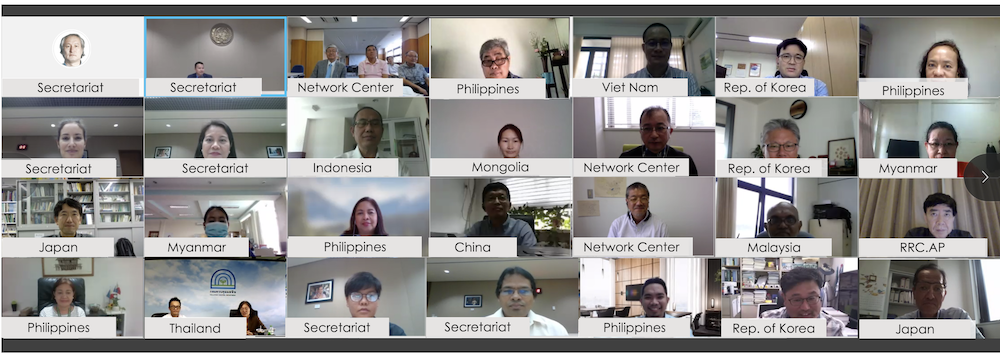
SAC20 virtual Participants

25 September 2020 – Bangkok, Thailand

The Scientific Advisory Committee (SAC) of the Acid Deposition Monitoring Network in East Asia (EANET) held its Twentieth Session of the SAC (SAC20) from 23-24 September 2020, virtually. The Session was organized by the Secretariat and the Network Center (NC) for the EANET.

Nearly 50 members of the SAC and/or their representatives from the Participating Countries of the EANET (from Cambodia, China, Indonesia, Japan, Lao PDR, Malaysia, Mongolia, Myanmar, Philippines, Republic of Korea, Russia, Thailand, Viet Nam) and from the Secretariat and the NC, participated in the two-day meeting.

.

Designing EANET’s Future Activities for 2021-2025

Main discussions, on day one, concerned the considerations by the SAC members of future activities from technical and scientific viewpoints. Outcomes of these discussions were recommendations to be presented to the 22nd Intergovernmental Meeting of EANET (IG22) and considered in finalizing the MTP for the EANET (2021-2025).

Currently, EANET’s main activities focus essentially on acid deposition monitoring and provision of data; promotion of quality assurance and quality control (QA/QC); implementation of technical support and capacity building; dispatch of technical missions; promotion of research and studies; and promotion of public awareness activities.

SAC20 members discussed the Draft MTP that includes new activities proposed by the Participating Countries. This will be further discussed next month during the Second Session of the Working Group Meeting.

.

Understanding Acid Deposition Monitoring and Data in 2019
Data Presentations from NC
Figure 1- Scientists from the EANET Network Center presented several acid deposition monitoring data reports from 2019, during the SAC20 virtual meeting, on September 24th, 2020.

.

Day two of the meeting focused essentially on the results from activities of acid deposition monitoring, compilation, evaluation, storage, and provision of data in 2019, based on data provided by the 13 EANET Participating Countries, retrieved from their national monitoring sites.

Scientists from the NC presented detailed results from the EANET Data Report 2019 data on wet deposition, dry deposition, soil and vegetation, inland aquatic environment, and catchment-scale, as well as and from the Report on the Inter-laboratory Comparison (ILC) Projects 2019, focusing on results of wet deposition, dry deposition (filter pack method), soil, and inland aquatic environment ILC Projects carried out in 2019.

An overview of the National Monitoring Plans from the EANET Participating Countries, Reports from the Chairpersons of the Task Forces of the Scientific Advisory Committee (SAC), Progress of Development of the Fourth Periodic Report on the State of Acid Deposition in East Asia (PRSAD4) and updates on other relevant scientific activities were also presented throughout the day.

EANET Data Reports can be accessed on EANET’s website and Reports for 2019 will soon be available.

.

Photo credits: All rights reserved to EANET.

The Twenty-First Senior Technical Managers’ Meeting (STM21)

STM21 featured image

27 August 2020 – Niigata, Japan

The Twenty-First Senior Technical Managers’ Meeting (STM21) on the Acid Deposition Monitoring Network in East Asia (EANET) was held online on 7 August 2020. The Meeting was organized by the Network Center (NC) for the EANET in collaboration with the Secretariat for the EANET. About 40 senior technical officials involved in the EANET monitoring activities from Cambodia, China, Indonesia, Japan, Lao PDR, Malaysia, Mongolia, Myanmar, Philippines, Republic of Korea, Russia, Thailand, and Viet Nam participated in the meeting.


Acid Deposition Monitoring Activities in 2019

The objectives of this annual meeting were to exchange information on the current status of the EANET monitoring activities, including the consideration of the draft Data Report 2019 and the draft Inter-laboratory Comparison Project Report 2019, as well as to discuss the EANET’s National Monitoring Plans for 2020.

During the meeting, the NC presented the preliminary draft Data Report 2019 which contains wet deposition, dry deposition (air concentration), soil and vegetation, inland aquatic environment, and catchment-scale monitoring data, as well as a summary of the monitoring data of 2019 and related information submitted by the 13 EANET Participating Countries in 2019.

The representatives of the EANET Participating Countries, later on, presented their National Monitoring Plans and current EANET activities, including monitoring capacities, technical limitations, future plans, etc. Throughout the meeting, the senior technical officials discussed implementation challenges and shared their experiences and knowledge to foster solutions in favor of future innovation.


Expanded Monitoring Sites in 2020

In 2020, the number of the EANET monitoring sites has significantly increased, with a total number of 60 wet deposition monitoring sites, 47 dry deposition monitoring sites, 21 soil and vegetation monitoring sites, 19 inland aquatic environment monitoring sites, and 2 catchment-scale monitoring sites, located in 13 countries of Asia.

Most recently, China started monitoring wet and dry deposition in two newly registered EANET monitoring sites: in Wuzhishan, Hainan Province, and Lijiang, Yunnan Province. Indonesia also introduced two new EANET monitoring sites: in Jembrana, in the province of Bali, and Lombok Barat, in West Nusa Tenggara Province.

.

Find out more about EANET’s monitoring activities on EANET’s website or contact us for more information on acid deposition monitoring and data.

Photo credits: Lijiang Shi, Yunnan Sheng, China, by Culacinno, free of copyright license.