The Twenty-second Session of the Intergovernmental Meeting on the EANET

27 November 2020 – Bangkok, Thailand

The Twenty-second Session of the Intergovernmental Meeting (IG22) on the EANET was held virtually from 25 to 26 November 2020. It was concluded by major decisions on the approval of the Medium Term Plan (MTP) (2021-2025) and Work Programme and Budget in 2021, as well as the decision to start expanding the scope of EANET’s Instrument.

.

The Twenty-second Session of the Intergovernmental Meeting

Over 50 representatives from Cambodia, China, Indonesia, Japan, Lao PDR, Malaysia, Mongolia, Myanmar, Republic of Korea, Russia, Thailand, Philippines, and Viet Nam participated in the IG22,  to discuss in detail how they envision the future of their Network.

Chaired by Thailand, the IG22 Session started with Welcome Remarks from Mr. Thalearngsak Petchsuwan, Deputy-Director General, Pollution Control Department, Ministry of Natural Resources and Environment, Thailand, followed by Opening Remarks by Dr. Dechen Tsering, Regional Director and Representative, United Nations Environment Programme for Asia & the Pacific, and by Dr. Shiro Hatakeyama, Director General, Asia Center for Air Pollution Research.
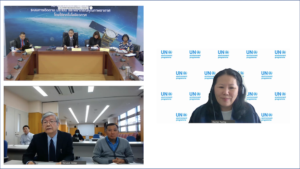
Screenshots from the Welcome and Opening Remarks delivered during the virtual IG22 meeting.
.
Medium Term Plan for the EANET (2021-2025)

After almost two years of conducting several discussions among the Participating Countries, the IG22 approved the MTP for the EANET (2021-2025). In addition, the Session approved the Work Programme and Budget for EANET in 2021.

Detailing the actions that will take place during the next five years, the MTP for the EANET (2021-2025) regroups activities related to five key objectives: Objective 1: Monitoring of acid deposition including related chemical substances with quality assurance and quality control (QA/QC), Objective 2: Promotion of data utilization and dissemination, Objective 3: Promotion of capacity building, Objective 4: Enhancement of outreach activities and Objective 5: Enhancement of cooperation and collaboration.

Screenshots from some participants discussing during the virtual IG22 meeting.

.

Future Activities Beyond Acid Deposition

The IG22 recognized activities related to air pollution as of major interest to Participating Countries, although considered beyond the current scope of the EANET.

For 20 years, based on the Instrument for the Strengthening the Acid Deposition Monitoring Network in East Asia (EANET), the EANET has been working specifically on acid deposition monitoring.

Marking an important milestone for the Network, Participating Countries agreed to start the process of expanding the scope of the Instrument allowing the EANET to work on wider air quality and air pollution issues in the near future.

.

Find out more about the IG22 by reading the Report of the Session and discover the pictures of the IG22 Meeting on Flickr.

Photo credits: all rights reserved to EANET.
The Twentieth Session of the Scientific Advisory Committee on the Acid Deposition Monitoring Network in East Asia

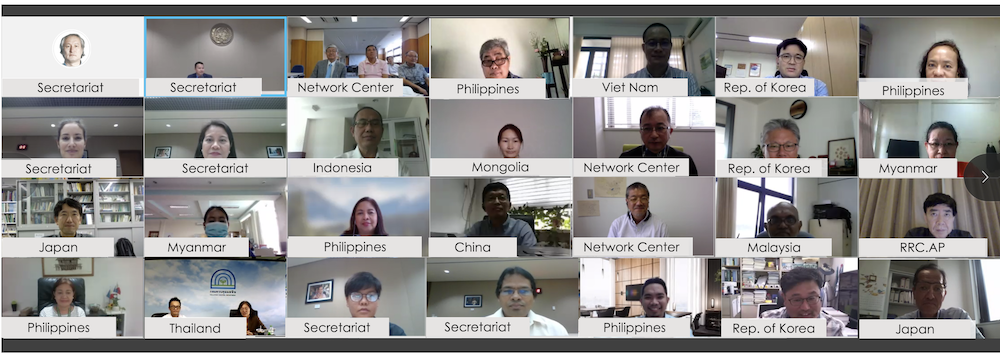
SAC20 virtual Participants

25 September 2020 – Bangkok, Thailand

The Scientific Advisory Committee (SAC) of the Acid Deposition Monitoring Network in East Asia (EANET) held its Twentieth Session of the SAC (SAC20) from 23-24 September 2020, virtually. The Session was organized by the Secretariat and the Network Center (NC) for the EANET.

Nearly 50 members of the SAC and/or their representatives from the Participating Countries of the EANET (from Cambodia, China, Indonesia, Japan, Lao PDR, Malaysia, Mongolia, Myanmar, Philippines, Republic of Korea, Russia, Thailand, Viet Nam) and from the Secretariat and the NC, participated in the two-day meeting.

.

Designing EANET’s Future Activities for 2021-2025

Main discussions, on day one, concerned the considerations by the SAC members of future activities from technical and scientific viewpoints. Outcomes of these discussions were recommendations to be presented to the 22nd Intergovernmental Meeting of EANET (IG22) and considered in finalizing the MTP for the EANET (2021-2025).

Currently, EANET’s main activities focus essentially on acid deposition monitoring and provision of data; promotion of quality assurance and quality control (QA/QC); implementation of technical support and capacity building; dispatch of technical missions; promotion of research and studies; and promotion of public awareness activities.

SAC20 members discussed the Draft MTP that includes new activities proposed by the Participating Countries. This will be further discussed next month during the Second Session of the Working Group Meeting.

.

Understanding Acid Deposition Monitoring and Data in 2019
Data Presentations from NC
Figure 1- Scientists from the EANET Network Center presented several acid deposition monitoring data reports from 2019, during the SAC20 virtual meeting, on September 24th, 2020.

.

Day two of the meeting focused essentially on the results from activities of acid deposition monitoring, compilation, evaluation, storage, and provision of data in 2019, based on data provided by the 13 EANET Participating Countries, retrieved from their national monitoring sites.

Scientists from the NC presented detailed results from the EANET Data Report 2019 data on wet deposition, dry deposition, soil and vegetation, inland aquatic environment, and catchment-scale, as well as and from the Report on the Inter-laboratory Comparison (ILC) Projects 2019, focusing on results of wet deposition, dry deposition (filter pack method), soil, and inland aquatic environment ILC Projects carried out in 2019.

An overview of the National Monitoring Plans from the EANET Participating Countries, Reports from the Chairpersons of the Task Forces of the Scientific Advisory Committee (SAC), Progress of Development of the Fourth Periodic Report on the State of Acid Deposition in East Asia (PRSAD4) and updates on other relevant scientific activities were also presented throughout the day.

EANET Data Reports can be accessed on EANET’s website and Reports for 2019 will soon be available.

.

Photo credits: All rights reserved to EANET.

The Twenty-First Senior Technical Managers’ Meeting (STM21)

STM21 featured image

27 August 2020 – Niigata, Japan

The Twenty-First Senior Technical Managers’ Meeting (STM21) on the Acid Deposition Monitoring Network in East Asia (EANET) was held online on 7 August 2020. The Meeting was organized by the Network Center (NC) for the EANET in collaboration with the Secretariat for the EANET. About 40 senior technical officials involved in the EANET monitoring activities from Cambodia, China, Indonesia, Japan, Lao PDR, Malaysia, Mongolia, Myanmar, Philippines, Republic of Korea, Russia, Thailand, and Viet Nam participated in the meeting.


Acid Deposition Monitoring Activities in 2019

The objectives of this annual meeting were to exchange information on the current status of the EANET monitoring activities, including the consideration of the draft Data Report 2019 and the draft Inter-laboratory Comparison Project Report 2019, as well as to discuss the EANET’s National Monitoring Plans for 2020.

During the meeting, the NC presented the preliminary draft Data Report 2019 which contains wet deposition, dry deposition (air concentration), soil and vegetation, inland aquatic environment, and catchment-scale monitoring data, as well as a summary of the monitoring data of 2019 and related information submitted by the 13 EANET Participating Countries in 2019.

The representatives of the EANET Participating Countries, later on, presented their National Monitoring Plans and current EANET activities, including monitoring capacities, technical limitations, future plans, etc. Throughout the meeting, the senior technical officials discussed implementation challenges and shared their experiences and knowledge to foster solutions in favor of future innovation.


Expanded Monitoring Sites in 2020

In 2020, the number of the EANET monitoring sites has significantly increased, with a total number of 60 wet deposition monitoring sites, 47 dry deposition monitoring sites, 21 soil and vegetation monitoring sites, 19 inland aquatic environment monitoring sites, and 2 catchment-scale monitoring sites, located in 13 countries of Asia.

Most recently, China started monitoring wet and dry deposition in two newly registered EANET monitoring sites: in Wuzhishan, Hainan Province, and Lijiang, Yunnan Province. Indonesia also introduced two new EANET monitoring sites: in Jembrana, in the province of Bali, and Lombok Barat, in West Nusa Tenggara Province.

.

Find out more about EANET’s monitoring activities on EANET’s website or contact us for more information on acid deposition monitoring and data.

Photo credits: Lijiang Shi, Yunnan Sheng, China, by Culacinno, free of copyright license.

The EANET Working Group Meetings on Drafting the MTP (2021-2025) and Reviewing the Scope of Instrument

WG1 Group Photo 29 June 2020

7 July 2020 – Bangkok, Thailand

From June 29th to July 2nd 2020, National Focal Points or representatives of the Acid Deposition Monitoring Network in East Asia (EANET) and other international experts met virtually, simultaneously in 13 countries of East Asia, to discuss the future of the Network and reaffirm their common motivation to fight the adverse effects of acid deposition in the Region.


The Working Group Meeting on Drafting Medium Term Plan for the EANET (2021-2025), June 29-30 2020

Amid the COVID-19 pandemic, EANET’s Working Group Meeting on Drafting Medium Term Plan for the EANET (2021-2025) took place via a virtual platform (see above a collage of most participants’ webcam). During the two-day meeting, over 50 participants from Cambodia, China, Indonesia, Japan, Lao PDR, Malaysia, Mongolia, Myanmar, Republic of Korea, Russia, Thailand, Philippines, and Viet Nam joined the EANET’s Secretariat and Network Center to discuss draft versions of the Medium Term Plan for the EANET (2021-2025).

The Opening Remarks, delivered by Dr Dechen Tsering, Regional Director and Representative, United Nations Environment Programme for Asia & the Pacific, emphasized that the global pandemic “COVID-19” has allowed us to reflect and re-assess our actions toward nature and reminds us of the importance of the health of people and the planet. The Welcome Remarks, delivered by Dr Shiro Hatakeyama, Director General, Asia Center for Air Pollution Research, reasserted the importance of the Working Group Meeting to recommend the future direction of the EANET.

During these discussions, gathering mostly government officials from Asian Ministries of the Environment, the EANET considered activities and budget for the next five years. As a conclusion, and given the importance of the task, meeting attendees decided to continue discussions during the Second Session of Working Group Meeting, to be held in October 2020.


The Working Group Meeting on Reviewing the Scope of Instrument for the EANET, July 1-2 2020

The Working Group Meeting on Reviewing the Scope of Instrument for the EANET also took place via a virtual platform, regrouping a little less than 50 participants, from EANET’s Participating Countries, most of which had also participated in the two previous meeting days.

WG2 Photos 1-2 July 2020
Screenshots from the Working Group Meeting on Reviewing the Scope of Instrument for the EANET, 1-2 July 2020.

The purpose of this meeting was to discuss the objectives and scope of the EANET’s Instrument and the possibility of expanding this scope further.

In addition to the Environmental government officials, several Resource persons joined the meeting, among which a Legal Expert Resource Person, to explain in details the legal options and consequences of how to expand the current scope of Instrument.

As a conclusion, meeting attendees prepared recommendations to be submitted to the next Intergovernmental (IG) Meeting, to be held in November 2020.


Meeting Reports for both Working Group Meetings will soon be available on the Resources webpage.

Curious about EANET’s activity? Find out more about the next EANET Meeting dates on the Event’s page and discover the pictures of the Working Group Meetings on Flickr.


.

New EANET Brochure and Fact Sheets of Participating Countries

15 April 2020 – Bangkok, Thailand

The Secretariat for the Acid Deposition Monitoring Network in East Asia (EANET) and the Network Center for the EANET have released the latest versions of the participating countries’ Fact Sheets and EANET Brochure.

.

Country Fact Sheets
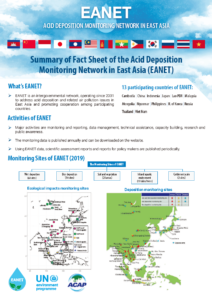
Summary of Fact Sheets

Regrouping 13 East Asian countries under its umbrella, Cambodia, China, Indonesia, Japan, Lao PDR, Malaysia, Mongolia, Myanmar, Philippines, Republic of Korea, Russia, Thailand and Viet Nam, EANET has released, in April 2020, the latest updated version of its participating countries’ Fact Sheets.

Composed of detailed, yet condensed, descriptions of the current situation and progress of the air quality state in each country, the Fact Sheets assess the main sources of pollution and the related trends. The documents also describe the monitoring sites per country, their locations, monitoring parameters, and types (wet deposition, dry deposition, inland aquatic environment, soil, and vegetation) and the monitoring results. Finally, the Fact Sheets highlight each country’s awareness activities, relevant policies, and future plans to tackle air pollution at a national level.

.

The EANET Brochure
Download the Brochure
EANET Brochure

At the same time, EANET has released the latest version of its Brochure. The 15-pages’ document first sets out the environmental and regional context in which the Intergovernmental Initiative has emerged, justifying the need for regional cooperation to prevent the increasing trends of air pollution in East Asia, before entering into details on the definition of the region’s major pollutants and the mechanism of acid deposition. The Intergovernmental regional network’s objectives, major activities, and institutional framework are described, as well as the monitoring activities and EANET’s major achievements since 2001.


Find out more about EANET by downloading the Brochure.


.