EANET Seminar on Expanding Monitoring Systems using LCS

23 August 2022 – Niigata, Japan

The Network Center for the EANET organized the Seminar on Expanding Monitoring Systems using Low-Cost Sensor (LCS) online on 21 July 2022. It gathered representatives, experts, and practitioners of air quality monitoring from the EANET Participating Countries, and other participants from international organizations, academia, and monitoring-related service providers. 127 participants joined the Seminar.

 .

Opening Session

The Seminar started with the Opening and Welcome Remarks by Dr. Shiro Hatakeyama, Director General of the Asia Center for Air Pollution Research (ACAP) in charge of the NC for the EANET, and by Dr. Mushtaq Memon, Regional Coordinator for Chemicals and Pollution Action Subprogramme, UNEP Regional Office for Asia and the Pacific. Remarks were followed by an Introductory Presentation by Mr. Taku Ohmura from the Overseas Environmental Cooperation Center, Japan (OECC) on the Overview of issues and opportunities of using LCS for air quality administrations and surveys.

.

Understanding Challenges and Opportunities of LCS

Key presentations by Dr. Supat Wangwongwatana, a Senior Instructor of the Faculty of Public Health, at Thammasat University, Thailand, and by Dr. Alison Simcox from the United States Environmental Protection Agency (US-EPA), delved into the limitations and opportunities of Low-cost sensor technology (LCS) for measuring air quality in the contexts of Thailand and of the United States.

Dr. Keiichi SATO, Head of the Atmospheric Research Department at ACAP, in charge of the NC for the EANET, then introduced the results of a survey on a Hybrid Air Quality Monitoring Network (HAQMN) and related technical studies in five EANET countries, namely Japan, Indonesia, Myanmar, Thailand, and Viet Nam.

His presentation was followed by discussions and presentations by Ms. Karma Yangzom, a Principal Environment Specialist from the Sustainable Development and Climate Change Department, at the Asian Development Bank (ADB), on ADB’s experience with LCS as part of the Technical Assistance (TA) 9608 on “Strengthening Knowledge and Actions for Air Quality Improvement”, and by Ms. Maria-Katharina Patdu’s presentation, an Associate Programme Officer, from the Asia Pacific Clean Air Partnership (APCAP), at UNEP Regional Office for Asia and the Pacific, on air quality data challenges and opportunities in developing Asia.

While the lack of precision of LCS and the variety of qualities and standards of sensors, may lead to data misinterpretation and presentation issues, keynote speakers and panelists mentioned that the cost-efficiency of LCS and the wide use of these air quality sensors by “citizen-scientists” educate the public and inspire behavioral changes. In addition, the effective utilization of regular monitoring data for the quality control of LCS, the importance of consistent city, regional, and country-level monitoring, and the continued cooperation with other networks and international organizations, were also key points presented to mitigate the limitations of LCS.

 .

Download the Workshop’s Presentations

–Issues of LCS and Efforts Against the Issues: Thailand’s Experiences (presented by Dr. Supat Wangwongwatana)

–US-EPA’s efforts on wise use of LCS (presented by Dr. Alison Simcox)

–Results of the survey on HAQMN and technical studies in some EANET Participating Countries (presented by Dr. Keiichi Sato)

–Experience in using Low-Cost Sensors under ADB TA 9608 (presented by Ms. Karma Yangzom)

–Air quality data challenges and opportunities in developing Asia (presented by Ms. Maria Katherina Patdu)

.

For further inquiries, contact the Network Center for the EANET.

.

Photo credits: All rights reserved to EANET.

The Twenty-third Session of the Intergovernmental Meeting on the Acid Deposition Monitoring Network in East Asia

30 November 2021 – Bangkok, Thailand

The Twenty-third Session of the Intergovernmental Meeting on the Acid Deposition Monitoring Network in East Asia (IG23) took place from 24 to 25 November 2021, virtually, and gathered over 70 representatives of the EANET Participating Countries, Secretariat, and Network Center for the EANET, to make important decisions on the expansion of the scope of the EANET, among other topics.

.

The IG23 Meeting

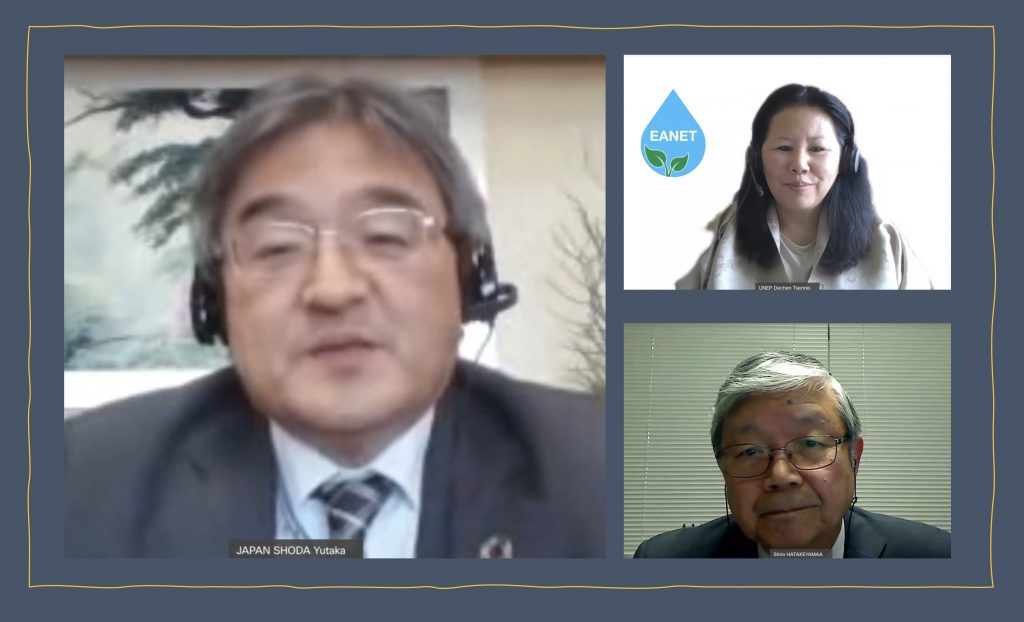
Chaired by Japan and co-chaired by Malaysia and Viet Nam, the IG23 started with the Opening Remarks from H.E. Mr. Yutaka Shoda, Vice-Minister, Ministry of the Environment, Japan, followed by Opening Remarks by Dr. Dechen Tsering, Regional Director, United Nations Environment Programme for Asia & the Pacific, and by Dr. Shiro Hatakeyama, Director General, Asia Center for Air Pollution Research.

.

Welcome and Opening Remarks delivered during the IG23 meeting.

.

Historical Decisions on the Expansion of the Scope of the EANET

Following the decision of the Twenty-second  Session of the Intergovernmental Meeting (IG22), held in November 2020, the EANET Participating Countries’ representatives have been working relentlessly on the process to expand the scope of the EANET, from acid deposition to also include a wider scope of atmospheric environment-related substances.

This historical progress required the EANET to develop a text supplementary document to the EANET Instrument, to define the scope of expansion and the target substances to be included in the EANET activities. In a landmark decision, 20 years after the creation of the Network, the IG23 has adopted the text of the Supplementary Document (Annex) to the Instrument for Strengthening the Acid Deposition Monitoring Network in East Asia.

.

Discussions among participants during the virtual IG23 meeting.

.

The EANET Project Fund and Project Guideline, a new financial mechanism allowing EANET to build co-financed projects with partners in the region and beyond, has also been approved by the IG23.

.

Ways Forward

In addition to these major decisions, the IG23 has also approved several important documents, including the Work Program and Budget of the EANET in 2022, and the Summary of the Twentieth Anniversary of the EANET publication, a new outreach document detailing the EANET’s past achievements and future opportunities.

As an important way forward for 2022, the EANET Participating Countries and partner organizations will be invited to start preparing and submitting project proposals for the pilot implementation of new EANET projects, in line with the EANET Project Guideline.

.

Read the IG23’s Report of the Session (including the Decisions of IG23 in Annex 2), and discover the virtual meeting’s pictures on Flickr.

.

Photos credits: all rights reserved to EANET.

The Working Group Meeting of EANET in 2022

29 August 2022 – Bangkok, Thailand

The Working Group Meeting (WG2022) of EANET in 2022 was organized virtually from 24 to 25 August 2022. It was attended by over 70 National Focal Points and representatives from the 13 EANET Participating Countries, and from the Secretariat and Network Center for the EANET, to discuss proposed projects submitted to the EANET Project Fund and other matters related to the expansion of the scope of the EANET.

.

Opening Session

Chaired by Japan and co-chaired by Malaysia and Viet Nam, the WG2022 started with Opening Remarks from Dr. Dechen Tsering, Regional Director, United Nations Environment Programme for Asia & the Pacific, and by Welcome Remarks from Dr. Shiro Hatakeyama, Director General, Asia Center for Air Pollution Research.

.

From left to right Mr. Bert Fabian, Dr. Dechen Tsering, and Dr. Hiro Hatakeyama, during the Opening Session of the WG2022 meeting

.

EANET Project Fund

In November 2021, the Twenty-third Session of the Intergovernmental Meeting on the Acid Deposition Monitoring Network in East Asia (IG23) approved a new financial mechanism, the EANET Project Fund. The Working Group meeting of the EANET was organized for the EANET National Focal Points and representatives from the 13 Participating Countries to discuss the EANET Project Plans, which are project proposals, to be submitted for funding from the EANET Project Fund.

.

Discussions among participants during the WG2022 meeting

.

During the WG2022, eight EANET Project Plans were presented and discussed by the Session. These project plans focus mainly on the effects of atmospheric deposition on ecosystems, capacity building (related to Volatile Organic Compounds – VOCs, monitoring activities, emission inventories, and PM2.5), and research fellowship programs.

.

Ways Forward

After the WG2022, the EANET Project Plans will be reviewed and discussed in October 2022 by the EANET Twenty-second Scientific Advisory Committee (SAC22) meeting, and finally submitted for approval to the 24th Intergovernmental meeting of the EANET (IG24) in November 2022.

Other important topics in line with the expansion of the Scope of the EANET adopted by IG23, were also discussed during the WG2022 and will be considered further by the IG23 in November 2022.

.

Read the Report of the WG2022 and discover the virtual meeting’s pictures on Flickr.

.

Photos credits: all rights reserved to EANET.