Joint Projects of the EANET with Participating Countries – Development of an Emission Inventory Manual for Mongolia

31 May 2021 – Niigata, Japan

Scientists from the EANET Participating Countries and the Network Center (located in Niigata, Japan) have been promoting joint research projects related to the EANET. In response to Mongolia’s request, an Emission Inventory Manual for Mongolia was developed and published in 2018 to provide key scientific data, including estimates of emissions of air pollutants, for policymakers to develop air pollution control measures.

.

Assessing Air Pollution in Mongolia

Mongolia is facing serious air pollution problems, especially in the capital, Ulaanbaatar city, where the population density is high. Most emissions of air pollutants result from the use of coal in power plants and domestic cooking. The level of air pollutants is normally high during the winter season when coal is also used for domestic heating. Emissions of air pollutants from road traffic are also quite significant. The major air pollutants detected in Ulaanbaatar city are sulfur dioxides (SO2), particle matters (TSP, PM10, PM2.5), and nitrogen dioxide (NO2).

To assist Mongolia in tackling air pollution issues, several international donors and agencies (World Bank, Asian Development Bank, Japan International Cooperation Agency) are developing and implementing projects for air pollution mitigation in Ulaanbaatar city. Since 2016, Clean Air Asia has been working closely with the Ministry of Environment and Tourism of Mongolia (MET) and the National Agency for Meteorology and Environmental Monitoring (NAMEM) on addressing air pollution at a national level.

 .

Developing Mongolia’s National Emission Inventory

In response to Mongolia’s request, the Asia Center for Air Pollution Research (ACAP), in collaboration with SUURI-KEIKAKU Co., Ltd, has developed an Emission Inventory Manual for Mongolia, as a part of the Integrated Programme for Better Air Quality in Asia (IBAQ Programme) of Clean Air Asia (CAA).

Available in Mongolian, English, and Japanese, the Emission Inventory Manual will be used for developing Mongolia’s national emission inventory of air pollutants and further support the formulation of effective air pollution control measures.

 .

Read the summary of the Emission Inventory Manual in the EANET Science Bulletin, Vol 5.

.

The authors appreciated the cooperation and assistance received from the Ministry of Environment and Tourism of Mongolia (MET), the National Agency for Meteorology and Environmental Monitoring (NAMEM), Clean Air Asia (CAA), and the Japan International Cooperation Agency (JICA).

.

Photo credits: Nogoonnuur, Mongolia, by Lightscape, free of the copyright license.
Joint Projects of the EANET with Participating Countries – Catchment Analysis in Thailand

10 June 2021 – Niigata, Japan

Scientists from the EANET Participating Countries and the Network Center (located in Niigata, Japan) have been promoting joint research projects related to the EANET. Consequently, the Network Center, in cooperation with the Thai Royal Forest Department, and the Environmental Research and Training Centre (ERTC), Thailand, conducted a joint research project on catchment analysis in Thailand to understand atmospheric deposition and its effects from 2005 to 2015.

.

Understanding Atmospheric Acid Deposition

Air pollution consists of significant amounts of aerosols (particulate matter) and trace gases (NOx, SOx, CO, and others). These air pollutants deposit on the earth’s surface through dry depositions and wet depositions (when dissolved in water droplets in clouds).

Wet and dry depositions of air pollutants cause detrimental impacts on the ecosystems and environment, including the acidification of the water bodies, such as rivers and lakes.

 .

Analyzing Acid Deposition and its Effects in Northeastern Thailand for Nearly 10 Years

The joint research project aimed to study the atmospheric wet deposition of acidic components and other relevant pollutants including elemental carbon, as well as their influence on water chemistry, chemical properties of soil, nutrient fluxes in soil-plant system, and sulfur dynamics in forest ecosystems.

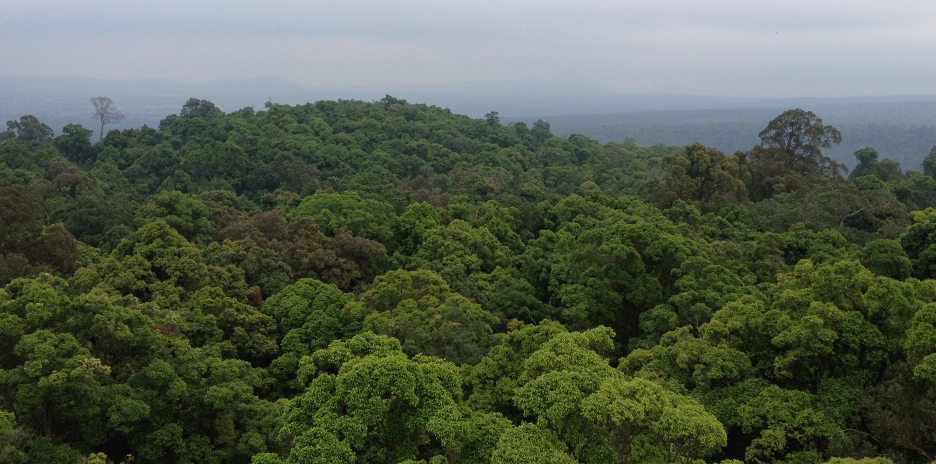
For the catchment analysis, scientists from the Network Center established a study plot in a dry evergreen forest in Sakaerat Silvicultural Research Station, Nakhon Ratchasima Province, northeastern Thailand. The surveys on-site allowed researchers to accumulate nine full years of data, from October 2005 to December 2014.

Based on these results, several scientific papers were published in international journals focusing mainly on atmospheric deposition, soil and stream water chemistry. Ultimately, these scientific outputs significantly contributed to enhancing the global understanding of atmospheric deposition and its effects on forest ecosystems in the region.

.

Read the Report of the joint research project on catchment analysis in Thailand in the EANET Science Bulletin, Vol 5.

.

The authors acknowledged Jesada Luangjame, Thiti Visaratana, and Bopit Kietvuttinon, Royal Forest Department for their great contribution to the Sakaerat project including other colleagues who were involved in the project.  The study was supported financially by the Grant-in-Aid for Scientific Research on Innovative Areas (JP20120012) from the Ministry of Education, Culture, Sports, Science, and Technology (MEXT), Japan, the Environment Research and Technology Development Fund (C-052, C-082 and B-0801) from the Ministry of the Environment of Japan, and Asia-Pacific Network for Global Change Research (APN).

.

Photo credits: Sakaerat forest by Sase H., all rights reserved.

Scientific Outputs by the Task Force on Soil and Vegetation Monitoring of EANET

Scientific outputs by Task Force on Soil and Vegetation Monitoring of EANET_image

9 July 2020 – Niigata, Japan

The Task Force on Soil and Vegetation Monitoring of EANET has published a review on air pollution and tree and forest decline in East Asia.


The Task Force on Soil and Vegetation Monitoring of EANET

Task Forces established under the Scientific Advisory Committee (SAC) of the EANET are leading scientific assessment and research activities on acid deposition, air pollution, and their effects. The Task Force on Soil and Vegetation Monitoring of EANET has been conducting scientific assessment and research activities based on the “Strategy Paper for Future Direction of EANET on Monitoring of Effects on Agricultural Crops, Forest and Inland Water by Acidifying Species and Related Chemical Substances”.

As one of the activities in line with the strategy paper, the regional condition of forest decline and its relationship with air pollution have been compiled as the scientific review led mainly by Task Force members from Japan, China, Russia, and Malaysia based on scientific literature published in the respective countries.


Tree and Forest Decline in East Asia

Tree and forest declines related to air pollution have been observed with industrialization in the countries of Northeast Asia and their causes have been shifting depending on the time period. Firstly, a direct effect of SO2 was the main cause, however, causes have been shifting to acidification and nitrogen deposition, and then ozone, particulate matter (PM), and the interlinkage with climate change. Haze phenomena due to forest fires have been increasing in tropical and boreal forests and emitted PM inhibits photosynthesis.

In recent years, chronically high ozone concentrations may have had adverse effects on tree physiology in conjunction with climate change. Under the changing climate, no apparent effect of air pollution on tree decline was reported recently. However, monitoring air pollution is important to identify the cause of tree decline. Further economic growth in Southeast Asia is projected. The expansion of the monitoring network in tropical and boreal forests has been proposed in the review. Also, it was pointed out that countermeasures, such as restoration of urban trees and rural forests, would be important to ensure future ecosystem services.


The review work was started as one of the activities of the Task Force on Soil and Vegetation Monitoring of the EANET. The study was also supported by JSPS KAKENHI Grant Number JP19H00955. The studies in Russia were funded by the Russian Fund Fundamental Researches, the projects numbers are 03- 04-49565, 05-04-97219, 05-05-97259, 12-04-31036, by the Russian Fund Fundamental Researches and Irkutsk Region Government, the project 14-44-04067, by the Siberian Branch of the Russian Academy of Sciences, the Integration Project 17 with using equipment of “Baikal analytical center”, Irkutsk.


Read the full scientific review: Takahashi et al. 2020. Air pollution monitoring and tree and forest decline in East Asia: A review Science of the Total Environment 742, 140288

Curious about EANET’s research activities? Find out more on the Research activities’ or Publications’ pages.

.

Photo credits: Featured image by Alberto Bigoni free of copyright license.

.